Naomi Frier’s casual errand had quickly turned into a crisis.
On a spring day two years ago, Ms. Frier, 28, was crossing items off her to-do list in Brooklyn when she picked up a book beloved by her daughter, “The Silly World of Chelm,” that was almost past due at the public library.
With her family’s local branch closed for renovations, Ms. Frier dropped off the book at a Bookmobile — part of a fleet of large vans run by the Brooklyn Public Library that service neighborhoods without access to libraries.
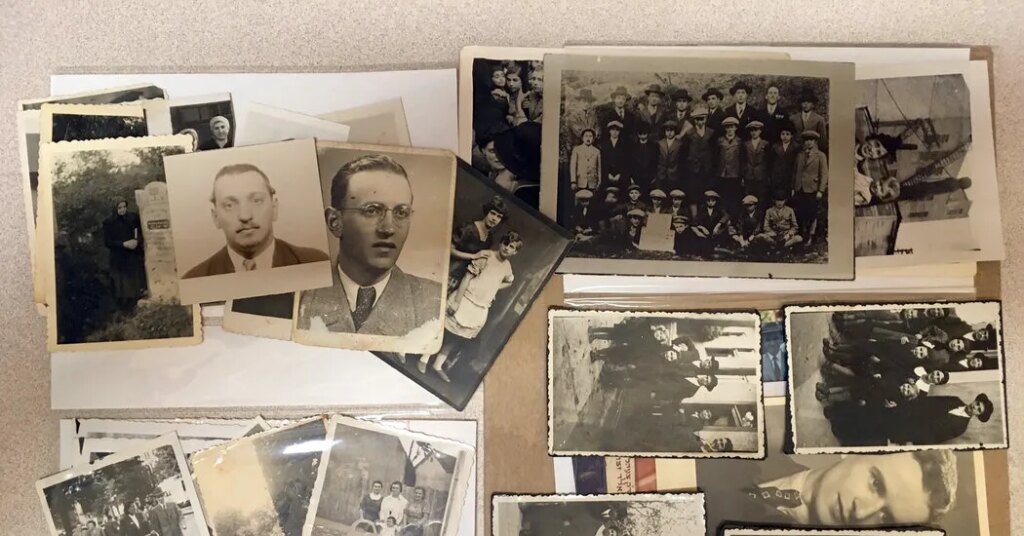
The next day, Ms. Frier’s husband, Moses Frier, 30, asked about the book. What would he want with a children’s book, she wondered? He reminded her that tucked inside its pages were dozens of 100-year-old photos of his family in Poland taken before the Holocaust. Mr. Frier, a historian and researcher, had borrowed the pictures for a book he was working on about his family.
Ms. Frier’s reaction? “Frantic,” she said.
“Those pictures were irreplaceable,” she added.
Library books are sometimes couriers for beloved misplaced items, said Crystal Irizarry, the office aide at the Adams Street Library in Dumbo, who is often in charge of checking in returned books.
The Adams Street Library had collected so many mementos over the years, said Polina Mitenko, the branch manager, that it debuted a display dedicated to the lost treasures for the branch’s fifth birthday in October. The display formalized a haphazard bulletin board where library workers had pinned items that were found tucked into the pages of books.
“Ticket stubs I always see — and what if that was a first date for someone, and they held on to it?” Ms. Mitenko said. “I can’t throw that away because it might mean so much to someone else.”
Mr. Frier’s book traces his great-grandparents’ journey from Poland to Brooklyn after the Holocaust. His great-grandmother fled the Nazis with a trove of family pictures that she kept in a suitcase as her family hid in bunkers, forests and peoples’ attics.
The pictures documented her family — seven children, four of whom died in Auschwitz — from before World War II, and they were the only memories she had of that time.
Mr. Frier, who decided to borrow the roughly 100 photos and scan them for his research, brought them to a photo lab in Brooklyn. But a leak on the floor above the lab damaged about 30 photos, Mr. Frier said.
The images became mottled and needed to be dried flat, so he searched his house for the perfect book, one that was wide and long enough to accommodate them. He settled on “The Silly World of Chelm,” and his plan appeared to be working — until he learned that his wife had returned the book.
“I was in panic mode,” Mr. Frier said. “It was saved through the Nazis, saved through a war, and here it should just get lost like this?”
Mr. and Ms. Frier reached out to the Central Library, the main Brooklyn library branch in Prospect Heights, but the workers there could not get in touch with the driver of the Bookmobile.
So Mr. Frier went to the Central Library himself, hoping to access the Bookmobile, which was parked in a secure yard there. But no one had the vehicle’s key. He was told to wait until the book was offloaded and then the library would try to track it down. As the book moved through the public library system, Mr. Frier worried that the photos would fall out.
At a dead end, Mr. Frier reached out to Yidel Perlstein, a relative who happened to be the chairman of Community Board 12 in Brooklyn, and whose great-grandparents were also pictured in some of the lost photos.
Mr. Perlstein then contacted Anthony Loum, a library supervisor at the time, who assured him that someone would get to the Bookmobile as it was unloaded and search for “The Silly World of Chelm.”
Days later, Mr. Frier heard that the book had been sent to the Mapleton Library in Brooklyn — with the photos inside.
“They said that it’s very rare that something that’s left in the book should be returned,” he said. “They said, ‘You’re really lucky.’”
Ms. Irizarry, the aide at the Adams Street Library, said it was hard to reunite lost items with their original owners. One man, she said, called every branch in Brooklyn looking for a picture taken in a photo booth of himself and his girlfriend. The Adams Street branch happened to have it.
Adams Street has seen holy communion photos, Mother’s Day cards, a thin metal boot presumably used as a bookmark and even a postcard from the Black Forest in Germany, with a recipe on it for Black Forest cake.
Recently, Ms. Frier headed back to her local library to check out a book. The one she chose? “The Silly World of Chelm.”
“When my daughter told me that she didn’t finish reading it, I was like, I don’t want to see that book again,” Ms. Frier said. “But ultimately, I did check it out again for her.”
The post These Photos Survived the Holocaust, Only to Be Lost in a Library Book appeared first on New York Times.