Treasury Secretary Scott Bessent tried to reassure investors worried about the pressure campaign on Iran on Thursday, declaring that a resumption of “large-scale” fighting was unlikely.
The problem for the Trump administration is that Iran was also listening.
President Trump this week promised an “economic D-Day” against Iran, a “crushing” operation to “cripple” Iran. The U.S. clampdown is formidable, a combination of wartime destruction, a naval blockade and sanctions that have already put the Iranian economy under more pressure than its regime has experienced in decades.
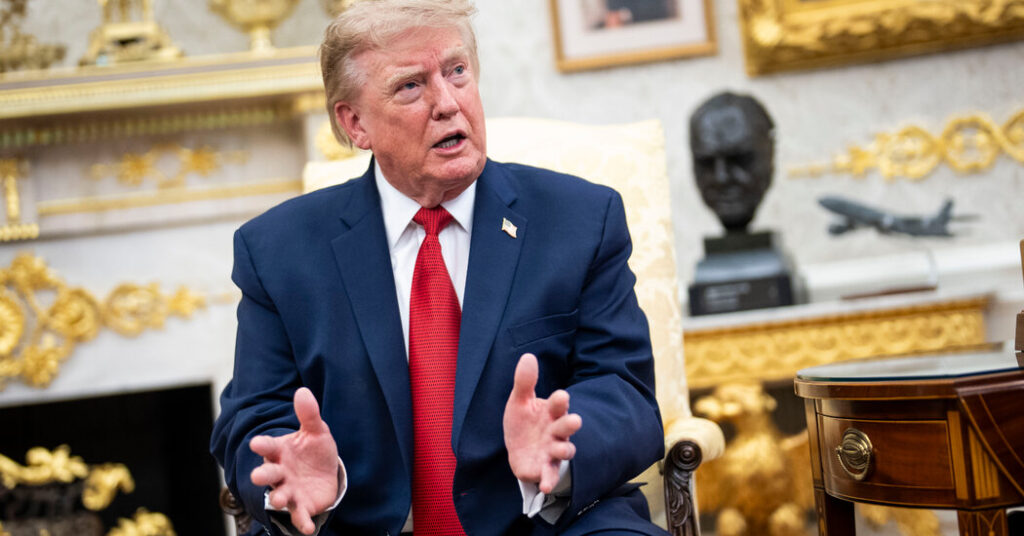
But between the lines of the administration’s threats was a signal that Mr. Bessent made as clear as ever on Thursday: Mr. Trump does not want to go back to war. The president is waging an economic campaign against Iran having already spent weeks bombing the country earlier this year, and having stepped back from multiple threats since then to resume the violence.
As a result, experts say, Mr. Trump is stuck in a conflict with limited leverage, a demonstrated vulnerability and an emboldened adversary. Even as Iran reels from shortages and inflation, Mr. Trump is likely to increasingly feel the pressure of the approaching midterm elections in the shadow of an unpopular war and high gas prices. It is a dangerous combination, experts say, that could prompt Iran to sense American weakness and lash out.
“They read him now as not wanting to escalate militarily,” Dennis B. Ross, a former Middle East negotiator for presidents of both parties, said of Iran’s leaders. “That creates an incentive for them to show that they may escalate militarily.”
Mr. Bessent told CNBC on Thursday that the Treasury Department would hold a news conference about the new measures targeting Iran next Monday. He said traders had been wrong to bid up the price of oil in response, given that the administration’s new economic threats were a sign there would not be an immediate return to full-scale bombing.
“If we are doing the maximum economic pressure, then that means that likely there will not be a large-scale kinetic restart,” Mr. Bessent said. “But I would emphasize, that is for now.”
Mr. Trump announced his upcoming “economic D-Day” against Iran in a social media post Wednesday evening, warning of “Economic Warfare and Isolation on an unprecedented scale.”
“These maniacs are on the ropes, and these HISTORIC MEASURES will cripple them and their ability to project terror worldwide,” Mr. Trump wrote on Truth Social.
Among the challenges for Mr. Trump is that he has repeatedly threatened Iran with large-scale destruction, only to pull back from the threat. He spoke in June about his fear of an extended war pushing the United States into an economic “depression.” And polls show the Iran war to be widely unpopular — even, increasingly, among Republicans — creating a political Achilles’ heel for Mr. Trump as a conflict he described as a weekslong “little excursion” nears its six-month mark.
Iran’s regime has shown in recent months that it can withstand the large-scale death and destruction meted out by American and Israeli bombs, as well as impose costs on the United States by, among other things, attacking oil tankers in the Strait of Hormuz. U.S. gasoline prices remain more than a dollar a gallon higher than they were before the start of the war, U.S. military bases in the Persian Gulf have been severely damaged, 18 American service members have been killed and munitions have run low. Along the way, a deal to end the war has remained elusive — even in terms of a full reopening of the strait.
The Iranian resilience and retaliation appear to have pushed Mr. Trump to rely on economic pressure to try to force Iran’s hand. Analysts note that the administration has already imposed extraordinary pain on Iran’s economy, with Mr. Trump’s naval blockade compounding the damage done by this spring’s bombing campaign.
A new escalation came on Wednesday when the United Arab Emirates, a crucial economic partner across the Persian Gulf from Iran, said it would halt all trade and financial transactions with the country.
But going further could be difficult for Mr. Trump, who warned in his Truth Social post that “ANY country” providing any kind of “lifeline to Iran” would “itself face TREMENDOUS Economic Consequences.”
Iran’s most important financial lifeline is China, which buys most of Iran’s oil.
“China is the indispensable piece” of an economic pressure campaign against Iran, said Miad Maleki, a senior fellow at the hawkish Foundation for Defense of Democracies think tank in Washington who previously worked on sanctions policy at the Treasury Department.
“No substitute can absorb Iranian crude at China’s scale,” Mr. Maleki added in a text message.
But Mr. Trump has worked to improve his relationship with Xi Jinping, the Chinese leader, who is expected to meet Mr. Trump in Washington on Sept. 24. Analysts said they anticipate that the Trump administration will be cautious in pressuring China, especially given the upcoming summit, leaving open the question of just how much more severe the U.S. economic campaign against Iran can become.
Mr. Bessent told CNBC that the administration’s conversations with China on the matter would remain private.
“Iran has been under comprehensive sanctions for years,” said Edward Fishman, senior fellow and director of the Maurice R. Greenberg Center for Geoeconomics at the Council on Foreign Relations. “The only major thing left to do is aggressively target Iran’s trading partners — above all, China.”
He added: “I’m skeptical Trump is willing to risk instigating an economic war with China right now.”
Then there is the question of how Iran would respond under severe financial strain — especially given the widespread recognition that Mr. Trump wants to avoid going back to war.
Mr. Ross, the former Mideast envoy, said Iran could be expected to look for a way to put fresh military pressure on the United States or its Gulf allies. And that expectation, in turn, highlights the uncertainty over Mr. Trump’s longer-term strategy as gas prices stay high, the midterms loom and munitions stocks remain low.
“I’ve not seen, throughout this process, the ability to think beyond the immediate next step,” Mr. Ross said of the administration’s approach to Iran. “They’re playing checkers. They’re not playing chess.”
The post The Message Behind Trump’s Threats of ‘Economic Warfare’ Against Iran appeared first on New York Times.