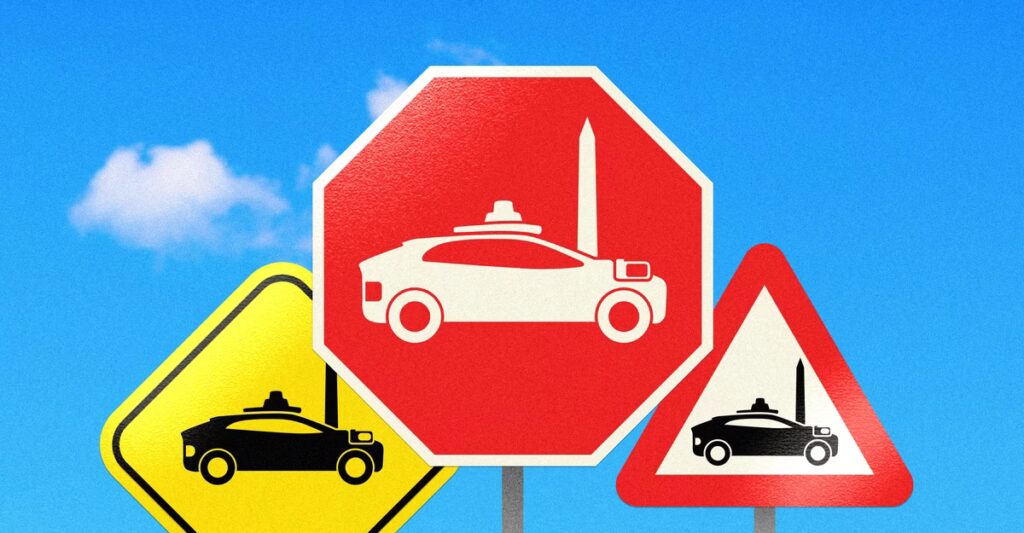
The driverless future is here—but, to borrow from William Gibson, it’s not evenly distributed. Waymo’s self-driving robotaxis are available in cities in California, Arizona, Florida, Georgia, Tennessee, and Texas. Aside from California, where the technology originated, those are all red or purple states. In every other blue state, meanwhile, driverless taxis are still not allowed to operate. If you live in Miami or Dallas, you can summon a Waymo to get where you’re going. If you live in Boston or New York, you can’t.
This is not an accident. In Democratic jurisdictions, a coalition of labor unions, anti-tech activists, and politicians have kept driverless vehicles off the streets. (Colorado, which passed a bill authorizing driverless vehicles in 2017, before the current backlash, is on track to become the exception later this year.) They argue that the new technology would make the roads more dangerous and throw millions of human drivers out of work, all to enrich a handful of tech oligarchs.
A version of this fight is now playing out in Washington, D.C., where Kamala Harris won more than 90 percent of the vote in 2024 and where local officials recently introduced a bill that would provide a pathway for robotaxis to begin operating. Some residents have welcomed that prospect. But others are digging in their heels. Bill Davis, the president of the local Teamsters union, declared in a statement that the legislation “doesn’t benefit anyone outside of Silicon Valley billionaires” and “comes at the expense of middle-class professional drivers and anyone else who wants safer streets in our city.”
Driverless cars will indeed cost some workers their jobs. But unlike so many other recent Silicon Valley innovations, they have already demonstrated the potential to bring immense societal benefits. About 40,000 Americans die in car accidents every year. The number of crash-related injuries is much larger. As many as 10,000 crash victims enter emergency rooms around the country every day. Waymos are so much safer than human drivers that deploying them widely could avert countless injuries and deaths every year.
[Saahil Desai: Move fast and break nothing]
They will also make transportation more affordable: A taxi without a driver is much cheaper. Waymo is currently more expensive than Uber and Lyft, but that’s largely because supply is artificially constrained and demand is high. The price differential is dropping fast and will go away soon. Waymos also show promise in reducing carbon emissions and air pollution (the cars are electric), and providing reliable access to people who live in poor neighborhoods (who are routinely turned down by rideshare drivers). Saying no to Waymo is saying no to a technology that will change the world for the better.
There is a name for a political movement that taps into people’s resistance to change and defense of the status quo. William F. Buckley famously described a conservative as “someone who stands athwart history, yelling Stop.” Progressivism was founded on the opposite ethic: that scientific and technological progress can bring about a better, more equitable future, provided that it’s steered in the right direction. In this sense, self-driving cars are a test for American progressives—a test of whether they have become so captured by interest groups, so hostile to corporations, and so fearful of technological change that they’ve transformed into enemies of progress itself.
In much of the country, the popular conception of self-driving cars is something between a bumbling idiot and a mechanical death trap. Videos of Waymo vehicles making ridiculous errors go viral online. Earlier this year, a Waymo hit a child who ran into the road near an elementary school in Santa Monica, California, causing minor injuries. When a jurisdiction considers whether to allow Waymos, stories like these come up again and again. “I’m also deeply concerned about the safety issues autonomous vehicles have already had in other cities,” Helen Raynor-Hughes, a longtime D.C.-area resident, testified during a public hearing in July, citing “reports of crashes, traffic disruptions, and situations where these vehicles failed to respond properly to pedestrians, cyclists, and other drivers.”
But anecdotes can mislead. The question is how robotaxis’ error rate stacks up against that of human drivers. In a recent study, researchers at the Insurance Institute for Highway Safety compared the crash and accident data on a per-mile basis for Waymo vehicles with those of human drivers in the cities where Waymos operated from 2021 to 2024. They found that Waymos were involved in 68 percent fewer crashes serious enough to be reported to police and 81 percent fewer crashes that caused an injury. These findings are “likely conservative” because human drivers regularly fail to report accidents, Eric Teoh, the report’s lead author, told me.
Several other studies have produced even more favorable results. These studies are co-authored by Waymo researchers but have been peer-reviewed by independent academics. Every expert I spoke with for this story, including Waymo skeptics, told me that they consider the research to be high-quality. “Reductions this big are basically unheard of when it comes to traffic safety,” Noah Goodall, a senior research scientist at the Virginia Transportation Research Council, told me. “Not even seat belts or airbags achieved the kinds of numbers we’re seeing here.” (Waymo, which is owned by Alphabet, is the only company that has demonstrated such a strong safety record. The others, including Tesla, have not disclosed the data needed to make safety claims.)
Even these figures probably underestimate how safe Waymos are. The journalists Timothy B. Lee and Kai Williams recently reviewed the details of the 78 accidents that Waymo vehicles had been involved in over a seven-month period and that were serious enough to cause an injury or trigger an airbag deployment. They found just one example where Waymo “could plausibly bear some responsibility” for a taxi crashing into another vehicle or a pedestrian—the Santa Monica–school incident—and another three where culpability was “mixed or unclear.” “We went into this looking for any evidence that Waymo could even remotely be at fault for a given crash,” Lee told me. “But those cases were just really hard to find.”
The big caveat to Waymo’s safety record is its difficulty with so-called edge cases—unpredictable situations for which its algorithm is unprepared and in which human judgment really comes in handy. When a power outage knocked out a third of San Francisco’s traffic lights last December, at least 60 Waymos abruptly idled mid-road, causing severe gridlock and delays. Something similar happened to a few dozen Waymos this year when the driverless vehicles encountered unexpected road closures during San Francisco’s Fourth of July celebrations. Waymos have obstructed emergency vehicles in several cities, typically because of their tendency to freeze when they encounter alarms, sirens, or temporary road closures. The company has not done nearly enough to fix the problem. “Competent driving is about a lot more than crash statistics,” Philip Koopman, an emeritus professor of engineering at Carnegie Mellon, told me. “If Waymo isn’t able to address some of these problematic patterns, it is going to be very hard to convince the public they are safe.”
Even so, the fact that Waymos are considerably safer than human drivers is undeniable. A robot driver can’t drink and drive, fall asleep at the wheel, or check its phone. It won’t flout the rules of the road when it’s running late or trying to impress its friends. And it is equipped with more than a dozen different cameras, plus radar and laser sensors, meaning it doesn’t have blind spots. Bryant Walker Smith, an associate law professor at the University of South Carolina, has advised governments on how to regulate self-driving cars. “What I always tell policy makers is that we absolutely should be concerned about automated driving,” he told me. “But we should be terrified of human driving.”
Safety might be the average American’s top concern about driverless cars, but the average American isn’t spearheading the political resistance to Waymo. Labor unions are. The campaign against driverless vehicles has been led by a coalition of unions representing taxi, rideshare, and truck drivers who argue that self-driving cars will destroy millions of working-class jobs. (Although experts believe that self-driving trucks and delivery vehicles are at least several years away from being a regular presence on roads, labor unions see robotaxi legalization as a stepping stone to a fully automated driving future.) Indeed, Helen Raynor-Hughes, the area resident who testified about Waymo’s safety record, began by identifying herself as a Service Employees International Union member who drives for Uber and Lyft.
In 2026 alone, this Labor United Against Waymo coalition has helped defeator delay legislation to authorize driverless vehicles in Illinois, Minnesota, Maryland, Virginia, Oregon, and Washington State. In January, New York Governor Kathy Hochul declared that she would pursue a bill to allow robotaxis to operate in the state, only to backtrack a few weeks later following an outcry from labor leaders.
When I arrived at D.C.’s city hall in July for a public hearing on the proposed bill to authorize Waymo, I passed dozens of protesters from various labor groups chanting and holding signs with slogans such as WAYMO? HELL NO and AI DOESN’T VOTE. We Do. Inside, about a dozen labor leaders and rideshare drivers demanded that city officials vote against the bill. Crystal Middleton, a D.C. resident who drives Uber and Lyft part-time to support her family, testified that if Waymo were adopted in the city, “many D.C. families, including mine, will struggle to make ends meet.”
I’m sympathetic to that argument. When I was growing up, my dad spent years driving Uber and Lyft on the weekends to help pay the bills. Like many drivers, he resented the meager pay and lack of benefits. (There’s an irony that unions and Democratic lawmakers are rallying to defend the type of precarious gig work that they have spent more than a decade criticizing.) But it’s hard to imagine what our family would have done without the extra income. The impulse to protect workers like him—not to mention the delivery and truck drivers who fear that they’ll be next—from being displaced by a new technology is understandable.
That approach, however, ignores the larger number of people who would benefit from a change to the status quo. At the public hearing, local nonprofit leaders and politicians, including Shane Simenstad, the director of public policy for Safe Kids Worldwide, pointed out that rideshare drivers often refuse to enter less desirable parts of the city, leaving residents of poor neighborhoods without a reliable way to get to work or school. Claire Stanley, the director of advocacy and governmental affairs for the American Council of the Blind, spoke about being denied Uber and Lyft rides because of her service dog. Multiple women testified about their fear of being harassed or assaulted by rideshare drivers. (According to a 2025 New York Times investigation, Uber received a report of sexual assault or misconduct nearly every eight minutes on average in the U.S. from 2017 to 2022.)
Some of the most moving testimonies came from the victims of car crashes and their loved ones. Rameez Tase, a local resident and avid cyclist, told the story of a friend who had been nearly killed after being hit by a car. “Anyone who knows me well knows that my biggest fear of death is being struck and killed by a distracted driver—and leaving my three young children without a father for the rest of their lives,” he said. Cesar Toledo, a member of the D.C. Commission on Poverty, recounted a childhood “marked by the terrifying reality of riding in vehicles driven by family members under the influence.”
Car accidents kill roughly as many Americans each year as breast cancer does, and twice the number of people who die from homicides. It is a leading cause of death among children and young adults. “The number of traffic deaths in America is the equivalent of a Boeing 737 crashing every single day,” Jonathan Slotkin, a neurosurgeon who regularly treats crash victims, told me. “That’s what we’ve chosen to tolerate as the price of mobility.”
Waymos, to be clear, wouldn’t solve this problem right away. Although rideshare and taxi drivers get into accidents at higher rates than the average driver, they make up a small fraction of cars on the road. But operating robotaxis is a key step for Waymo and other companies to perfect their self-driving technology, which could then be sold to vehicle manufacturers like Toyota to include as an optional feature in every car. “If we had a drug that showed these kinds of results, we’d be doing everything we could to get it out to as many people as fast as possible,” Slotkin said.
[Read: The huge problem Waymo didn’t see coming]
Widespread adoption of driverless vehicles would further a litany of goals that anyone should celebrate, especially those who claim to be progressive: slashing traffic injuries and deaths; helping the poor and disabled secure stable employment; making cities safer places to bike and walk; reducing the prevelance of sexual assault and misconduct; putting more electric vehicles on the roads. And yet progressives are the ones standing in the way. “Honestly, it’s just embarrassing,” Colin Mortimer, the director of the Center for New Liberalism, a center-left advocacy group, told me. “Liberals are always talking about how we’re the party that believes in science, that believes in data, that believes in helping the vulnerable. But on this issue we’re doing the exact opposite.”
Some Washington, D.C., legislators believe that the nation’s capital can pioneer a different approach to Waymo. In May, the D.C. Council member Charles Allen introduced a bill that would authorize driverless vehicles to begin operating in the district, but only if their makers meet certain key conditions designed in part to address the edge-case problem and reduce the impact on the city’s labor force. These include completing stringent testing and safety requirements and submitting a plan for interacting with first responders. Even then, the total number of driverless vehicles would be capped at a few hundred during the initial rollout. Each vehicle would also be subject to a per-mile tax used to fund public transit, as well as workforce training and compensation for displaced rideshare and taxi drivers. “We have to be honest with ourselves: This technology is already here and is only going to become a bigger part of our lives going forward,” Allen told me a few weeks after the hearing. “And so we can either bury our heads in the sand and have this change happen to us. Or we can put guardrails in place to make sure the technology works for us and our communities.”
In Allen’s view, too many restrictions would risk throttling a technology that could otherwise bring huge benefits; too few would invite a high-profile incident that draws a public backlash. Getting the balance right will be difficult. My own view is that the bill should have more restrictive testing requirements around edge cases—for instance, simulating power outages or major emergencies—before driverless vehicles can be deployed. But it should also create a less bureaucratic process for increasing the number of vehicles once those requirements have been met. The bill also faces several political obstacles, including an incoming mayor who expressed skepticism about Waymo expansion on the campaign trail. But Allen is trying to do something that no city has done before: chart a middle course between letting the new technology rip and blocking it altogether.
One-hundred and fifty years ago, the United States was experiencing the advent of a brand-new transportation technology. Railroads reduced cross-country travel from months to days, turned the U.S. into an industrial powerhouse, and enabled the modern consumer economy. But they also displaced workers, such as canal operators and stagecoach drivers; led to skyrocketing inequality; and produced corrupt monopolies presided over by ruthless oligarchs. A new political movement formed in response. Its adherents passed legislation that protected workers, created novel regulatory agencies, broke up powerful monopolies, and developed safety standards. Neither techno-utopians nor luddites, they believed that technology could be a force for progress—but only if it was actively shaped and regulated by the public. They thus called themselves progressives. Their political descendants would do well to remember their example.
The post Democrats Are Failing the Waymo Test appeared first on The Atlantic.