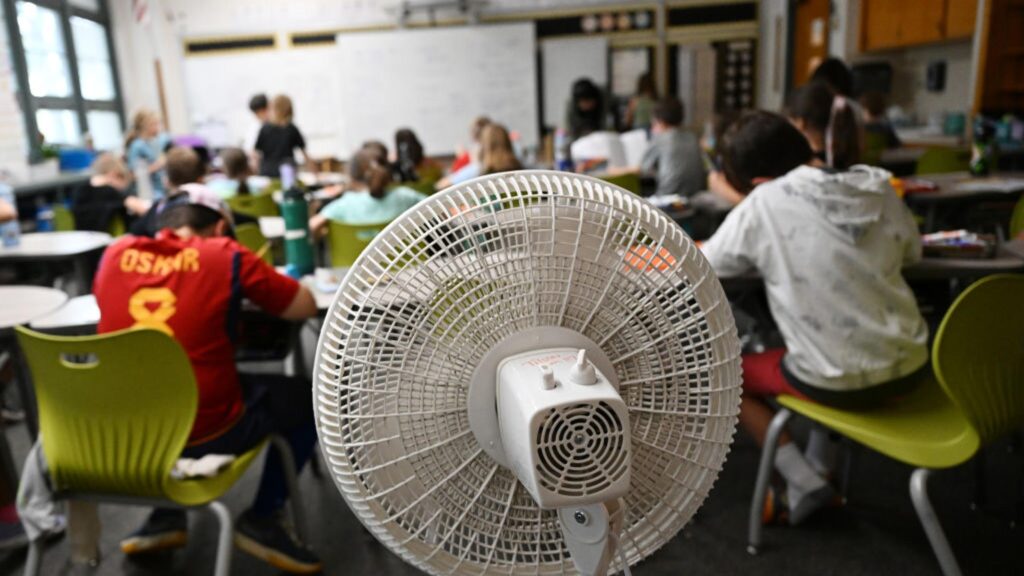
As students go back to school in the midst of record-breaking summer heat, many are returning to overheating classrooms whose aging air conditioning systems can’t keep up with extreme heat waves—if they even have air conditioning at all.
Extreme heat has already caused school closures and disruptions across the country. In July, Milwaukee Public Schools shut down its Summer Academy and other indoor school programs for two days because of extreme heat. One day in May, 57 Philadelphia schools went remote and canceled all in-person activities due to soaring temperatures. That same month, a Washington, D.C. high school carried out a “heat evacuation” as classroom temperatures reached the mid-90s. Eight elementary schools in Doylestown, PA also closed for a day because old buildings couldn’t protect students from the heat. And in recent years, schools in Memphis dismissed students early as temperatures climbed to 110 degrees.
During the 2024-25 school year alone, more than 9 million students at 10,000 schools nationwide experienced extreme heat- and weather-driven school closures or disruptions. These are not isolated inconveniences. They are warning signs that our school buildings and grounds were not designed for today’s new weather patterns.
It’s important to understand that students struggle to learn in hot, stuffy classrooms. Air quality, temperature, and ventilation can affect how students think, focus, and perform. Poor ventilation can impair cognitive function, while excessive heat diverts the body’s energy from learning, slows reaction time, and weakens attention.
In fact, research has shown that in schools without cooling, each 1° Fahrenheit increase in school year temperature reduces the amount learned that year by approximately 1%.
Extreme temperatures (80 to 90 degrees Fahrenheit and above) are known to exacerbate student absenteeism and disciplinary referrals, while poor indoor environments can also contribute to the spread of illness and exacerbate respiratory conditions like asthma, one of the leading causes of missed school days. Younger children, whose bodies and brains are still developing, are especially susceptible.
In medicine and education alike, we have seen how the environments where people spend their time can directly affect their health, well-being, and ability to thrive. We would never accept these conditions in a hospital. We should not accept them in a classroom.
At the same time, outdated heating and cooling systems are placing a growing financial strain on school districts. Across the country, energy costs are rising and becoming more unstable. For school leaders, that often means tradeoffs: dollars spent on inefficient energy systems are dollars not spent directly on teaching and learning. But there is a better path forward.
Modern HVAC systems, often paired with on-site solar energy, offer schools a way to deliver reliable heating and cooling while reducing exposure to volatile fossil fuel costs. These solutions can stabilize energy budgets over time and are increasingly supported by domestic manufacturing, including the production of heat pumps here in the United States.
Just as important, new federal tools make these upgrades far more accessible than they once were. Through energy tax credits and a mechanism known as Elective Pay, public school districts can receive direct financial support to invest in these improvements. That means lower upfront costs and faster payback, turning what was once out of reach into a practical, near-term option.
We are already seeing what this looks like in practice.
In Indiana, Center Grove Community Schools are demonstrating how modern HVAC upgrades can improve classroom comfort while helping manage energy costs, in part by replacing aging boilers, chillers, and fan coils with a geothermal heat pump system. In Virginia’s Prince William County, at the heart of the nation’s data center corridor, district leaders are acting to shield their budgets from steep projected utility increases. And in Wisconsin, a school in Menasha modernized its facility with a ground-source heat pump system, solar panels, and energy storage to deliver better air quality, lower costs, and create local jobs.
The benefits extend well beyond temperature control. Students are better able to focus and learn. Districts gain predictability in their operating costs. And communities benefit from more resilient, efficient infrastructure that reduces strain on the grid during periods of peak demand.
For school and district leaders, this moment calls for action. Now is the time to explore how these solutions can work in your community.
The environments we live in shape the health within us. Nowhere is that more immediate, or more consequential, than in the classroom.
We can improve student health and learning, strengthen our schools, and protect public resources at the same time. And we have real-world proof from communities across the country that this is not only possible, but doable.
The real risk is not the price of modernization, but the cost of continuing to send students and teachers into unhealthy, inefficient buildings unprepared for the realities ahead.
The post As Students Return, America’s Classrooms Are Dangerously Hot appeared first on TIME.