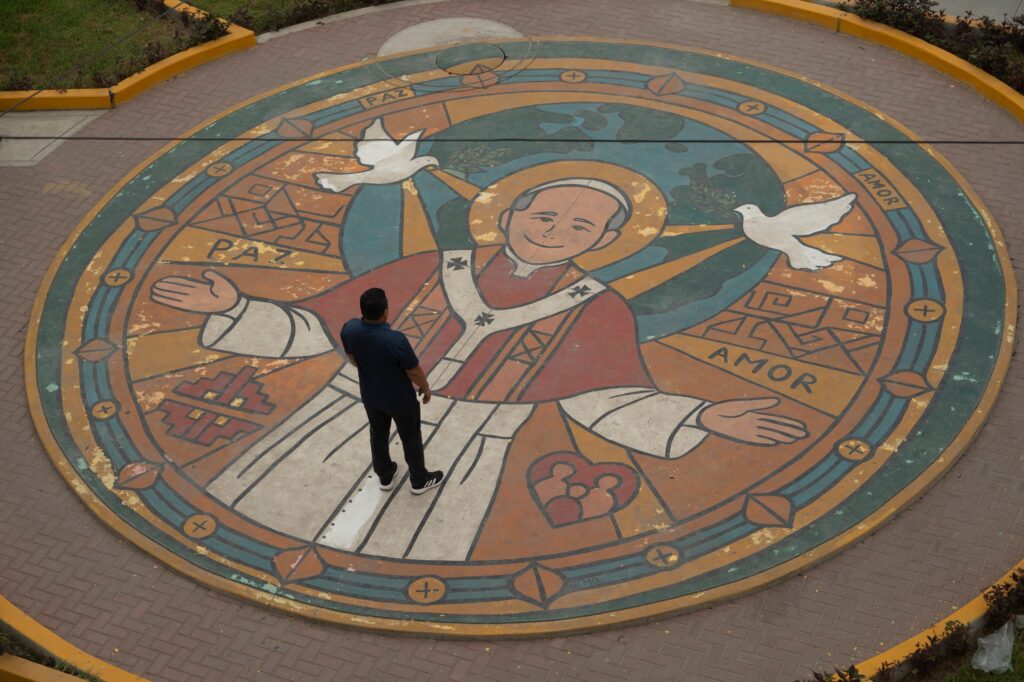
CHICLAYO, Peru — His face is in storefronts and on street corners, on murals and banners, on balconies and church entrances. His name is engraved over the central plaza. A new statue of him towers over the city entrance.
Ask almost anyone here about the man who became the first U.S.-born pope, and they’ll proudly show you a photo in their phone archives of the local bishop many still call “monseñor” or “Padre Robert.” They’ll tell you about the time Robert Francis Prevost presided over their daughter’s confirmation, the time he sent them a message on their birthday, the time he hand-delivered food to their neighborhood during coronavirus quarantines.
With tears in their eyes, they’ll recall the moment last year when, in his first speech as Pope Leo XIV, he greeted in fluent Spanish his “beloved diocese of Chiclayo, in Peru,” a “faithful people” who had accompanied him as bishop and given “so much, so much, to continue being a faithful Church of Jesus Christ.”
This midsize Peruvian city, more than the Vatican and more than his birth city of Chicago, is the city of the pope. And on Friday, as the emotional high point of a three-country tour of South America, the pontiff returns to his chosen home.
It’s the place that taught Prevost, as the local bishop, to lead a community through crisis, from massive floods to the pandemic to a tuberculosis outbreak in a seminary. To embrace local expressions of spirituality often dismissed or outright rejected by Catholic purists. To lay roots in a community so different from his own, and to return to them.
Papal homecomings are rare events, especially one in which a pope has two homes. The first Latin American pope, Pope Francis, never returned to his native Argentina. Perhaps the most stirring in recent memory was Pope John Paul II’s return to Poland in 1979, where he kissed the ground and appeared moved by the overwhelming support from millions of Poles.
Leo’s six-day homecoming to Peru is already harboring echoes of John Paul II’s emotional trip, with the Peruvian-naturalized pope more visibly joyful and moved than he has been on many of his other recent tours. On Wednesday, he appeared misty-eyed and moved while singing the Peruvian national anthem. On Thursday, he joked with warm familiarity during a meeting with top Peruvian clergy, who appeared to rally around a pope they proudly declared had “come home.”
To kick off his visit to Chiclayo, Leo was expected to appear on vast, arid terrain on the outskirts of the city for a sprawling Mass on Friday morning. By Thursday evening, hundreds had already lined up to camp out in anticipation of the pope’s arrival.
Nearly a third of the size of Chicago, Chiclayo is far from the country’s capital and its popular tourist attractions. When tourism plummeted in the pandemic era, Chiclayo planned to organize a gastronomic tour in the hopes of reviving the industry, said David Cardenas, assistant manager for tourism for Chiclayo. Those plans were scrapped on May 8 of last year when the city found itself on the global stage.
Tourism has since increased by 30 percent. Roads have been repaved, and the cathedral is showing off a new coat of yellow paint. An estimated 600,000 visitors are expected for the pope’s visit, Cardenas said.
In the nearby town of Zaña, a historically Afro-Peruvian and Indigenous community in a district of less than 14,000 people where the water gets cut off for hours a day, hundreds of thousands of visitors will flood in when the pope visits on Saturday. Ahead of the event, the town laid bricks on a previously dirt path leading up to a sanctuary dedicated to Saint Toribio de Mogrovejo. (Dignitaries in suits, days before the visit, could be seen assessing the construction of a bathroom for the pope, since the chapel had none.) A newly constructed pavilion next to the chapel will host the papal gathering, including special guests requested by Pope Leo — Afro-Peruvians, speakers of the Indigenous Quechuan languages and migrants.
In the Chiclayo city center, the pope is everywhere. There’s a new pope museum in the city hall adjacent to the church. There’s a “pope route” with sightseeing relevant to Pope Leo’s life. Chiclayo residents walk around in handmade pope costumes and offer photos with “the pope” for sale. Speakers blast a song written by a Chiclayo musician — “The Pope Cumbia.” A famed local dessert, a cookie sandwich known as a King Kong, has released a King Pope, billboards proclaim.
But beyond the papal swag and tourism push is a deep personal connection, a community of people who never expected to find themselves just one or two degrees of separation from the highest levels of global attention, or of the Catholic Church.
It is a city now inextricably tied to the pontiff, so much so that he chose his longtime aide, a young Chiclayo priest, as his personal secretary in the Vatican, where it is said that only he, Edgard Rimaycuna, and God are constantly at the pope’s side.
Rimaycuna’s parents, Mauro Rimaycuna Chumacero and Edisa Inga Díaz de Rimaycuna, are elementary school teachers who still live in the house where Rimaycuna grew up, just blocks from a church the pope plans to visit. The walls and shelves of their living room are laden with images of Prevost.
A photo above the television commemorates a brief meeting between the parents and Pope Francis in the Vatican. During the encounter, they recall, he said of their home city: “You have a great bishop there.”
On May 8, 2025, Edisa Inga Díaz de Rimaycuna missed the white smoke rising from the chimney of the Sistine Chapel to proclaim the choice of a new pope. She was in class, helping her students with a Mother’s Day project. When she heard from her niece that Prevost had been selected, she began to weep.
“Mom, you can say that your son is the secretary of the pope,” she recalled her son saying on a short call later that day.
Rimaycuna still calls his parents every Sunday, they said. And when they visited Rome in May, the pope set aside time to meet with them. The mother couldn’t help but hug him, she said.
It was clear even before then, she said, that the Pope, and their son, were eager to return home.
“He’s a spiritual man, but he’s also human,” Edisa Inga Díaz de Rimaycuna said of Pope Leo. “As a human being, he needs to be with his people.”
The homecoming will give Prevost a chance to reconnect, briefly, with the priests that became his family.
Jasson Sempertigue Libaque, 36, was Prevost’s secretary for four years in Chiclayo. It was Sempertigue who helped Prevost get back into the sport he loved — tennis. One night, after playing for three hours straight, Prevost was so sore he could hardly raise his arms at Mass.
The bishop, a longtime car lover, insisted on teaching the young priest how to drive. They spent many afternoons in a Volkswagen station wagon, with Prevost in the passenger seat, his hand on the emergency brake just in case.
Sempertigue learned that Prevost had a slight taste for an adrenaline rush. One day, he asked the bishop if he had ever dared to step onto the cathedral roof. Prevost was tempted, Sempertigue said. So the pair climbed the narrow stairs up to the tower and walked across the uneven rooftop, watching the plaza below as an hour went by.
Prevost seemed to connect with Chiclayo culture and its quiet sense of humor. When he’d have a drink with the priests for a birthday celebration, he’d jokingly tell them they’d have a “resaca,” or hangover, in the office the next day, Sempertigue recalled.
He took pride in sharing his American traditions, too. When his home team played, Prevost would don a White Sox jersey and cap to watch the game. The priests, more used to soccer than baseball, would often doze off, Sempertigue said. During one Thanksgiving, the bishop organized a meal and carved a turkey for them all. The following year, the Peruvian priests carried on the tradition for him.
Sempertigue, who has visited Prevost more than a half dozen times since he became pope, said he believes the Holy Father knows Chiclayanos are deeply loyal but that they begin to resent friends and family members who lose contact.
“We get sad very quickly when someone stops talking to us,” Sempertigue said, with a laugh. “Maybe he understands that and thinks, ‘I can’t leave Chiclayanos for long.’”
Anthony Faiola in Lima, Peru, contributed to this report.
correctionA previous version of this article gave the incorrect time frame for Pope Leo XIV’s Chiclayo Mass. The Mass was scheduled for Friday, and participants camped out in anticipation Thursday night.
The post Before he was Pope Leo, he was their bishop. Now he’s coming home. appeared first on Washington Post.