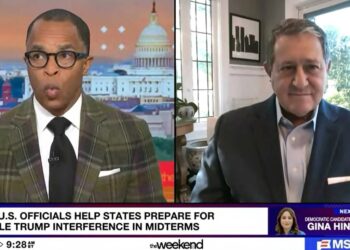
When Los Angeles Mayor Karen Bass amplified the results last week of a favorable political poll that turned out to be fake, she was inadvertently following in the footsteps of conservative Detroit singer Kid Rock.
In 2017, as Rock — real name Robert Ritchie — publicly contemplated a run for U.S. Senate is his home state of Michigan, he posted on social media the results of a poll conducted by a firm calling itself Delphi Analytica that showed him leading Democratic incumbent Debbie Stabenow.
But those results were bogus. The people behind Delphi Analytica took down their website and refused to be identified, telling a local reporter: “Thanks again and go kid rock.”
Little is known about who was responsible for a poll supposedly conducted by an outfit calling itself Median Strategies showing Bass with a wide lead in the L.A. mayoral race over Councilmember Nithya Raman.
The group told The Times on Monday that its results were also fake.
But the episode has revived questions about whether political polling can be trusted, particularly in light of several recent high-profile primary races in which the polls seemed to have gotten the results wrong.
In the Michigan Democratic primary for the U.S. Senate, a number of preelection polls showed progressive Abdul El-Sayed holding a commanding, double-digit lead over Rep. Haley Stevens (D-Mich.), but on election night, El-Sayed eked out a one-point victory.
In Wisconsin, numerous polls showed progressive state Rep. Francesca Hong leading Milwaukee County Executive David Crowley in the Democratic primary for governor. Crowley narrowly defeated Hong in the primary.
Median Strategies — the entity behind the fake Los Angeles poll — claimed on social media that it had also conducted polling in the Wisconsin Democratic gubernatorial race and that it had also gotten it wrong about Hong.
Polling in primary elections can be particularly difficult, because it can be hard to know who will actually show up on election day, said Christian Grose, a USC political science professor. Both Michigan and Wisconsin also hold open primaries, meaning that any voter can cast a ballot in a race, regardless of party affiliation, making it harder for pollsters to predict exactly who will cast a ballot on election day.
Experts say fake polls are exceedingly rare but that these recent election results highlight the differences between high- and low-quality polls and how much easier it has become to conduct less rigorous polling.
“The barriers to entry are a lot lower now than they were 20 to 30 years ago,” said Charles Franklin, a professor of law and public policy at Marquette Law School who conducts the Marquette Law School Poll.
Put simply, a poll is a series of questions asked of a sample of people in a given locality, state or country whose opinions are supposed to represent the attitudes of everyone in the coverage area of the poll. Pollsters typically weigh the responses they receive — sometimes amplifying the voices of respondents from a particular ethnic group, for example — to ensure that the results are representative of the population they are surveying.
For decades, survey respondents were typically contacted by phone.
That work was expensive, Franklin said.
“You needed a call center, you needed to hire interviewers and you needed some sort of data processing,” he said.
But now as modes of communication have changed — many people have ditched landlines and are hesitant to answer calls from unknown numbers on their cellphone — polling operations have adopted a wide variety of methods to try to contact survey respondents, including e-mail, text-messages and online surveys, which sometimes offer incentives to encourage participation.
Online polls can be conducted much more cheaply than polling using other modes of communication, but the quality can also vary widely.
Historically, most polls randomly contacted survey respondents, backed by research showing that a random sample of the population — adjusted appropriately by demographics and other factors — would give a more accurate picture of the public’s attitude on a particular question.
But not all online polling relies on a randomly selected group of respondents, and when respondents are offered an incentive — such as cash — to complete an online survey, it can lead to inaccurate results.
The Pew Research Center released a report in 2024 showing that these so-called opt-in surveys did a particularly bad job of capturing the attitudes of adults under 30 and Latino adults. Researchers at Pew, for example, asked respondents in one survey if they were licensed to operate a type of nuclear submarine. In the survey, 12% of respondents under 30 said yes. In reality, the share of people under 30 holding such a license “rounds to zero,” the report said.
While even legitimate pollsters can get election results wrong — a poll represents public opinion at the time it was taken, and that can change — experts say there are a few key things to look out for when vetting the quality of a survey.
“The more transparent a poll is — in terms of its data and methods — the more you should believe it,” said Grose, who also conducts the California Elections and Policy Poll.
Franklin said that pollsters with a track record are typically more trustworthy, as their future business and reputation relies on their accuracy.
He said that polling conducted by upstart organizations is not necessarily bad, but that the people conducting it don’t necessarily have the training or expertise of more established outfits.
Inaccurate polling can misinform voters and lead to election night surprises, but it can also have a corrosive effect on elections themselves.
“Polling can drive outcomes,” Grose said. “Favorable polls lead to more fundraising. There’s a bandwagon effect.”
The post The fake L.A. mayor poll adds to challenges facing the public opinion industry appeared first on Los Angeles Times.