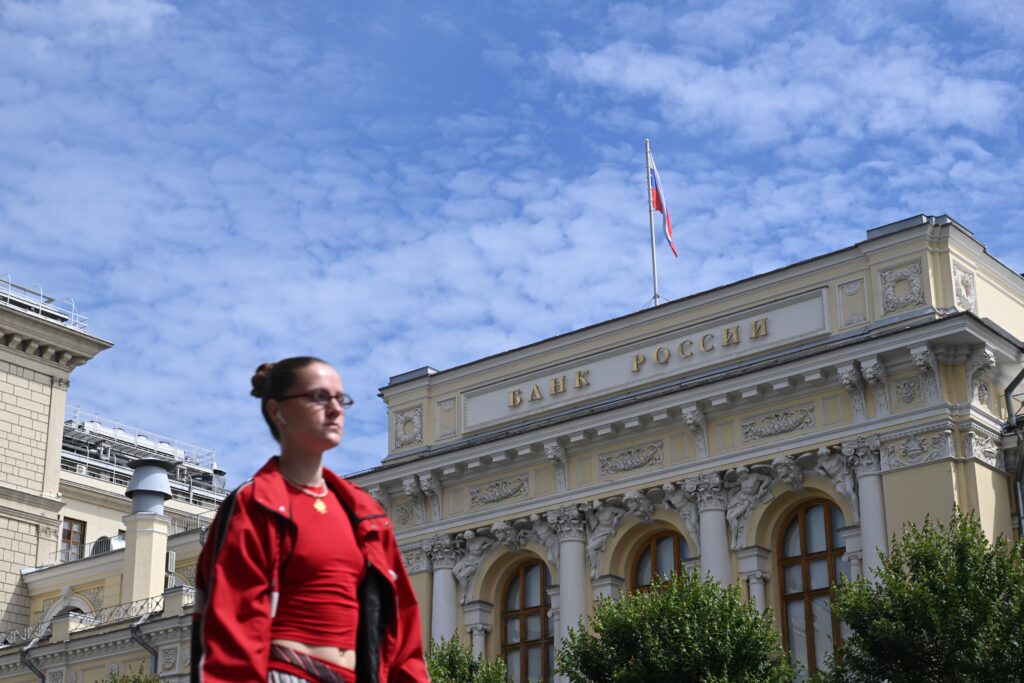
Russians are pulling billions from the country’s banking system ― a record cash outflow amid intensifying Ukrainian drone attacks and rising fear that the Kremlin could start seizing deposits to finance its war.
Nearly $3.4 billion (286.4 billion rubles) was withdrawn in the first two weeks of August, on top of the $7.3 billion withdrawn in July and more than $4.5 billion in June, according to Russian Central Bank data.
Total withdrawals this year could nearly double the amount taken out in the first year of Russia’s full-scale invasion of Ukraine, according to Taras Skvortsov, a senior executive at Sberbank, Russia’s biggest retail financial institution.
The withdrawals are causing liquidity problems, according to Skvortsov and a former senior Russian finance official, overstretching a financial sector already strained by increasing levels of bad debts following a government-directed lending boom to ramp up military output.
“Drones are flying. Things are burning down. Nervousness is growing. And people’s everyday wisdom may be kicking in that they need to have cash under their pillow and not somewhere in banks where it may never be returned,” said the former finance official, who like others spoke on the condition of anonymity to discuss sensitive issues.
“For some banks this really is a problem,” the former official said. “They didn’t expect this and they invested all the cash elsewhere, and yet people are coming and taking out half a trillion rubles a month.”
Alexandra Prokopenko, a former adviser to the Russian Central Bank, said the withdrawals reflected deepening fear among the Russian public.
“It means people have no trust in the Russian banking system or in the Russian financial system,” Prokopenko said. “This is all a consequence of the fear that the government will do something with the banking system, that it could nationalize deposits.”
She said she believed that such a nationalization was unlikely but added, “I would not exclude that the authorities could impose limits on withdrawals.”
The total siphoned out this year already exceeds the $24.7 billion (2 trillion rubles) removed in the first year following the February 2022 invasion.
In the first two weeks of the invasion, $23 billion fled the system, and banks appeared to be imperiled by depositors and businesses lining up to empty their accounts, until the government stemmed the drain by imposing tough capital controls and sharply raising interest rates.
Now, big businesses are also seeking to move money out of the reach of Russian regulators as anxiety grows over potential asset seizures. That is further exacerbating the problems, the former official said.
In all, more than $9.4 billion was transferred out of Russia in the second quarter of 2026, according to Central Bank data.
“Each month there is a big outflow,” Skvortsov told RBK Radio, a Russian radio station. “If the trend continues things are not going to get better.”
The withdrawals have already undermined the Russian government’s efforts to raise money to finance the war through issuing state bonds.
The Finance Ministry last month was forced to cancel planned bond issues, even though it has become ever more dependent on them as a means of filling a yawning budget deficit as spending on the military continues to grow while the economy stalls.
Skvortsov told RBK Radio that the banks’ liquidity problems mean many cannot spare cash to buy government bonds.
“If there is an ominous sign of imperial overreach, this is clearly one of them,” said Craig Kennedy, a former vice chairman in investment banking at Bank of America Merrill Lynch who is now a scholar at Harvard University’s Davis Center for Russian and Eurasian Studies.
“Great powers don’t have repeated treasury bond failures in the middle of a war,” Kennedy said.
As a result of government orders to ramp up lending to the defense sector, Russian banks “appear to have so much exposure to nonviable borrowers that they’re not certain how it’s going to get restructured, when it’s going to get restructured and how much of that they are going to have to eat,” Kennedy added.
In a sign of how sensitive the strain on Russia’s finances is becoming for the Kremlin, the chief economist at VEB, one of the country’s biggest state banks, Andrei Klepach, was fired from his post this weekend after commenting that Russia could not win a war of attrition against Ukraine while Kyiv is supported by the West.
“We won’t win the competition in this war of attrition,” Klepach said in a presentation he made in May, which was circulated in the media last week. “We’re under the illusion that everything [in Ukraine] will collapse. It hasn’t, and it won’t. Meanwhile, the costs we bear are mounting.”
Ever since Ukraine began expanding its drone campaign against Russian oil facilities this spring, taking out more than 30 percent of the country’s refining capacity and causing the worst fuel crisis since the fall of the Soviet Union, anxiety has intensified.
In June, the Russian Central Bank was forced to limit an expected interest rate cut because of fears that fuel price hikes could spur inflation. Panic spiraled through the bond market, driving interest rates up to 17 percent for the government’s 10-year bonds and forcing the Finance Ministry to postpone further issues.
With the budget deficit for January to July already at 6.46 trillion rubles ($76.1 billion) — far exceeding the 3.8 trillion rubles forecast for the entire year — fears are mounting that the Kremlin could seize big businesses’ revenue to finance the war.
“If the government needs cash, Putin will just do a grab for assets. He doesn’t care,” said an associate of one Russian billionaire. “And that’s where I think it’s heading.”
In addition, “there is the feeling that political power is becoming not quite as stable, and this is such a period when it is better not to be present,” the former finance official said.
Already several businesses owned by Russian billionaires have been targeted by the government in a nationalization drive that last year alone saw $51.5 billion in assets seized for the state, according to Russian prosecutors.
In June, the Russian state seized $7.6 billion (550 billion rubles) of assets linked to Vadim Moshkovich, who founded Rosagro, one of Russia’s biggest agricultural holdings, after the billionaire was detained and charged with large-scale fraud.
It was the biggest asset seizure in Russia since the start of the full-scale invasion. Others who have lost assets to the state include Dmitry Kamenschik, who previously owned Domodedovo airport in Moscow, and Konstantin Strukov, who controlled one of the country’s biggest gold mines.
Some economists argue that the Kremlin’s drive to direct bank lending into cranking up military output is strangling the civilian economy, especially because high interest rates and inflation leave banks and companies with few funds left for investment in nonmilitary sectors.
The Russian economy ground to a halt in the first half of 2026, with gross domestic product growth falling to 0.3 percent, compared with 1.2 percent in the first half of 2025.
For now, however, the Trump administration’s war with Iran has pushed oil prices back up and given the Kremlin a partial reprieve from its budget squeeze.
Russian state oil and gas revenue increased by 60 percent in July compared with the same month the previous year, as global oil prices rose, but it is still down 11 percent between January and July compared with the same period last year.
Ukraine’s attacks on Russian oil refineries as well as on the sprawling network of warehouses belonging to Wildberries, Russia’s largest online retailer, are also hitting Russian billionaires’ bottom line.
“It’s costing these guys money,” said the associate of the Russian billionaire, referring to Russia’s richest individuals. “They have to put their hands in their pocket. They’re not used to having all these problems.”
Ukraine has hit more than 20 Wildberries warehouses since it began targeting the company’s facilities on July 18, in an onslaught that some economists estimate has destroyed more than $6 billion in goods and caused more than $3 billion in damages to Wildberries infrastructure.
“It’s not a place you want to be doing business,” the billionaire’s associate added. “If you can pull money out, you do it.”
One Moscow business executive said, “Everyone who can is trying to move money out of the country, but it’s getting more and more difficult to do so.”
A key channel for removing money from Russia, amid increasing government restrictions on large cash transfers abroad, involves opening brokerage accounts in neighboring Kazakhstan, Kyrgyzstan and Armenia, according to the Moscow business executive and the former finance official.
“From there this money can be invested across the world,” the former finance official said.
As concerns grow over the war’s mounting financial toll, several senior officials have staged rare public interventions in recent weeks.
German Gref, the head of Sberbank, broke ranks at the end of June by publicly saying everyone wanted the war to end as soon as possible.
Then early in August, the powerful Moscow mayor, Sergei Sobyanin, spoke out against calls by hard-line members of parliament to further focus the economy on the war.
“If there’s no economy of peaceful life itself, there will be no taxes, no income for the population, the political situation will be completely different, and then we won’t achieve success in the war either,” Sobyanin told Tass, a state news agency. “And to kill life, to kill the civilian economy, is to kill the country itself.”
Natalia Abbakumova contributed to this report.
The post Russians pull billions from banks, fearing Kremlin will seize deposits for war appeared first on Washington Post.