Ishe and Dembe, two young eastern chimpanzees, were leaping from branch to branch in the dense jungle canopy of a reserve in Uganda when the chimps surprised watching researchers. The pair approached a nearby red-tailed monkey, but not with aggression, as is common in chimpanzees, but with caresses. Ishe and Dembe began calmly combing the monkey’s tail.
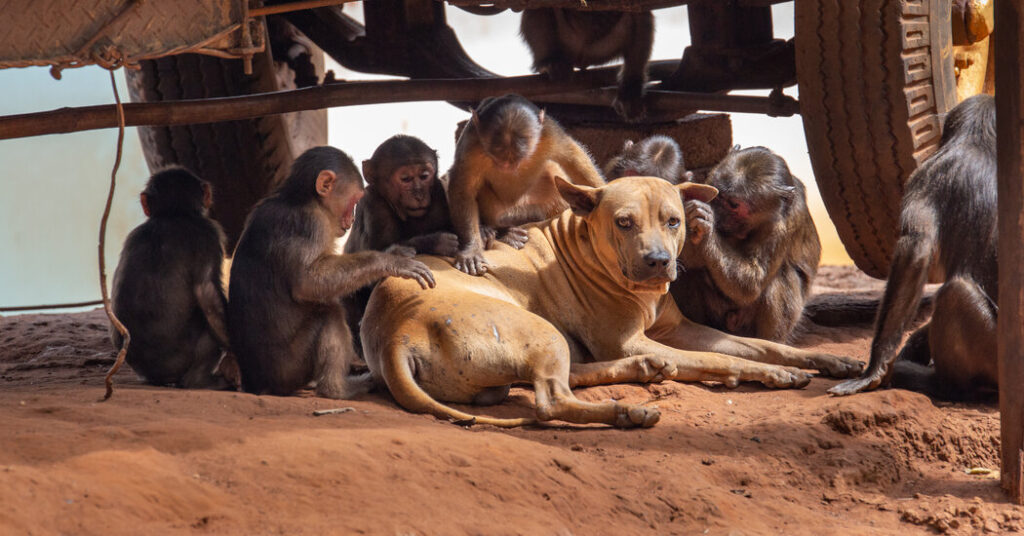
A rare interaction like this one may represent an early stage of pet-keeping behavior in our primate cousins, says a study published recently in the journal Primates. The new work suggests that we Homo sapiens are not the only ones to take care of other species — and that the roots of wanting a pet companion may stretch deep into our primate past. (Think Koko, the world-famous gorilla, and her adopted kitten, All Ball.)
Pets have long posed an evolutionary enigma for researchers. We have to feed them, house them, cut their toenails, clean their teeth and scratch behind their ears. A relationship like that could be considered a poor return on investment.
“Lavishing resources on members of other species we have no evolutionary stake in seems to make no evolutionary sense,” said Hal Herzog, a psychologist and animal expert at Western Carolina University who was not involved with the research. Yet many cultures across the world have pets and cherish them dearly.
Previous research shows that the reasons for why we have pets are as varied as the pets we keep, ranging from companionship and social connection to novelty-seeking and status. The actor Nicolas Cage once owned a two-headed snake, and Pablo Escobar maintained his own zoo, complete with hippos, elephants and giraffes. Studies following twins suggest part of the desire for animal companions is genetic, but the definitive origins for a pet proclivity are shrouded in mystery.
“There are theories that pet-keeping began either because animals were useful for tasks like hunting and protection or because humans have a natural tendency to care for and bond with other living beings,” said Zoë Goldsborough, a behavioral ecologist at the Max Planck Institute of Animal Behavior who was not involved with the research.
The earliest archaeological evidence of keeping pets comes from a 14,000-year-old grave in Germany in which a man and woman were buried alongside their beloved pooch. But the relationship most likely emerged much earlier than that. At some point as we domesticated animals, our connection with other species jumped from something primarily utilitarian to something more modern.
“Unfortunately, we have no idea how long humans have been bringing animals into their lives as pets,” Dr. Herzog said. “Lacking a time machine, we may never know.”
The idea to scrutinize our cousins for pet-owning behaviors began when Cyril Grueter, a biological anthropologist and primatologist at the University of Oxford and the new study’s lead author, was visiting the Shanghai Zoo as a master’s student. He saw that a female gibbon in its exhibit managed to capture a small mouse, gently holding and caressing it in her hand. “She kept taking very good care of that little mouse,” Dr. Grueter said, “and the mouse seemed to be comfortable in her palm.”
Interspecies interactions like these might hold key clues about why we fill our households with furry creatures, Dr. Grueter reasoned, but they are not the kind of data researchers normally publish in peer-reviewed journals. “If you see a gorilla cuddling a bush baby,” he said, “someone might get a photograph and post it on social media, but you don’t write a scientific paper about it.”
To move beyond isolated examples, he and his colleagues scoured media reports and scientific literature and surveyed primatologists for similar accounts of primates interacting with other species. Their assessment drew 427 entries across 88 primate species. The data revealed that every primate, regardless of species, held some behavior that could be linked to pet-keeping.
“There’s one case where a macaque monkey formed a very strong social bond with a chicken that accidentally appeared in its enclosure,” Dr. Grueter said, and another where a troop of capuchin monkeys adopted a baby marmoset, nursing it and caring for it for months. It seems to be a common phenomenon in both wild and captive animals.
After further scrutinizing the videos, the researchers found that monkeys and apes interacted with a litany of unrelated species, including lizards, birds, deer, dogs, squirrels and other primates. The most common interactions consisted of play and grooming, and tended to match the relationships the primates have with members of their own species: Juveniles were more likely to play with other animals, adult females were more likely to nurse adopted animals, and adult males were generally indifferent and sometimes violent. In a majority of cases, the interactions were fleeting, but in a few cases the relationship seemed to mimic straightforward adoption.
What might monkeys and apes get out of fleeting interactions with unrelated animals? Dr. Grueter suspects that part of the motivation might be loneliness. Similar to when humans feel lonely, our primate relatives can scratch an itch for intimacy by grooming or briefly huddling with another warm body. So while we adopt a puppy, a howler monkey might capture and coddle a nearby mouse.
Dr. Grueter hopes the research might help zoos and sanctuaries that host multispecies enclosures identify which animals would live together in equanimity.
Still, he makes the point that the examples he found are far from the Fidos or Tigers living in our homes. “There’s no real equivalent of pet-keeping in nonhuman primates,” he said, but we can examine the “ingredients” that might have led to its evolution.
The post Humans Love Having Pets. Seems Like Some Other Primates Do, Too. appeared first on New York Times.