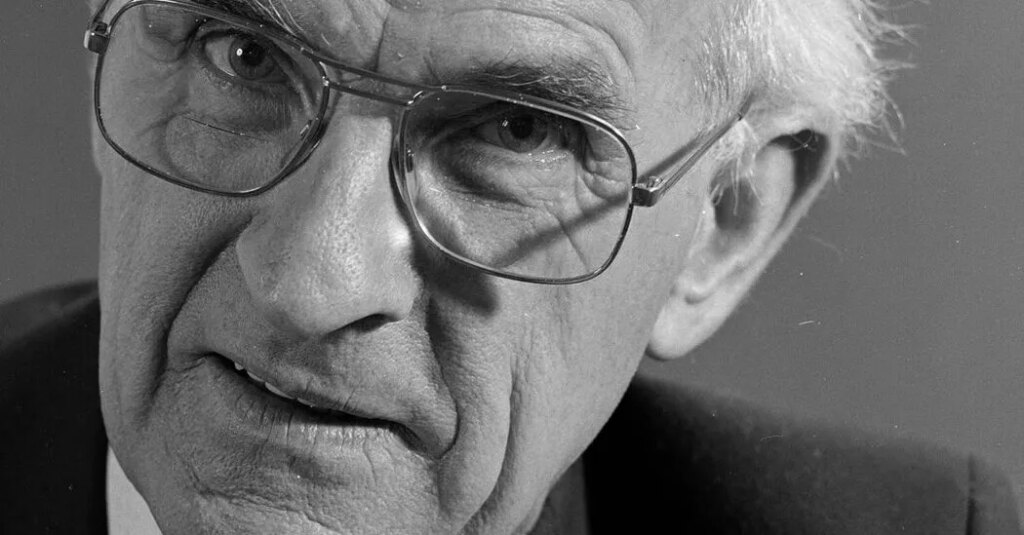
Lloyd Geering, an iconoclastic pastor and Presbyterian theologian once accused of heresy for disputing the physical resurrection of Jesus Christ, the divine inspiration of the Bible and other pillars of Christian faith dating back centuries, died on Thursday at a retirement village in Lower Hutt, a city on the North Island of New Zealand. He was 108.
Mr. Geering was New Zealand’s oldest man.
The death was confirmed by his daughter, Elizabeth Geering.
Within the country, his break with time-honored tradition in the 1960s became a cause célèbre, lauded by supporters who regarded it as an emblem of modernism in a world of anachronistic dogma. But others across the mainstream denominations condemned his views — questioning the very nature of God and rejecting the notion of an immortal soul — as a denial of the fundamental tenets and mysteries of the Christian faith.
The charges before the General Assembly of the Presbyterian Church of New Zealand in 1967 included the assertion that Mr. Geering had disturbed the “peace and unity” of the church. Coupled with the claim that his disavowal of scriptural teaching constituted “doctrinal error,” the allegations of theological wrongdoing were widely interpreted as a rare charge of heresy. He was the first New Zealander to face such accusations.
At the time, Mr. Geering was the principal of the Theological Hall, the center of Presbyterian religious education. The case against him, led by a prominent lay Presbyterian, Robert Wardlaw, and a pastor, Robert Blaikie, unfolded in a blaze of publicity. The religious hearing, in November 1967, drew an audience of 1,000 to St. Paul’s Church in Christchurch, where the proceedings were bathed in the glare of television crews’ lighting, recorded in detail by local newspapers and chronicled internationally in the pages of The New York Times, among other publications.
“It is faith that man needs, not past doctrines,” Mr. Geering said in his 90-minute defense. He enjoined New Zealanders to abandon past securities and “launch out into this world with the same insecure faith as marked the patriarchs and prophets, the apostles and reformers.” He said he had not disturbed the peace of the church, only its somnolence.
His defense “received a thunderous applause” despite an earlier decision to ban acclamation at the hearing, The Times reported.
For Mr. Geering, the episode forced a reappraisal of the Presbyterian Church — a branch of Reform Christianity implanted in New Zealand largely by Calvinist Scottish immigrants.
“I was saddened by the recognition that, while it encompassed many fine and even noble people, the institution of the church was every bit as human as any other element of society,” he wrote in “Geering and God: 1965-1971 — The Heresy Trial That Divided New Zealand,” adding that the church’s “benign face” cloaked “poisonous animosities and sheer hatred.”
Even though the charges against him were quickly dismissed, the schism lingered, exposing deep divisions between traditionalists and modernizers within several Christian denominations that redefined the terms of Christian belief. For their parts, Mr. Blaikie expressed disappointment and Mr. Wardlaw resigned from the church.
The dispute had its roots in a series of articles, beginning in 1965, in a leading Presbyterian publication. The Bible, Mr. Geering wrote, “is not literally inerrant,” adding: “The Bible is not the ‘Word of God in written form.’ The Bible is not a simple guide setting forth what every Christian in every generation must believe and do.” Rather, he said, the Bible was “a book from the ancient world and must be studied in the light of modern scholarship and all that it can tell us about the world that bequeathed to us the Bible.”
Mr. Geering’s views reflected a theological debate that had consumed religious thinkers inside and outside New Zealand for decades but that had not been widely aired among the 550,000 members claimed by the country’s Presbyterian Church at the time — a far higher number than in later years as New Zealand Christianity dwindled.
In a subsequent article, Mr. Geering cited the words of a fellow theologian, Ronald Gregor Smith: “We may freely say that the bones of Jesus lie somewhere in Palestine.” The assertion directly contradicted biblical accounts of the bodily resurrection of Christ on the third day after his crucifixion, rising to leave an empty tomb and appearing to his disciples before ascending to heaven.
“The storm that followed the publication of my article took me by surprise,” Mr. Geering wrote in “Geering and God,” which was published in 2013. And when he sought to calm the situation with a series of published explanations, he said, “Far from having the desired effect, my articles were like petrol thrown on an already blazing fire.”
The ferocity of the discussion became intensely personalized. “Some of my critics prophesied that God’s curse would descend on me in the form of fire and brimstone or some equally excruciating commodity,” he wrote in “Geering and God.” “When death threats started to arrive, my advisers insisted that I inform the police.”
The debate pitted “tradition and modernity, faith and reason,” said James Veitch, a Presbyterian minister, in “Lloyd Geering: Prophet or Heretic,” a 2025 study.
“I can’t imagine an incident in New Zealand religious history that has had such a huge impact on the people of New Zealand as a whole,” Mr. Veitch said in a recent interview. “I don’t think there’s anything else in New Zealand history like this event.”
And yet, the essence of Mr. Geering’s arguments were familiar to theologians outside New Zealand.
“The issues he raised can’t be forgotten,” The New Zealand Weekly News wrote. “Many platitudes of belief are destroyed, and people have been forced to see religion as a commitment to be questioned rather than a comfortable habit.”
Lloyd George Geering was born in Rangiora, New Zealand, on Feb. 26, 1918. His mother, Alice (Johnston) Geering, was a weaver descended from Scottish Presbyterian immigrants. His father, George, was an immigrant from Britain who worked variously as a loom technician and a farmer.
Mr. Geering was the youngest of four sons, born several years after his siblings: Ray, Ira (who died of tuberculosis at 33) and Fred. He was named Lloyd George for the British prime minister of the day, David Lloyd George. At the time, New Zealand was a self-governing dominion of the British Empire.
When James Easton, a prisoner of the Japanese in World War II, died at the age of 108 on Sept. 17, 2025, Mr. Geering assumed the mantle as New Zealand’s oldest man. During his life, he married three times and outlived all his wives.
The first marriage to Nancy McKenzie, a teacher, lasted from 1943 to 1949, when she died of tuberculosis. They had two children, Jonathan and Judith. (An unnamed third child was stillborn.) In 1951, he married Elaine Parker, a speech therapist who died in 2001 of a cerebral aneurysm, Mr. Geering wrote in “Wrestling With God,” a 2006 autobiography. They had a daughter, Elizabeth. In 2004, he married Shirley White, who died in 2021 at 94.
Mr. Geering’s survivors include his daughters, Elizabeth Geering and Judy Neil, eight grandchildren and 14 great-grandchildren. His son, Jonathan Geering, died in 2024.
His standing as a theologian was such that he drew a range of honors including a knighthood in 2009 that gave him the title Sir Lloyd Geering and his wife Lady Geering.
Mr. Geering studied mathematics at the University of Otago in the late 1930s and joined the Student Christian Movement before embarking on theological studies in 1940. During World War II, he declared himself a pacifist on the grounds of his Christian faith.
He was ordained as a pastor of the Presbyterian Church and served as a parish priest before becoming a theologian specializing in Old Testament and Hebrew studies. He became the principal of the Theological Hall in 1962, he said in “Wrestling With God.” In 1971, he became a professor of religious studies at Victoria University of Wellington, a position he held until his formal retirement in 1984. Mr. Geering went on to write books and lecture on religious matters, not always to universal acclaim.
“He was absolutely nodal in our recent national cultural narrative, and he has a significant place in our national story,” Paul Morris, a professor of religious studies at Victoria University of Wellington, said at a seminar for Mr. Geering’s 100th birthday. But, Mr. Morris added, “he effectively closed down public debate about religion and muted religious voices in the country.”
In redefining perceptions of belief, Mr. Morris continued, Mr. Geering may have accelerated a trend toward the secularization of New Zealand by offering a vision of religious thought outside the established churches.
Ama Sarpomaa contributed reporting.
The post Lloyd Geering, Pastor Who Disputed Christ’s Resurrection, Dies at 108 appeared first on New York Times.