Bradley Bowman is a co-author of the book “Axis of Aggressors: Countering the Cooperation of China, Russia, Iran & North Korea” and the senior director of the Center on Military and Political Power at the Foundation for Defense of Democracies, where Cameron McMillan is a senior research analyst.
Iran’s extensive list of demands for opening the Strait of Hormuz has many scratching their heads and wondering how to make sense of a frenetic U.S. approach toward a regime in Tehran that is exercising influence.
A significant reason for Iran’s resilience, lethality and leverage is the growing support Tehran is receiving from China and Russia. These two nations were nowhere to be found when Israel and the United States struck Iranian nuclear and military sites in June 2025, leaving Iran to defend itself.
However, when the U.S. and Israel launched military operations against Iran in February, Russia increased its help, providing Iran with valuable drone and intelligence support that strengthened its offensive capabilities. Russia has aided Iran’s campaign of attacks by unmanned aerial vehicles by reportedly sharing valuable drone tactics and technologies tested on the battlefield in Ukraine.
In fact, the Islamic republic’s prolific use of drone attacks targeting U.S. and partner forces across the Middle East has been one of Tehran’s most potent tools throughout the war. On March 1, an Iranian drone struck a U.S. operations center in Kuwait, killing six American soldiers.
Perhaps most startlingly, Russia reportedly provided Iran with satellite imagery and other forms of intelligence to enable Iranian attacks on American military positions in the region, likely improving Tehran’s ability to target U.S. forces and high-value assets — such as radars and command-and-control sites — with drones and ballistic missiles. On July 17, three American soldiers were killed by an Iranian ballistic missile attack in Jordan.
China has not been idle, either. Beijing has long provided Tehran with dual-use support, meaning items that can be used for civilian and military purposes. This is perhaps most evident in Iran’s ballistic missile program. China has supplied Iran with chemicals such as sodium perchlorate, which can be used to produce ammonium perchlorate. The latter is controlled under the Missile Technology Control Regime, a multinational agreement seeking to limit missile proliferation. Ammonium perchlorate can be used in the solid-propellant rocket motors that power most ballistic missiles.
The shipments have been steady. In January 2025, two Iranian cargo vessels sailed from China carrying more than 1,000 tons of sodium perchlorate. By June 2025, Tehran had placed a new order for ammonium perchlorate through a Hong Kong-based holding company.
On April 29, 2025, the Treasury Department sanctioned Iranian and Chinese entities for supplying missile-propellant ingredients to Iran’s Islamic Revolutionary Guard Corps, saying the network “facilitated the procurement of sodium perchlorate” from China to Iran.
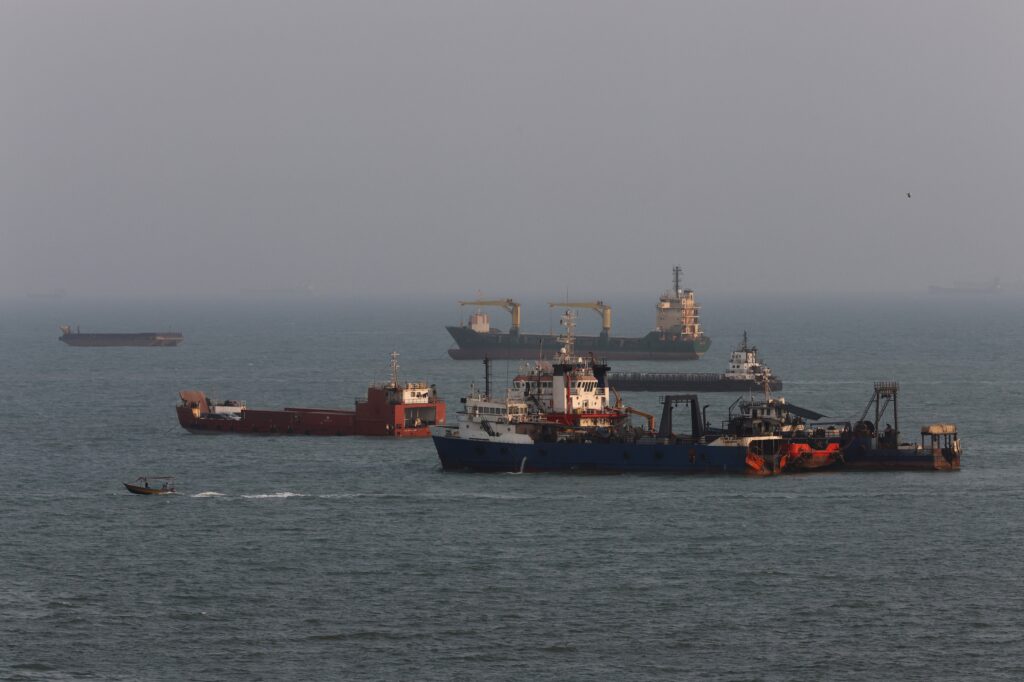
The aid continued after the U.S. and Israeli attacks on Iran in June 2025. According to European intelligence sources, China sent some 2,000 tons of sodium perchlorate in several shipments, which began arriving on Sept. 29 of last year as Tehran worked to reconstitute its ballistic missile stocks. Even during this year’s war, Chinese chemical shipments to Iran appear to have continued, with two ships suspected of carrying sodium perchlorate arriving in Iran in March, according to maritime tracking data.
But China’s backing of Iran’s ability to threaten the region goes beyond assistance for ballistic missile production. In 2024, the IRGC acquired a Chinese surveillance satellite previously launched by China, which Tehran has reportedly used to target U.S. forces.
If Washington ignores these actions by Russia and China, Tehran’s regime will continue to become more resilient and lethal. That is likely to put additional pressure on U.S. munitions, exacerbate problems in the Strait of Hormuz and potentially cause more American casualties in a future conflict.
A weak response from Washington will invite additional help for Iran as it seeks to rebuild its arsenal and defense-industrial base. That could include the delivery of hundreds of Chinese-made QW-12 and FN-16 shoulder-fired air-defense systems.
To punish, block and deter China and Russia from propping up Iran, Washington and its allies should take decisive steps. These should include increasing intelligence and munitions support for Ukrainian offensive strikes and imposing sanctions on Beijing if it provides Iran with weapons systems or significant military components. The U.S. and its allies should also interdict Chinese chemical shipments that boost Iran’s ballistic missile program. Finally, Congress should require an annual report from the intelligence community detailing Beijing’s dual-use support to Iran and share that information with U.S. partners.
The post How China and Russia keep Iran armed and dangerous appeared first on Washington Post.