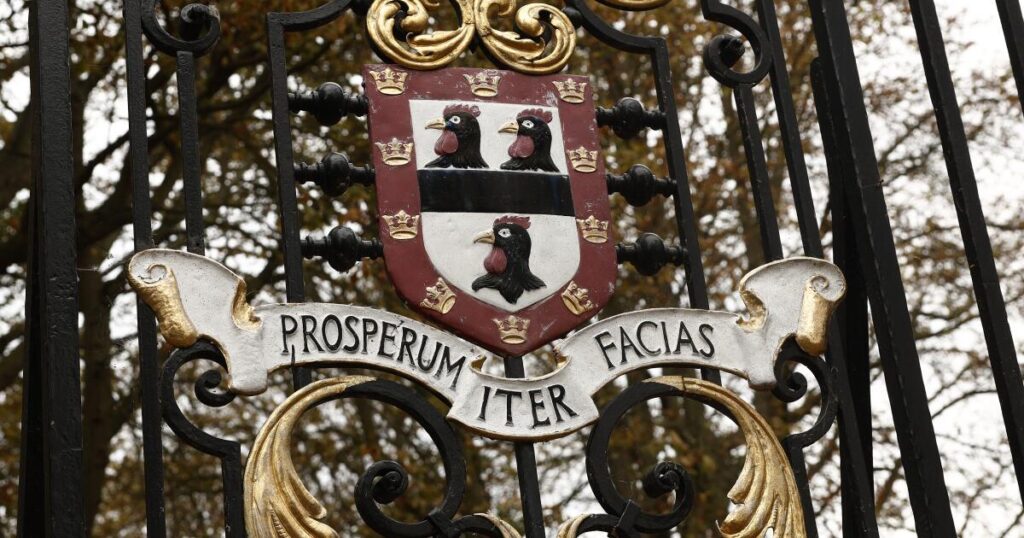
LONDON — Britain’s prime minister called for reflection Saturday after a Black professor who faced accusations of plagiarism and misrepresenting his background died suddenly, days after resigning from a prestigious role at the University of Cambridge.
Jason Arday, who became Cambridge’s youngest Black professor in 2023, was found dead at an address in south London on Friday. He resigned last week as professor of sociology of education after coming under media scrutiny, with weeks of news headlines alleging plagiarism in his academic work and questions surrounding apparently unfounded claims about his athletic and fundraising accomplishments.
His death has prompted outcries that the allegations against Arday, 41, were magnified into a cruel public takedown motivated by racism and long-standing hostility to diversity, equity and inclusion, or DEI, policies at universities and other institutions.
Prime Minister Andy Burnham said Arday’s death was “a tragedy on so many levels.”
“It’s not a moment for any rushing to judgment. It’s a moment for reflection, I would say, reflecting on how things came to this,” Burnham told reporters.
Arday ‘felt he couldn’t go on,’ friend said
Police said the death was being treated as “unexpected” but not suspicious. They said officers were called to an address in south London on Friday afternoon and a 41-year-old man was pronounced dead at the scene. They did not name Arday, in accordance with police policy.
A friend said Arday had told him that he “felt he couldn’t go on” in a voice note earlier Friday.
“He was being subjected to relentless scrutiny, including ridicule, discrediting absolutely every detail of his life, and he wasn’t coping with the loss of his career, the loss of his reputation,” Cambridge professor and director of the Autism Research Center, Simon Baron-Cohen, told the BBC.
Arday’s family said in a statement that he had been subjected to a “campaign of harassment” and “sustained abuse” ever since he took up his post as professor at Cambridge.
“The campaign of misinformation was too much for Jason,” the family said in a statement issued through his publisher, Simon & Schuster U.K. “We are in shock to have lost this amazing father, partner, brother, uncle and son.”
Cambridge Vice Chancellor Deborah Prentice, who earlier announced that the university would investigate the circumstances around Arday’s employment, said she was “desperately saddened” by the news.
Plagiarism investigation
Questions about Arday’s qualifications were raised publicly last month by Nathan Cofnas, a onetime Cambridge philosophy researcher who left the university after his critique of DEI programs sparked widespread protests. Cofnas previously claimed that in a meritocracy, Black people “would disappear from almost all high-profile positions outside of sports and entertainment.”
Newspapers soon published stories detailing findings that more than 100 passages from Arday’s 2015 PhD thesis were “identical or near-identical” to an earlier paper written by another researcher.
British media then raised wider questions about many of Arday’s claims about his life, including statements he had raised $7.4 million for charity through unlikely feats such as running 30 marathons in 35 days and 600 miles in six days. Arday later revised those claims.
Some also questioned his claim that he had overcome developmental delays that left him nonverbal until the age of 11. Arday said he was diagnosed with autism at a young age and didn’t read or write at 18 years old. Findings in news reports indicated both claims appeared to be untrue.
Arday resigned from Cambridge on Aug. 5. He denied plagiarism, but admitted to mistakes when working on his doctorate.
Dozens of Cambridge academics signed a letter calling for an independent inquiry into how Arday was appointed. Cambridge initially stood by Arday, saying that the plagiarism allegations had been investigated by Liverpool John Moores University, which awarded Arday’s doctorate.
The university then changed its stance and said it had opened an investigation “following new information about Professor Arday’s qualifications and honorary appointments.”
Prentice, the university’s vice chancellor, said this week she shared concerns regarding his appointment and that Cambridge will run a review of how it hires senior staff.
Reflection of broader culture wars
While some believe Arday was a victim of media “hounding” and racism, others say there are more complex issues at play — including whether Cambridge made the right call when it appointed Arday to such a high-profile position.
Daniel Kebede, general secretary of the National Education Union, said questions about Arday’s credibility “unleashed a tirade of racism.”
“There is a profound difference between scrutiny and a sustained public campaign that turns an individual into a symbol of everything the right believes is wrong with DEI,” he said. “The effect has been chilling. It tells Black people and others from underrepresented backgrounds that entering prominent public positions will make you a target.”
London Mayor Sadiq Khan said Arday had been “the victim of a pernicious public shaming that other people in his position simply wouldn’t have faced.”
Conservative former Home Secretary James Cleverly, who is Black, wrote on X that academic institutions “have serious questions to answer.”
“They put him into positions he was clearly not qualified for so they could have a Black wunderkind to show off; they pushed him into the spotlight for their own benefit,” he said.
Hui writes for the Associated Press.
The post British leader calls for reflection after the death of former Cambridge professor accused of plagiarism appeared first on Los Angeles Times.