Michael Anton is the author of “Studies in Machiavellian Political Philosophy,” from which this essay was adapted.
“How, if at all, is Niccolò Machiavelli relevant today?”
That is one version of the question I’ve been asked in my many years of teaching and writing about the great Florentine philosopher. Whenever I hear it, I imagine Niccolò sitting on a throne in the afterlife in which he didn’t believe, laughing down at us. “I’ve been relevant to you for the last 500 years,” he’d sneer. “You are who you are because of me.”
That might be an exaggeration, but I have no doubt Machiavelli went to his grave believing it. Were he able to see us today, he’d probably be even more smugly certain about his influence.
When students pose the question, though, they’re typically searching for what they can learn from Old Nick that will help them win in the here and now. They’re looking for easy advice, quick fixes, “rules” for navigating a tricky and often treacherous world. Machiavelli, in his infinite craftiness, gives them reason to think he can help.
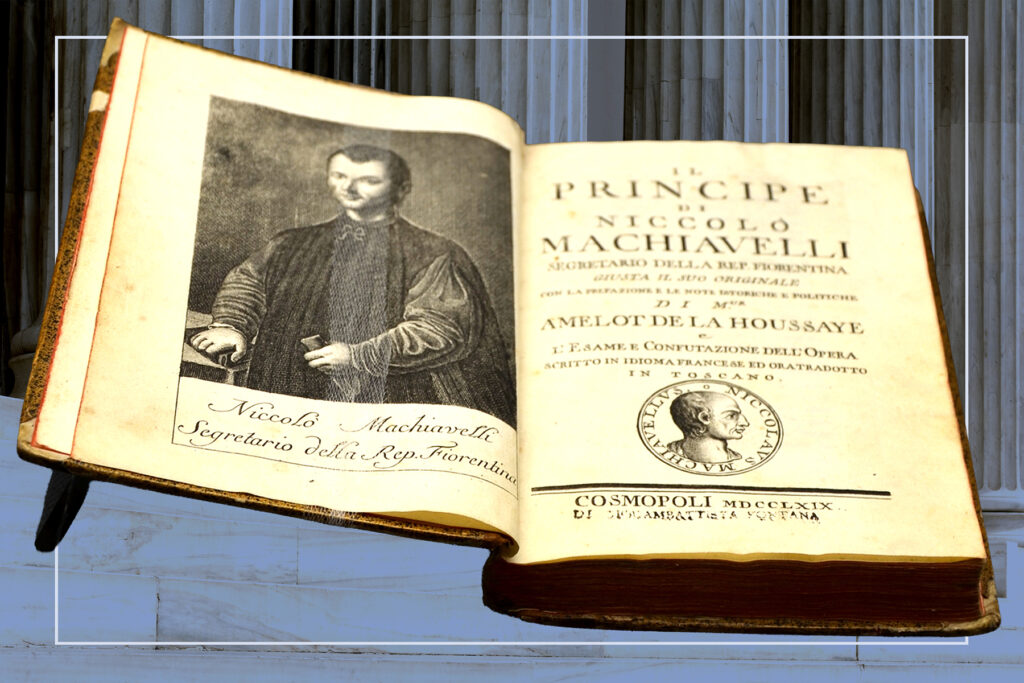
In the dedicatory letter to “The Prince” (1532), his most famous book, Machiavelli claims that he “dares to discuss and give rules” for how to govern. Later in the book, he twice proclaims “general rules” and refers authoritatively to “the rules written above” — that is, written by him. On the surface, “The Prince” appears to be nothing more than a how-to-rule handbook, a compilation of rules for ruling.
But that surface is deceptive. It would take a commentary of many hundreds of pages to explain all the complexities of that text. For now, then, two considerations must suffice.
First: A lot of Machiavelli’s advice is simply — and intentionally — bad. As the discerning reader will notice, Machiavelli often recommends stupidly heedless courses of action likely to get one killed, perhaps to weed out the idiots and pretenders. In Chapter 21 of “The Prince,” for instance, he insists that a prince must always choose a side in others’ quarrels, that neutrality is always the worst course.
Always? It’s almost as if he’s amusing himself by making fun, avant la lettre, of those “Machiavelli for Managers” frequent-flier bestsellers such as “The 48 Laws of Power.” The real Machiavelli knows that while there may be fixed laws of physics, there are none for human behavior and that his general rules that “never” fail in fact often do. One way he shows this is via his examples, which frequently undermine or even contradict his explicit statements.
Second and more important: As much as “The Prince” purports to be a rule book, it is really a weapon of spiritual warfare meant to take on — and replace — the Bible and ancient philosophy. Machiavelli’s ambition was nothing less than to become a “new prince” ruling over humanity posthumously through his books. He founded modernity — or, as I have put it elsewhere, “changed his time into our time.” His legacy includes the revival of republicanism, contemporary liberal regimes, modern natural science, “the conquest of nature for the relief of man’s estate,” as Francis Bacon had it, religious disenchantment and the Enlightenment.
It is a vast claim, first advanced by Leo Strauss in the early 1950s, fully fleshed out in his monumental “Thoughts on Machiavelli” (1958), and further elaborated over some 50 years by his brilliant student Harvey Mansfield (among others).
That anyone could have intended so much is admittedly hard to accept. That he could have tried to do it solely through writing is harder still. To borrow from his “Discourses on Livy,” demonstrating all this is “too long and too high a matter to discourse of” here. Even Strauss, who had 350 pages to prove his case, still hasn’t convinced every Machiavelli scholar. But he has persuaded me.
The real reason, then, to read Machiavelli is not to learn how to get one over on your rivals, which in any case isn’t that complicated. It is to understand the times in which we live and how they differ from those they replaced. Strauss famously accused Machiavelli of effecting “an enormous simplification,” of contracting humanity’s “horizon,” and charged that “one half of humanity remains outside of his thought.” Machiavelli forgets tragedy, reduces philosophy to a handmaiden serving material wants and rules out of bounds any appeal to a higher metaphysics.
He is nonetheless worthy of study not merely for his historical importance but because, while it might not be true that to understand anything one must know its origins, it is certainly true of a philosophic teaching.
Only in Machiavelli can we see the beginnings of modernity and the confrontation with what it replaced. In his writing, we’re able to look forward and backward: to observe how we got here, what we’ve gained and the outlines of what we’ve lost. That outline is distorted — Machiavelli did so deliberately — but in an ironic twist he may even have intended, in comparing the distortion to the original, we’re able to see the latter more clearly. Our world of empty pews and iPhones, streaming porn and cancer-killing oncology, and desiccated academia and a $100 trillion global economy is the result.
Machiavelli is relevant to you, all right — even more than you might have thought, but probably not in the way you thought.
The post We’re all Machiavellians now appeared first on Washington Post.