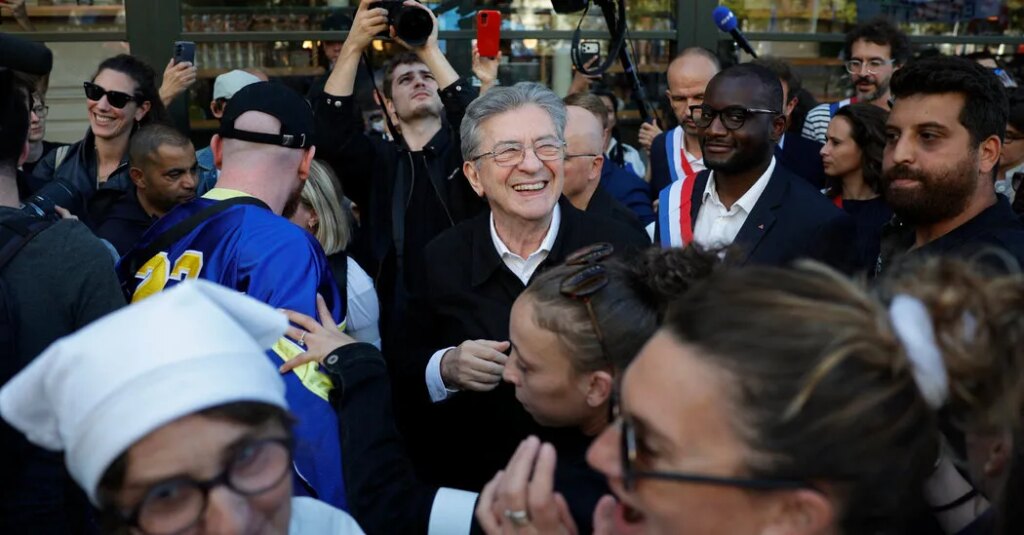
He shook hands and posed for selfies. He brandished a protest sign. He accepted a hug from a young fan. He cheered after an enthusiastic, if somewhat tuneless, rendition of “La Marseillaise,” the French national anthem.
Jean-Luc Mélenchon, the combative leader of France’s far-left party, France Unbowed, seemed to relish his appearance at a mass demonstration of high school students in Paris on Tuesday. And why not?
For a left-wing firebrand who appeals to young people and heads an insurgent party built on grass-roots protest, the student-led demonstrations that have swept France are a golden opportunity. Coming seven months before a presidential election in which Mr. Mélenchon is a genuine contender, they could not be better timed.
Yet the demonstrations have occasionally escalated into violent clashes between the protesters and the police, which carries acute risks for a politician seeking mainstream acceptance. Mr. Mélenchon, 75, seems to recognize the danger, moderating his usually pugnacious statements after the French recoiled from images of tear gas and trash cans set aflame.
“I call on you, young people, wherever you may be, to embrace the discipline of the struggle,” Mr. Mélenchon said at a rally last week. He encouraged students to take to the streets but added a caveat. “You must use nothing but nonviolent methods of struggle,” he said.
Marching on Tuesday, Mr. Mélenchon wore a white armband, meant to signify his role as a gentle chaperone for the students — an authority figure who could calm the protesters if their youthful passions overflowed and protect them from the police if scuffles broke out.
French government officials, however, assert that Mr. Mélenchon plays neither role. Far from moderating the students, they accuse his party of fomenting the unrest for political gain. What began as an organic protest movement, these officials say, has been hijacked by France Unbowed, emboldening bad actors who want to burn trash cans and hurl fireworks at police officers.
“Why wear a white armband to better give a leg up to those wearing black balaclavas?” France’s prime minister, Sébastien Lecornu, said angrily on Tuesday to the party’s leader in the National Assembly, Mathilde Panot.
“The reality is that you are ambiguous about violence,” Mr. Lecornu continued, “because violence is part of your political plan to throw the country into chaos between now and the presidential election.”
Mr. Mélenchon, Ms. Panot and their colleagues flatly reject those charges. Ms. Panot said the violence was a result of heavy-handed police tactics and accused the government of treating young people like “military adversaries.”
Still, there is no question that the party’s leaders have walked an increasingly fine line since the students began blockading schools last month. They have endorsed the students’ list of grievances and championed their right to take to the streets. In some cases, they have even linked arms with them.
“Mélenchon is seemingly trying to occupy two positions simultaneously,” said Philippe Marlière, a professor of French and European politics at University College London. “Political amplifier of the revolt, and politically disinterested defender of a movement that supposedly arose spontaneously.”
Nobody embodies those contradictions more than Bally Bagayoko, a rising star of France Unbowed and mayor of St.-Denis, a working-class suburb north of Paris that has been the epicenter of the unrest.
Critics pounced on a brief television interview Mr. Bagayoko gave last week after turning up at an early blockade of a school. “Violence, at a certain point, can be legitimate,” he said, though he hastened to add that his message to the students was that it is always better to avoid violence.
A charismatic, one-time semiprofessional basketball player, Mr. Bagayoko, 53, has become a conspicuous presence at the blockades and rallies. Standing in front of Rosa Parks High School in St.-Denis last Thursday, he listened to students, defused arguments between them, held court with visiting journalists and even stomped out a small fire lit by a handful of disrupters.
Asked about the risk of violence, Mr. Bagayoko said, “Of course, here and there, there might be some dysfunction, some mistakes that are made. But these are the signs of young people, who are not necessarily experienced activists and who, in the heat of the demonstration, sometimes tip over the edge. That’s a fact, and it’s the reason why adults must be there.”
“Sir,” said a young man, interrupting the mayor to gesture toward clouds of smoke nearby, “there’s a fire.”
Mr. Mélenchon said the government had unfairly painted Mr. Bagayoko as an instigator rather than a protector. “When Bally pulls out a burning trash can so that it doesn’t set fire to the building, he’s the one who’s accused of setting the trash can on fire,” Mr. Mélenchon said at the rally on Sunday.
He has good reason to push back against that narrative. In recent polls, Mr. Mélenchon is projected to finish just behind the leading center-right candidate, Édouard Philippe, in the race to replace President Emmanuel Macron. The far-right candidate, Marine Le Pen, maintains a double-digit lead over both.
That would put Mr. Mélenchon within striking distance of advancing to the second round of the French election next spring, the closest he has come to victory in three previous presidential campaigns.
Though Mr. Mélenchon presents himself as an insurgent, he spent much of his career as a member of the Socialist Party, France’s main center-left party. He served as a minister under Socialist prime minister Lionel Jospin before leaving the party in 2008. He founded France Unbowed in 2016.
A one-time Trotskyist, Mr. Mélenchon offers simple solutions to complex problems — writing off part of France’s debt, for example. He said France’s debt-burdened government should spend more money on schools.
Analysts said Mr. Mélenchon benefited from a hunger among voters for root-and-branch change. But his party — commonly known as L.F.I., the acronym of its French name, La France Insoumise — faces deep resistance. Centrists say his economic policies lack credibility, while some of its leaders, including Mr. Mélenchon himself, have been accused of antisemitism. And then there are the worries about violence.
“Almost seven French people out of 10 say that France Insoumise is a party that stirs up violence,” said Antoine Bristielle, director of the Public Opinion Observatory at the Jean Jaurès Foundation, a left-leaning think tank in Paris.
That is a higher percentage than those who voice similar fears about the far-right party, the National Rally, Mr. Bristielle said. Even in “rebellious France,” he said, “it can be quite negative for them in electoral terms.”
Giulia Imbert and Ségolène Le Stradic contributed reporting.
The post For France’s Resurgent Far Left, Student Protests Are an Opening and a Threat appeared first on New York Times.