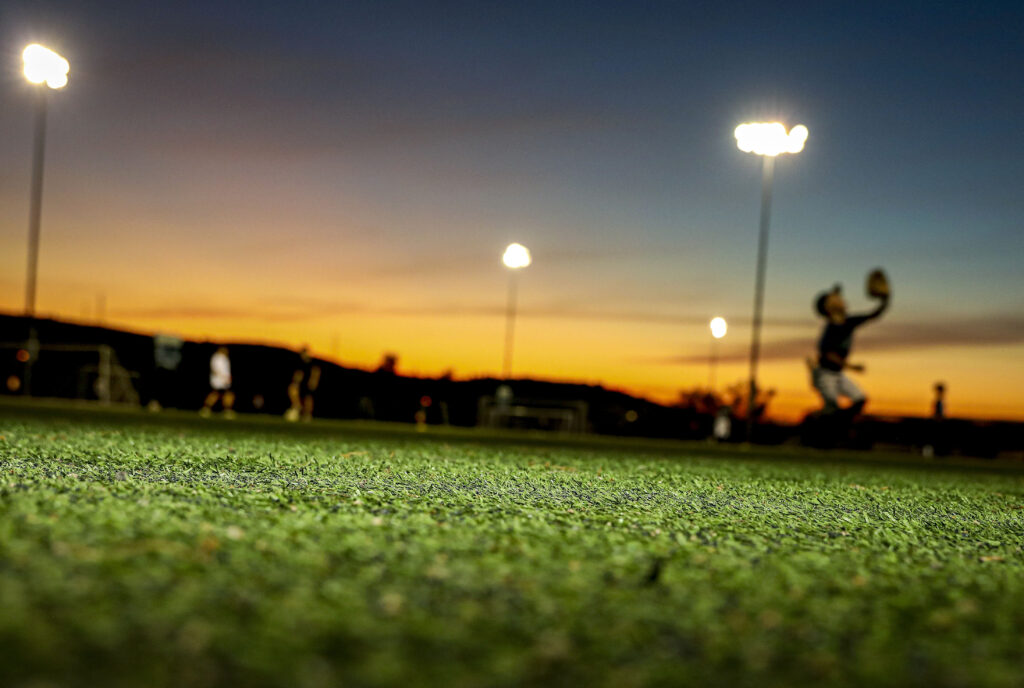
Maryland’s largest school district is replacing its natural-grass athletic fields with artificial turf, a move that is pitting arguments for convenience and versatility against concerns about cost and students’ health.
The turf-versus-natural grass debate has been ongoing for decades in athletic and environmental circles. Synthetic turf enthusiasts tout its lower maintenance costs and extended lifetime, but critics point to the environmental and health effects the material could pose.
The back-and-forth is flaring locally as Montgomery County Public Schools prepares to spend $55 million to install synthetic turf — some of it to replace natural-grass fields and some to update old artificial-turf fields — over the next six years. The district plans to spend $15 million through next June on six fields, as well as two or three turf playground installations, according to data from the school board.
The school board approved the project as part of its Capital Improvements Program last year, but has yet to accept specific bids for the work.
Poolesville High School rising junior Sidharth Harishanker said district leaders should listen to students who want to keep natural grass. Synthetic fields pose too many risks with too few benefits, said Harishanker, who is co-president of Eco MoCo, a student-led nonprofit environmental advocacy group.
“Why are we spending so much money on this?” he said. “Turf fields are environmentally detrimental, as well as kind of stupid.”
The district estimates it will cost $1 million each to replace the existing turf fields at Richard Montgomery and Walt Whitman high schools. Three of the new installations — at Col. Zadok Magruder, Springbrook and Watkins Mill high schools — will cost $2.75 million each. A new field at Poolesville High will cost closer to $3.65 million.
District plans to transition remaining grass fields to turf
Jeffrey Sullivan, the district’s athletics director, said there is no comparison between natural grass and artificial. Natural fields can’t support the hours of play needed for the district’s robust athletics and physical education programs, Sullivan said, a situation that becomes an equity issue for schools without alternatives.
About half of the district’s 25 main high school athletic fields — which are used for sports such as football and soccer — are synthetic. The district is on track to transition the rest to turf, Sullivan said.
Synthetic turf is more than just a sheet of plastic — it’s layers of concrete, plastic and rubber. At the base is a gravel or concrete layer installed to support drainage. That is topped with a shock-absorbing pad, then covered with a “grass” carpet made of plastic — typically polypropylene or polyethylene. Finally, infill, most commonly made up of crumb rubber, is dumped on top to fill the gaps.
There are caveats to nearly every argument about whether a natural or synthetic surface is best. Natural grass requires more maintenance, but doesn’t have to be replaced every 10 years. Synthetic turf can support more hours of play, but it can get dangerously hot in the summer. Natural grass is cheaper to install, but synthetic turf is cheaper to maintain.
The dollars and cents of grass vs. turf
The district estimates the cost of natural-grass installation to be $634,000, compared to $2.5 million for a synthetic field. But yearly maintenance costs are $100,000 for a grass field and $12,000 for synthetic turf. The latter also carries an additional $1 million replacement cost every decade.
In November, the district released a 10-year analysis that compared the cost per hour of use for turf and grass fields. By that measure, turf fields cost $5.72 an hour, compared with $23.73 for grass fields. That hourly breakdown does not account for the cost to replace a synthetic field.
Sullivan said artificial-turf fields “save our grass fields” from overuse. The district estimates that in fiscal year 2025, its synthetic-turf fields supported 45,816 hours of play compared with 6,885 hours on natural-grass fields.
One of the main selling points of synthetic turf is the ability to use it quickly after heavy rain, Sullivan said. County-maintained natural-grass fields are off-limits if more than a half-inch of rain falls in 24 hours, according the county parks department policy. Turf fields have no such restrictions.
Grass advocates cite turf’s cost, heat and toxicity
Hannah Donart, vice chair of health and wellness for the Montgomery County Council of Parent-Teacher Associations, said the district could save money by investing in well-maintained natural-grass fields, and use any extra money to help address other needs such as a $740 million backlog in HVAC projects. She said the school’s long-term cost analysis is incomplete because it doesn’t account for synthetic turf’s replacement cost, and that grass fields could support the same amount of activity as synthetic turf if they were better maintained.
Donart, an environmental scientist, called synthetic turf a more expensive and more toxic alternative, noting exposure to chemicals used in manufacturing. She also called turf less safe, pointing to research that shows rates of injuries like Achilles tendon and ACL tears are higher for people who play on the turf.
“Kids and teens are not little adults and are more vulnerable to all these cumulative impacts from these harmful exposures,” Donart said.
Synthetic turf can get much hotter than natural grass. The Montgomery council of PTAs took heat readings in early July of three synthetic fields in the county. On average, the synthetic turf was 65 degrees hotter than nearby natural grass, according documents and photos reviewed by The Washington Post.
The school district restricts the use of turf fields once outdoor temperatures reach 90 degrees, according to the district’s athletics handbook.
Yale University epidemiologist Vasilis Vasiliou said the high temperatures of artificial fields have burned children who play on them. His research into turf infill identified the presence of dozens of carcinogens, hormone disrupters and toxic metals that could be released into air during high heat, which, among other things, could aggravate asthma symptoms.
Richard Montgomery High soccer player Margot Ashford, who has sports-induced asthma, said she has a harder time breathing on the main athletic field, which is artificial, than on the practice field, which is natural grass.
“I’ve definitely seen some of the real negative impacts of synthetic turf,” the rising senior said.
Grace Chi, a rising junior at Poolesville High, said that along with the concerns about plastic pollution and high surface temperatures, students are worried about the smaller nuisances turf fields bring, too.
“Any time I would play on those plastic turfs, I wasn’t a big fan of the smell or the little rubber pellets that would get into my shoes,” Chi said.
Turf advocates point to its versatility
Melanie Taylor, CEO of the Synthetic Turf Council, a national trade association, said that while synthetic turf does get hotter than natural grass, it can support play year-round with proper planning, hydration breaks, shade and heat-safety policies.
Taylor said there are studies that show no significant difference between injury rates on synthetic turf and those on natural grass. The introduction of shock pads and standard safety testing has also made the surface safer since it was introduced, Taylor said.
She said there are environmental trade-offs to both synthetic turf and natural grass, whose maintenance involves pesticides. The artificial-turf industry is advancing technology to mitigate plastic migration, Taylor said, which would limit the amount of microplastics in surrounding areas.
“We’re very confident in turf as a surface for every level of play. So, it should not keep parents up at night,” Taylor said.
The post Synthetic or natural grass? The turf war in a Maryland school district. appeared first on Washington Post.