For a half-century, Congress has been offering middle- and working-class Americans options for tax-advantaged individual retirement savings, largely to compensate for the disappearance of traditional pensions.
But the transition from so-called defined benefit pensions to defined contribution accounts such as 401(k) plans and individual retirement accounts hasn’t worked for millions of Americans. Roughly 40% of working Americans don’t have any retirement savings at all, and among those who do, their savings are too meager to support them through their retirement years.
That isn’t the case for America’s richest households. The number of 401k and IRA accounts with balances of tens of millions of dollars has mushroomed in recent years, an artifact of ever-expanding wealth inequality.
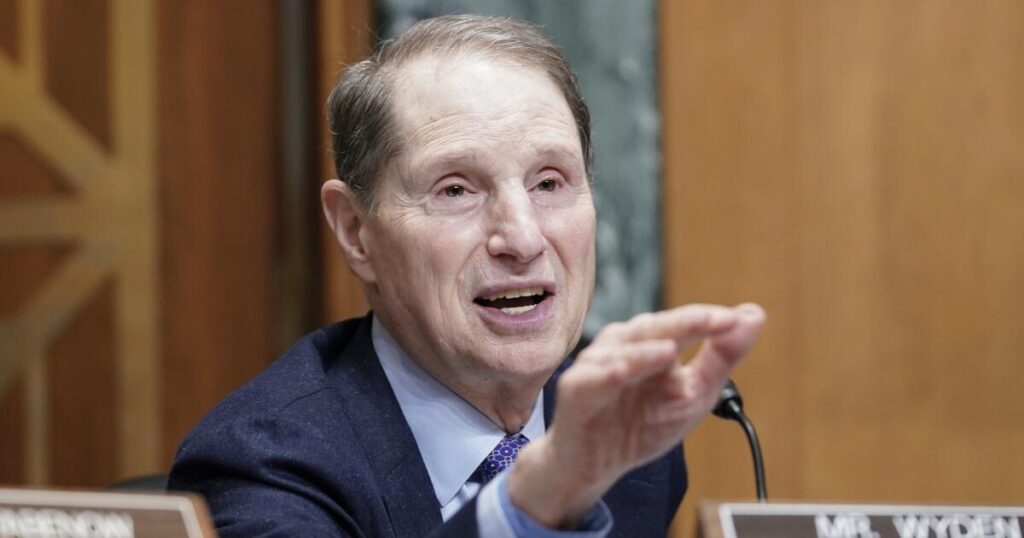
“Tax-preferred retirement accounts are not supposed to be a loophole for the ultrarich to shelter immense fortunes,” Sen. Ron Wyden (D-Ore.) said recently in introducing a measure to cap contributions to retirement accounts worth $10 million or more and increase the required annual distributions from those mega-accounts. “They’re a lifeline for working Americans who may not otherwise have a dignified retirement.”
Wyden introduced the bill along with Rep. Richard Neal (D-Mass.). They’re ranking members of the Senate Finance Committee and the House Ways and Means Committee, respectively.
Even Ted Benna, who is often dubbed the “the father of the 401(k),” is doubtful that his brainchild has served its target beneficiaries. “The 401(k) isn’t working really well now for many middle- and lower-income employees,” Benna told Bloomberg last month. One reason is that “many of them can’t afford to have money taken out of their paycheck even if they have the opportunity to do so,” he said.
It’s also true, however, that the tax advantages of defined contribution plans tend to skew toward wealthier households. That’s because many lower-income households owe little or no federal income tax, so they can’t profit from the tax breaks.
Under the law, contributions to traditional IRAs and 401(k)s are tax-deductible when they’re made and grow tax-free over time. Distributions from those accounts are taxable at the taxpayer’s top marginal rate, though. (Distributions from Roth IRAs, for which contributions aren’t tax-deductible, aren’t taxed upon withdrawal after the account holder passes age 59 1/2.)
According to the federal reserve, about 40% of households have no savings at all in tax-advantaged accounts. Only 9% of private-sector workers, or more than 11.3 million, have a traditional pension funded by their employers. Among those with retirement accounts, in 2019 the median balance was only $3,000 for those ages 25 to 55 and $10,000 for those 55 and older. Average balances are higher — $85,000 for the younger cohort and $222,000 for their elders — but that’s a reflection of the run-up in balances among the very wealthy.
For the 1%, meanwhile, 401(k) plans and IRAs have been an indisputable boon. More than 32,000 taxpayers had more than $10 million each in those accounts, averaging $17 million each, according to the congressional Joint Committee on Taxation. The richest 208 taxpayers, the joint committee found, held a total of more than $85 billion in those accounts, with average balances of $409 million each.
In recent years, the outsized growth of plutocrats’ retirement accounts has bubbled up to public notice. During his 2012 presidential campaign, Mitt Romney disclosed that his IRA held as much as $101 million. For the most part, the sum reflected Romney’s earnings from Bain Capital, the private-equity firm he co-founded. At the time, a Romney spokesman defended the holding by asserting that the tax treatment of his IRA “is the same for Gov. Romney as it is for every citizen of the U.S.”
Under the law in effect then, Romney was required to start withdrawals from the IRA in 2017, when he reached the age of 70. Those withdrawals were taxed as ordinary income at the top marginal rate, currently 37% on income over $751,600 for married couples.
After Romney’s disclosure, the prime example of excessive retirement account balances was investor and entrepreneur Peter Thiel, whose Roth IRA was worth less than $2,000 in 1999 and $5 billion in 2021, when it was disclosed by the investigative newsroom ProPublica.
Thiel declined to respond to ProPublica’s request for comment at the time. But the source of the money was shares in PayPal, then a startup. Because PayPal was a private company, the shares’ value was conjectural; as PayPal staged an initial public offering in 2002, was subsequently acquired by EBay that same year, and was spun off as an independent company in 2015, its value soared. Its shares currently trade at about $60 and the company’s market value is about $51.7 billion. Thiel isn’t currently listed as a major shareholder.
Because his holdings are in a Roth IRA, Thiel won’t have to pay federal tax on his withdrawal. Under current law, he won’t have to make required withdrawals until he turns 73 in 2040.
The creators of today’s tax-advantaged retirement accounts didn’t appear to anticipate the growth in account balances being seen today. When the traditional IRA was created in 1975, lawmakers confined the accounts to middle- and working-class households without access to company pensions. The initial contribution limit was $1,500; starting in 1977, nonworking spouses could contribute an additional $250.
The contribution maximum has continued to rise. Today, it’s $7,500 each for workers and their spouses, and those 50 or older can add an additional $1,100. Even workers with pensions can contribute today.
For Roth IRAs, the contribution limits are $7,500, and $8,600 for those 50 and older. Because Bill Clinton, who was president when Roth IRAs were enacted in 1997, was wary of giving wealthy Americans a tax break they didn’t need, contribution limits also were constrained by family income. This year they’re phased out for single taxpayers with an income of $153,000 and married couples earning $242,000, and are barred for singles with income an income of $163,000 and couples with an income of $252,000.
That reflects the intention of the late Sen. William Roth Jr. (R-Del.) to steer the benefits of his namesake retirement account to “hard-working, middle-class Americans.”
As for 401(k) plans, these originated as an outgrowth of corporate profit sharing-deferral programs crafted for executives. In 1981, the IRS issued regulations allowing any employee to contribute to such plans out of their wages. The 401(k), named for the tax code section that authorized it, was born.
It took a few years for the concept to take root.
“Because it wasn’t expected to be a big deal, there wasn’t anyone running around the country setting up 401(k) plans in the fall of 1980,” Benna told the Motley Fool. Benna, then a corporate benefits consultant, brought what he called his “aggressive interpretation” of section 401 to treasury officials, who took his suggestions on board.
The contribution limit for 401(k) plans this year is $24,500, or a combined employee and employer match of $72,000. No one can contribute more than their actual salary or wages. Older workers can make additional “catch-up” contributions, if their employers allow, of $8,000 for those ages 50 to 59 or more than 64, and $11,250 for those ages 60 to 63.
It’s worth noting that the tax benefits enjoyed by retirement account holders — and especially those with mega-accounts — don’t come cheap. The nonprofit Tax Policy Center estimates the tax expenditures associated with the tax breaks — that is, the tax deductions for contributions and the deferral of taxes on growth — came to nearly $2.2 trillion in 2022-2026. Most of that sum — $1.3 trillion — reflected tax breaks for IRAs, 401(k) plans and other defined contribution accounts.
The truth is that “tax subsidies for retirement savings are upside down,” as the labor-oriented Economic Policy Institute puts it. Some 80% of those subsidies go to households earning more than $100,000.
There’s little evidence that higher-income households are encouraged by those tax breaks to save more for retirement than they would without them — “they simply steer savings to tax-favored accounts,” EPI says.
The unaddressed problem, as Benna told Bloomberg, is that average workers are increasingly strapped to the point that they may not be able to make retirement contributions at all. Tax deferrals won’t help if you don’t have the money in the first place.
In other words, the affordability crisis doesn’t unfold only at the supermarket and the gas pump — it’s also a burden for those trying to prepare for the future. Giving those families a tax break they may not be able to use doesn’t help anyone.
The post Ordinary Americans struggle to fund their 401(k) plans while plutocrats fill theirs with tax-free millions appeared first on Los Angeles Times.