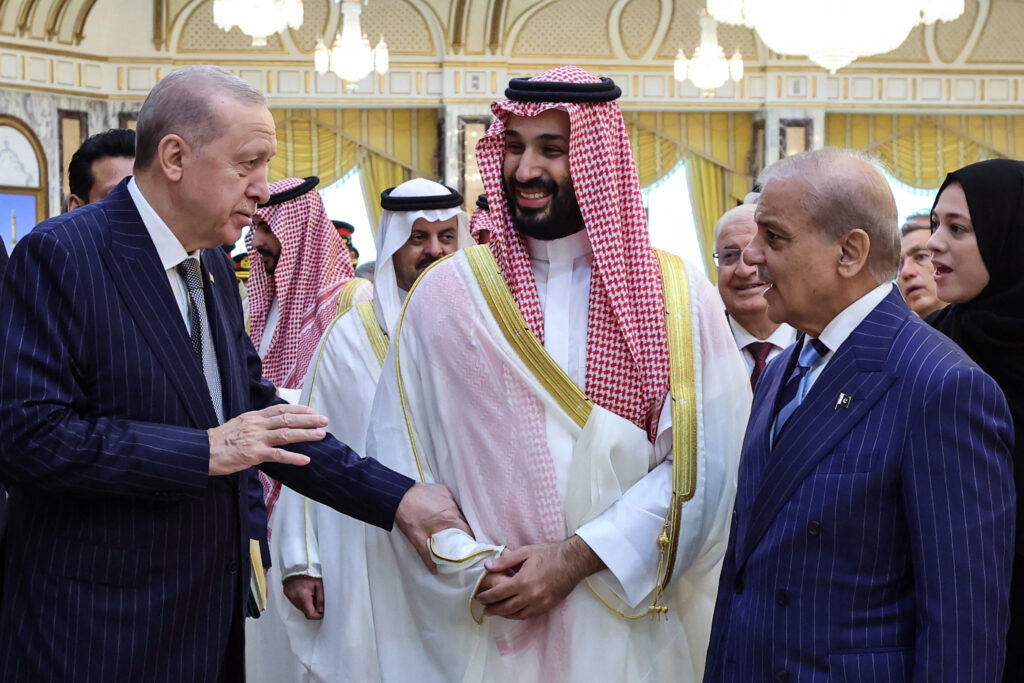
Last week, a minor geopolitical earthquake shook the Middle East. Saudi Arabia and Turkey — two nations that have been openly hostile toward one another for much of the last decade — pledged to go to war in each other’s defense. Along with Pakistan, they signed the Mecca Joint Defense Agreement, declaring, NATO-style, that an attack on one would be treated as an attack on all. Pakistan and Saudi Arabia have long had close security ties. But Saudi Arabia and Turkey have been bitter regional rivals, clashing over Qatar, Egypt, the Muslim Brotherhood and, most explosively, the murder of Jamal Khashoggi in Istanbul, which Turkish leader Recep Tayyip Erdogan appeared to blame directly on the Saudi crown prince, Mohammed bin Salman.
So what brought them together? President Donald Trump — or rather the two countries’ diminishing faith in him and his word.
The Iran war has been a master class in how to squander credibility. Recall that Saudi Arabia and Qatar both received security commitments from Trump only last year. But Trump’s word is as solid with his counterparts abroad as it was with his bankers in New York. He has repeatedly declared that a deal with Tehran was just days away. By mid-June, one tally counted at least 38 pronouncements that a deal was near or Iran desperately wanted one. Yet this week an Iranian source told Reuters that negotiations had made “absolutely no progress.” The world has learned to treat his Truth Social announcements as a mix of fact and fiction, like some of the AI-generated videos he posts.
The same pattern is visible in Europe. In May, Trump announced that 5,000 American troops would leave Germany and suggested more cuts were coming. The Pentagon then scrapped a planned deployment of roughly 4,000 troops to Poland. Days later, Trump announced that an additional 5,000 troops would go to Poland. Sometimes he threatens not to defend Europe against Russia; other times he says he will. Imagine being a European defense minister trying to construct a 10-year military plan around this.
Trump declared this week that the United States had “total control” of the Strait of Hormuz. Yet ship-tracking data recorded just 14 vessels transiting in one day recently, compared with more than 130 a day before the war.
This is not simply a matter of presidential style or rhetoric. It goes to the heart of American power.
For eight decades, the U.S. built up something as powerful as aircraft carriers and squadrons of F-35s: credibility. Allies believed American commitments would endure from one administration to the next. Adversaries understood that American threats, while sometimes exaggerated, carried real weight. The system was not perfect. Washington broke promises and made mistakes. But there was a broad presumption that the U.S. was a predictable actor and the president’s words meant something.
Trump treats promises and threats as if he is playing a grand game of bluff. But unpredictability is a very different thing in an alliance than in a real estate negotiation. If allies cannot know whether troops will arrive or leave, whether tariffs will rise or fall, whether an agreement signed today will survive until tomorrow, they do not become more obedient. They become more independent.
Countries are building insurance policies. Denmark chose the Franco-Italian SAMP/T air-defense system rather than the American Patriot. Canada is reconsidering its F-35 purchases. European governments are investing heavily in their own arms industries. South Korea has become the second-largest seller of arms to European NATO countries and is helping supply the Gulf’s air defense with systems cheaper than Patriots. The Dutch central bank has moved critical cloud services to a European provider to reduce dependence on American technology. And now Saudi Arabia, Turkey and Pakistan are constructing a security architecture of their own.
None of these moves by itself amounts to a rupture with Washington. But they show a deepening loss of faith in America’s word.
The same thing is happening with American threats. If Washington threatens tariffs, extracts concessions and then threatens tariffs again, governments conclude that accommodation does not produce safety. To paraphrase Canadian Prime Minister Mark Carney from earlier this year, if countries hope that compliance will buy safety, it won’t. So the rational response is to build alternatives.
Even Bibi Netanyahu did not take too seriously Trump’s proposals, curtly and summarily dismissing the American President’s 15 point plan for Gaza this week. He has seen many Trump plans announced with great fanfare, which are then quickly forgotten. Remember the Gaza Riviera plan?
This is how great powers decline — not necessarily through some dramatic defeat, but as others quietly stop organizing their world around them.
The U.S. remains immensely powerful. It has the world’s strongest military, frontier technologies, vast capital markets, formidable alliances and the dollar. But credibility is an asset too, painstakingly accumulated over generations and astonishingly easy to spend and squander.
During the Cuban missile crisis, President John F. Kennedy sent former secretary of state Dean Acheson to Paris to brief Charles de Gaulle on the discovery of Soviet nuclear missiles in Cuba. Acheson brought reconnaissance photographs to prove the case. De Gaulle, hardly an American supplicant, waved them away. He said he did not need the evidence. The word of the president of the United States was enough.
That scene is unimaginable today.
The post How to squander a superpower’s credibility appeared first on Washington Post.