LA GUAIRA, Venezuela — His mother, father and two sisters were among those entombed somewhere in the wreckage. He pitched a tent not far from the ruins of their former home.
“I’m not leaving here until they find the bodies,” vowed José Luis Villegas, 37.
Accompanying him was his wife, who held out hope for two missing brothers. “My mind is blank,” said Marianne Ramírez, 29. “I feel too much pain. How does one reconstruct a life lost?”
An ineffable sense of grief and uncertainty dominates the coastal state of La Guaira, the hardest-hit zone in the June 24 twin earthquakes — registering magnitudes of 7.2 and 7.5 — that pummeled Venezuela, leaving more than 6,300 dead. More than six weeks later, at least 1,300 remain missing, though there is no exact count.
Now, as international attention has shifted to Monday’s 7.4 magnitude temblor in neighboring Colombia, La Guaira presents an apocalyptic sense of bleakness: Flies drone above ubiquitous piles of rubble reeking of decomposition in the unforgiving tropical sun; dazed residents embark on doleful daily pilgrimages to mounds of debris in the faint hope of discovering the fates of the disappeared; empty beach chairs face the turquoise surf.
The rescue teams from across the globe that descended upon this strip of coast are long gone, as is international attention to the plight of La Guaira.
La Guaira, a sprawling region home to some 400,000 people, has long been a sun-splashed Caribbean retreat for residents of the inland capital, Caracas, a 40-minute drive away.
The quakes hit as La Guaira was marking the feast of San Juan, an annual celebration featuring the ritual beating of drums. It’s a chance to chill for the people of a nation — once among the richest in Latin America — that has endured more than a decade of economic meltdown, political turmoil and mass emigration.
But, shortly after 6 p.m. on June 24, the two powerful quakes struck just 39 seconds apart.
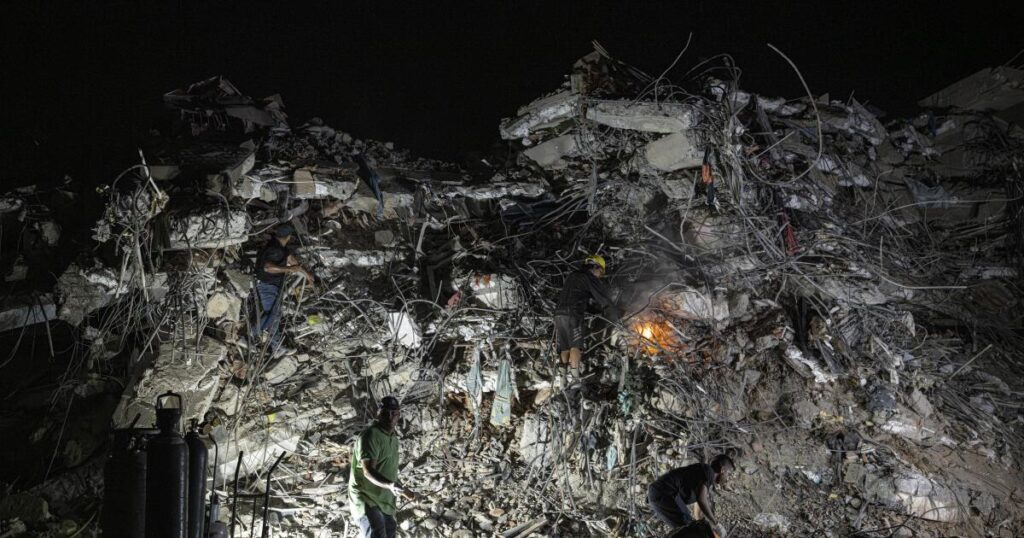
Hundreds of buildings — hotels, apartment blocks, mixed-use structures — collapsed or were damaged beyond repair.
The frantic search for survivors has long since yielded to the grim spectacle of excavators clearing ruins. Searchers in hazmat suits probe for corpses in mounds of cement, twisted rebar and the scattered detritus of everyday life. Many residents, like Villegas, squat close to destroyed homes, hopeful to be nearby when, and if, the remains of relatives are found.
Government and private aid personnel struggle to house and feed thousands of displaced residents now residing in camps and schools across the state and in the capital, also named La Guaira. Apart from material assistance, volunteers seek to provide some measure of emotional salve for the communal trauma.
“We don’t bring any material aid,” said Sandra Rodríguez, part of a volunteer group that organizes clown shows and other diversions, speaking at a golf course that has become an official homeless encampment. “We bring a hug, a smile, a sense of hope.”
That’s a challenge.
“It’s difficult to maintain hope amid so much tragedy,” said a nun from Mother Teresa’s Missionaries of Charity congregation, who was consoling survivors. “People ask: ‘Why did it happen to me? Why to us?’ They don’t have the answers. Nor do we.”
Venezuela’s acting president, Delcy Rodríguez, whose administration was widely assailedfor its desultory initial response, has made high-profile appearances in La Guaira. The U.S.-backed leader has touted Venezuela Renace (“Venezuela Reborn”), an expansive plan to build thousands of new homes.
Many Venezuelans are skeptical, given the government’s early inaction — and the $50-billion estimated price tag for repairs. Denizens of La Guaira also express fears that they will be forced to relocate far from a place where they have deep roots.
“If the government offers to move us from La Guaira, we won’t go,” said Carmen Gascón, 45, a teacher and mother of three whose apartment was rendered uninhabitable.
Now, Gascón — whose entire family survived — is among hundreds residing in a tent city in a large sports complex that includes facilities for soccer, basketball, volleyball and other sports.
“Any help will probably takes years to come,” said Gascón. “We will probably end up rebuilding homes with our own hands.”
She bemoaned the litany of Venezuela’s miseries. “This destruction comes on top of everything else — the low salaries, the inflation, the loss of opportunities … What can we do? Keep on crying? We cannot even cry with so much pain.”
Also found at the sports complex turned displaced-persons camp was Nelly Aparcedo, 71, a grandmother of 24.
The matriarch shares a sweltering tent with 18 others, mostly relatives, with eight minors among them. But she is thankful: Her entire family escaped, even though her apartment building collapsed. She ran outside as the shaking began, receiving only a wound on her leg.
Decades earlier, she had survived La Guaira’s signature calamity: The catastrophic 1999 flash floods that triggered massive mudslides from the Cordillera de la Costa, the verdant mountain range that forms a scenic backdrop for the state.
The death toll from the tragedy is estimated at between 10,000 and 30,000, though there is no official count; many victims were buried in mud or swept out to sea. The cataclysm is indelibly seared into La Guaira’s collective consciousness.
Aparcedo and her family spent three years in a shelter following the floods before being relocated to a public housing project — which toppled in the June earthquake.
“Everyone faces uncertainty,” Aparcedo said. “But we are alive.”
A landmark of sorts in La Guaira is El Rey del Pescado, a family-owned seaside restaurant that dates back almost seven decades. The venerable establishment was undamaged, but shut down amid the chaos.
Less than a month later, the owners decided to reopen, largely at the urging of the workers — who, like so many others here, were left without jobs.
“We have 18 employees, and many of them lost family members,” said Karina Ferreira, currently managing El Rey del Pescado. “The staff wanted us to open again.”
Ferreira, 29, is running the restaurant in the absence of her uncle. He is mourning the loss of his wife and much of his family in a building collapse.
“My uncle is in shock, he doesn’t want to have anything to do with this,” said Ferreira. “It was left to me to carry on.”
These are times that test one’s faith, said Father Robert Cardona La Rosa. On a recent Sunday, he officiated a packed Mass at the church of Saint Bartholomew the Apostle in Macuto, a city known for its seaside boulevard. Before the service began, a worshiper read aloud the names of some 200 parishioners who perished.
“We need time to digest what happened,” the priest said. “Thousands of lives lost, hundreds of homes destroyed. How to face this challenge? Right now there are more questions than answers.”
On Macuto’s largely empty beach, los pescadores who hawk fresh catch find few buyers these days.
“Whatever we don’t sell we donate to the schools and the camps,” said Roberto Oses Izaguirre, 42, a lifelong fisherman, now living with relatives after his apartment was destroyed. “It will take years to remove so much rubble, to rebuild. Maybe we won’t be alive to know what happens.”
But he can’t forsake the sea. “Fishing is all we know.”
He is also a survivor of the calamitous 1999 floods. Since then, he feels a sense of foreboding whenever dark clouds signal the onset of another storm.
“Here in La Guaira we are always afraid of the sky,” said Oses Izaguirre. “Each rainstorm is a reminder of the disaster. Nowadays, however, we also fear something else. The earth.”
Special correspondent Mogollón reported from La Guaira and staff writer McDonnell from Mexico City.
The post From deadly floods to twin quakes, a Venezuelan coast wonders how much more it can bear appeared first on Los Angeles Times.