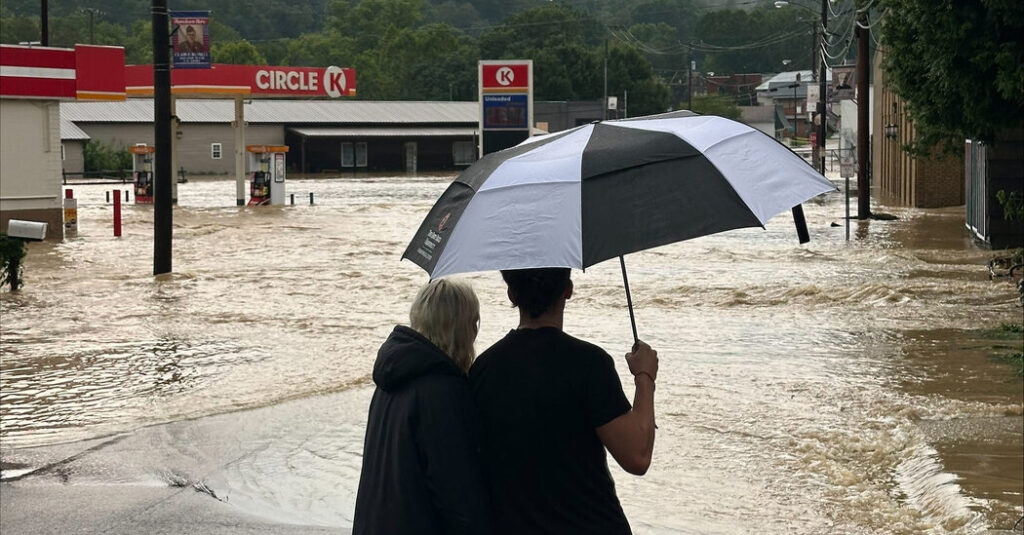
Roads collapsed into sinkholes in Indiana. Roofs tore off buildings in Illinois. Residents cried out for water rescues in Ohio.
A deadly storm system damaged and drenched large swaths of the Midwest and portions of the Mid-Atlantic this week, displacing people in several states and cutting power to hundreds of thousands of homes.
Officials across the region were still assessing the damage on Thursday — and in many places, the rain was still falling.
Some of the most extreme weather occurred on Tuesday, when a derecho — a group of intense storms that can travel hundreds of miles and generate powerful wind gusts — swept into the region. The strongest gust recorded on Tuesday was 99 miles per hour in Gary, Ind.
Here is what we know about the damage so far.
Some places had historic floods.
Across the Midwest, floodwaters surged into intersections, ruined highways and seeped into homes and cars. There were dozens of water rescues in several states, including Ohio, Pennsylvania and Indiana.
Some Indiana cities have measured almost a foot of rainfall since Monday. The National Weather Service office in Indianapolis had never issued a flash flood emergency — its most dire flood alert — until Wednesday. It issued the warning three times that day.
Floods hit several cities east of Indianapolis, including Anderson, Muncie and New Castle, inundating entire neighborhoods and forcing many schools to close. Floodwaters also washed away a piece of Interstate 70 in Indiana, closing westbound traffic near Wayne County on Thursday.
Dan Ridenour, the mayor of Muncie, said in a video address on Wednesday that the rain and floods were more severe than they had been in over a century. “This is a hundred-year event that we’re working our way through,” he said.
Gov. Mike DeWine of Ohio declared emergencies in two counties — Perry and Muskingum — and said at a news conference on Wednesday that the Ohio National Guard was helping with water rescues.
Indiana’s governor, Mike Braun, declared a disaster emergency for the entire state on Thursday.
Three people died in Indiana and Ohio.
Officials are still working to identify the number of people who died because of the storms. At least three deaths appear to be weather-related.
In Portage, Ind., one person died in an apparent home explosion. Storm damage on the roads slowed emergency workers, according to officials.
In Geneva, Ind., a 4-year-old boy died after a tree fell on his home, the Jennings County Sheriff’s Office said.
And in Roseville, Ohio, a person died after a health emergency because emergency workers could not reach the individual in time because of the storm, local officials said.
There have been injuries, too. A lightning bolt on Tuesday struck at a state prison in Grafton, Ohio, when eight inmates were returning from their evening meal, JoEllen Smith, a spokeswoman with Ohio’s corrections department, said in an email.
Sixteen inmates were hospitalized, Ms. Smith said, though most of them had returned to the prison by Thursday.
Overall, there were thousands of lightning strikes in the Midwest.
Strong winds knocked down power lines.
Hundreds of thousands of people lost power in the storms this week. Flooding was partly to blame, along with intense wind gusts.
The outages were concentrated in Illinois, Indiana and Ohio, according to Poweroutage.us, a site that tracks electrical problems. As of Thursday afternoon, more than 200,000 customers were without power in Indiana, as well as more than 90,000 in Ohio and more than 60,000 in Illinois.
In addition to the strong gusts across the Midwest, there were at least five tornadoes in the Chicago area on Tuesday, according to the Weather Service, all along the southwestern edge of the city.
The tornadoes knocked out power for homes, schools and churches. They ripped trees from the ground and tore roofs from houses. And they left debris scattered all over the grounds of a suburban concert venue in Tinley Park, Ill.
This weather pattern is stubborn.
The risk of thunderstorms — and at least some flash flooding — in the region continued on Thursday, while a persistent heat dome affected parts of the south-central United States.
The greatest potential for excessive rain was across central Indiana and in small portions of Ohio and Kentucky, and that possibility will linger into Friday, forecasters said. In some places, rain could fall at a rate of up to three inches per hour — a situation made more dangerous where the ground is already saturated.
Ishani Desai, Amy Graff and Judson Jones contributed reporting.
The post What We Know About the Storms Battering the Midwest appeared first on New York Times.