Kelly Holley-Bockelmann had always oriented herself by looking up at the sky, but now it was tilted and unfamiliar. The Milky Way sank toward the horizon line, and darkness never arrived quite the way it had in Tennessee, fast and enveloping. Instead, there was hazy dusk and then stubborn twilight before the sun rose again over her extended-stay hotel thousands of miles from home.
She took a tram, then a train, then a bus until she arrived at a glass-walled building in the Netherlands. There was a Dutch flag near the entryway and a replica of a spaceship in the lobby. She rode the elevator to her new office, a small room with whitewashed walls, empty drawers and a handwritten note taped to the desk. “We are thrilled to welcome one of America’s great scientists,” it read.
A new colleague stopped at the doorway to check in on her. “I know it might not look all that impressive,” he said, gesturing around the office.
“It’s perfect,” Holley-Bockelmann said. “After these last few years, I’m just so grateful to be here.”
She had never expected to be starting over halfway across the world at age 55, just as she reached the pinnacle of a career that was often celebrated as uniquely American. She’d grown up in Montana, lying in the grass beneath the night sky and trying to feel the Earth spin. She dreamed of becoming an astronomer before she knew the word for it. Nobody in her house growing up had finished college. She’d never met a scientist. But she made herself into a theoretical astrophysicist, a leading expert on gravitational waves, a top adviser to NASA, and a chaired professor at Vanderbilt. She helped begin a new graduate program for astronomers and raised millions in federal money to recruit American scientists with backgrounds as unlikely as her own, only to watch that pipeline be dismantled piece by piece.
Her research funding was threatened after President Trump took office in 2025. Graduate students were squeezed out of the field. The space observatory that had become her life’s work was marked for elimination in the federal budget, twice. One by one, the scientists around her did the math and chose to leave, until she decided to move to Europe with a husband who had just become an American citizen and two teenagers who had spent their childhoods in Tennessee. She had devoted her career to studying the most violent events in the universe as galaxies merged and black holes collided, sending gravitational waves rippling through space for billions of years. Now the disturbance was closer to home, and she was still measuring the damage.
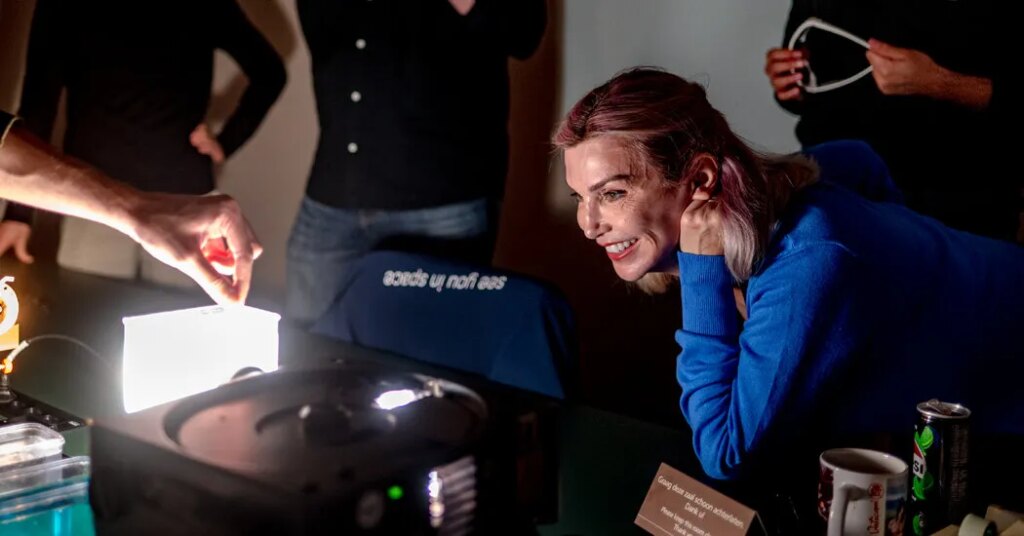
She left her office and walked down the hall to meet with a few co-workers at the Netherlands Institute for Space Research. She was the most established scientist in the room, but she fetched everyone coffee and sat back from the table, trying to disappear into the group despite her dyed pink hair and a vocabulary shaped by years in Tennessee.
“OK, y’all, where are we right now with LISA?” she said.
It was the question she’d been asking for more than a decade. LISA was a space observatory scheduled to launch in 2035: three spacecraft linked across millions of miles, using lasers to listen for gravitational waves. Scientists hoped it could detect signals from the universe’s earliest moments, beyond the reach of any telescope. In work for similar missions, American scientists had invented technology behind the camera sensors, lasers and satellites the country and its military came to depend on. The project was meant to be a collaboration between the United States and Europe, but the United States had fallen behind because of staffing and budget shortfalls at NASA. Trump had repeatedly tried to eliminate funding for the program, and Europe was making contingency plans to save the mission rather than cede a new frontier of physics and a generation of scientific advances to a similar project from China.
“I hate to say it, but right now America can’t be counted on as a full partner,” one scientist said. She glanced over at Holley-Bockelmann and winced. “Sorry,” she said. “The trust just isn’t there at the moment.”
“Please,” Holley-Bockelmann said. “I know it’s a mess. That’s why I’m here.”
“Maybe the system will recover,” another scientist offered.
Holley-Bockelmann shrugged. “I don’t recognize the place anymore,” she said. “Every lever I knew how to pull was just gone. I’m still trying to understand it.”
It had taken almost two decades at Vanderbilt for her to help build a program that was a national model for training astronomers, with more than 20 students who’d come from tech jobs in California, historically Black colleges or graduate programs around the world. They gathered in their Nashville lab for daily meetings named after Einstein’s equations and a weekly happy hour called ringdown, named for the final tremors of two black holes becoming one. The students sometimes referred to their program as its own solar system, and Holley-Bockelmann was the sun. She gave a TEDx talk in a dress adorned with purple gravitational waveforms and often described the sky as “almost holy, like a religious experience.”
Then came the day after Trump’s election in 2024, when she flew to Washington for a meeting as the chair of NASA’s Astrophysics Advisory Committee. She brought along one of her graduate students, a black-hole researcher named Kamara Culbreath who dreamed of working for NASA. Holley-Bockelmann was leading the group through a review of Trump’s campaign promises to cut federal funding and roll back diversity programs when Culbreath pulled her aside during a break. He showed her a text message on his phone from an unknown number, one that had been sent anonymously to dozens of other Black students at Vanderbilt and other universities.
“Good afternoon, you have been selected to pick cotton at the nearest plantation,” it read. “Masters will pat you down before entry. Make sure you pack some sturdy shoes.”
Holley-Bockelmann walked away from the meeting and forwarded the message to Vanderbilt’s administration and then the police.
“Where do I go to report a racial attack?” she wrote. “Do we have a protocol for crisis response?”
Trump was sworn into office a few months later, and it seemed to Holley-Bockelmann that crisis response was her new job. The federal government froze active grant payments, which many of her students depended on for living expenses. She wrote to the National Science Foundation for advice, but her emails bounced back. A few of her international students stopped coming into work for fear of immigration enforcement, and Culbreath moved out of state to finish his research remotely. Another early-career researcher had a panic attack, booked an overnight flight and then called Vanderbilt the next morning to say he’d permanently returned home to Santo Domingo.
Every few days, Holley-Bockelmann opened another all-caps email from colleagues about “an EXTINCTION level scientific event.” The administration threatened to cut funding for NASA’s science programs by as much as 47 percent. It took over the National Science Foundation’s headquarters in Alexandria, Va., on one day’s notice and gave the building to another department. Holley-Bockelmann scrambled to comply with Trump’s executive orders against diversity programs, changing the name of one Vanderbilt program from “Inclusive Training” to “Interdisciplinary Training,” and scrubbing grant applications of flagged terms like “gender,” “barriers,” “race” and “historically.”
She made several trips to lobby in Washington and organized media campaigns with other scientists, but the footholds she once used for support were disappearing. NASA’s advisory committee on astrophysics was disbanded. Vanderbilt’s chancellor, one of the country’s leading advocates of “institutional neutrality,” largely avoided criticizing the administration, even as cuts reached his own campus. It was increasingly left to Holley-Bockelmann to email her students with a running log of the program’s deterioration.
“I’m flip-flopping between rage and despair, with a side of determination.”
“We haven’t been shut down (yet).”
“Anxiety, depression, stress, fatigue …”
“Please take care of yourselves and others.”
“I’m spending the morning deploying mental health crisis teams.”
She arranged free counseling sessions for students and reserved space in their building for yoga, crochet, puzzles and therapeutic art. For the first time in her life, she didn’t have energy for science. Instead, she found herself gravitating to diamond art, sticking hundreds of dots onto a piece of paper and following a mindless pattern until her brain went numb.
Several months into Trump’s term, a colleague asked Holley-Bockelmann to speak at a conference for young astronomers. There was no money to pay for the flight, so she agreed to appear onscreen. She had won national mentorship awards as one of the best recruiters in American astronomy, but now some of the top astronomy programs were cutting graduate slots and the federal government was eliminating tens of thousands of scientific jobs. She worried that she was becoming a huckster, luring students into six years of training for heartbreak and dead ends. She opened her presentation by showing a photograph of herself, head down, her hands on her temples.
“How can we stay afloat?” the caption read. “How can I lead our community when I’m so enraged? How can I continue to do the work that I love?”
Marcel Levi followed what was happening in the United States and called his team together at the Dutch Research Council in the winter of 2025. He had friends at the National Institutes of Health and the Centers for Disease Control and Prevention who were losing their funding, their labs, their jobs.
“It’s a tragedy for them, but a once-in-a-lifetime opportunity for us,” Levi said.
He’d gone to medical school in the Netherlands in the 1980s and then watched many of his classmates move across the Atlantic. No country at that time spent more than the United States on research and development, and Levi found it difficult to do serious work anywhere else. He flew to Atlanta and Washington several times every year to study cardiovascular disease and blood clots in labs that were better than his own.
But Europe and Asia had begun to catch up. A few months after Trump’s election, Levi saw a poll of 1,600 U.S.-based scientists published in the journal Nature in which 75 percent of respondents said they were considering leaving the country. As president of the Dutch Research Council, Levi proposed setting aside €50 million to recruit some of them. The Netherlands named the program the Tulip Fund, after a flower the Dutch had imported from the Ottoman Empire four centuries earlier and then made their own.
“The roles have been partially reversed,” Levi said when the program began in July 2025. “Some of the brain drain is now moving the other way.”
More than a dozen other countries landed on a similar idea, starting programs to poach American scientists. There was APART-USA (Austria), Safe Place for Science (France) and Canada Leads. The European Union set aside $560 million. South Korea promised a fast track to citizenship.
The Tulip Fund offered Dutch institutions up to €1 million per recruited scientist, paid out over five years. The first selections included 29 Americans from places like Yale, Stanford and the National Cancer Institute. They specialized in everything from Alzheimer’s to artificial intelligence, and soon there was a job posting circulating on the American Astronomical Society’s website.
Gravitational wave specialist. Forty-two days vacation. Supporting the LISA mission as part of an “inclusive work force” that valued “collaboration” and “diversity.”
“We are looking for you!” the posting read.
Holley-Bockelmann saw it in Tennessee and showed the ad to her husband, Andreas Bockelmann. The position would require a pay cut. Andreas would need to quit his job as an automotive engineer. They had a house they loved and two teenagers who didn’t want to move. Their daughter was starring on her basketball team. Their son had special needs and thrived on routine.
As they weighed the possibility, Andreas became a citizen decades after arriving from Germany with a green card. He stood with dozens of immigrants early in Trump’s term, listened to “The Star-Spangled Banner” and recited the Oath of Allegiance. An official handed out American flags and played a video message from Trump. “Today you receive one of the most precious gifts ever granted by human hands,” Trump said, as Andreas looked at his family and wondered about the country they were inheriting.
Trump’s tariffs had upended his automotive work. Their children were both adopted from Asia, and lately Andreas had heard reports of state troopers pulling over people based on how they looked. His wife was happiest when she was immersed in science, and she hadn’t run a simulation in weeks.
He told his wife he was ready to move late last year, but she spent weeks going back and forth. “It feels like giving up,” she said. She hated the thought of abandoning her students and leaving the hardest problem of her career unsolved.
“I’m going to have survivor’s guilt,” Holley-Bockelmann said. “Is it worth rearranging our whole lives?”
“It makes more sense than staying here,” Andreas said.
Two months into her new job, Holley-Bockelmann crowded around a computer screen with a few other scientists to watch a simulation of the LISA launch. The mission wasn’t scheduled until 2035, but one of her colleagues had spent the weekend making a digital re-creation. He clicked a button and they watched three spacecraft lift out of French Guiana, escaping Earth’s gravity and flying past the moon. The spacecraft settled into formation about 31 million miles from Earth and exchanged laser beams across the darkness as a ticker of theoretical discoveries accumulated onscreen.
The simulation picked up the steady hum of tens of thousands of burned-out stars, each about the size of Earth but so dense that every spoonful of matter weighed several tons. The lasers registered signals from black holes colliding billions of years in the past, and small black holes falling into giant ones, tracing a hundred thousand loops before they vanished. The simulation reached back to the first million years after the Big Bang, behind the wall of hot fog that had blocked every telescope ever built.
“God, can you imagine?” Holley-Bockelmann said. “I want to know how the first black holes were formed.”
“The first stars, the first galaxies,” said Nora Lützgendorf, the lead project scientist for LISA. “And then we can look forward to all the real discoveries — the stuff we don’t even know how to anticipate or predict yet.”
“How am I going to wait another 10 years?” Holley-Bockelmann said.
Lützgendorf, a 41-year-old German scientist, knew what it meant to wait. She’d spent seven years in the United States working on the James Webb Space Telescope, the largest telescope ever sent into space. NASA had hoped to launch it in 2007, but the mission endured years of manufacturing delays, budget fights, testing failures and finally Covid. It lifted off on Christmas Day in 2021, and Lützgendorf waited another six months for the first images. One revealed hundreds of new stars emerging behind towering cliffs of rust-colored gas in the Carina Nebula, 7,600 light-years from Earth. Lützgendorf tried to call over a colleague to look, and the words caught in her throat.
“I couldn’t breathe,” she said. “I’d spent 10 years imagining these amazing discoveries, and then they were so much better than I thought.”
“Like we could finally see,” Holley-Bockelmann said.
“Yes, exactly,” Lützgendorf said. “I had a little telescope as a kid, and it was like that magical first moment when I got the moon into focus.”
“The glow. The sharp edges,” Holley-Bockelmann said, because she also remembered the feeling of being transported into the sky. Her parents were busy looking straight ahead at the problems of the next day, the next bill, the next job that kept them moving from town to town across Wyoming and then Montana. Meanwhile, she was studying constellations, reading Carl Sagan and writing letters in high school to European observatories to ask for obscure coordinates of black holes.
Each new fact opened into something larger: that the Earth was part of a Milky Way galaxy of a few hundred billion stars; that beyond the Milky Way there were as many as two trillion more galaxies in the observable universe; that most of the atoms in her body were forged inside stars that had died billions of years before the sun came to life. She tried to understand the vastness of space-time by imagining the history of the universe laid out across a 100-yard field. The Earth was born at the 67-yard line. Complex multicellular life formed after 96 yards. Apes began to walk upright in the final two inches. And all of human civilization — the end of the ice age, the birth of agriculture, every war and every empire — had come in the last three thousandths of an inch.
And then she became an astronomer, and what astonished her wasn’t just the universe but the scientists around her, humans pressed against the goal line who had somehow learned to map most of the field.
“LISA will finally give us the whole sky,” Holley-Bockelmann said.
“There are so many secrets hiding out there,” Lützgendorf said. “But 10 years is a long time to wait. People get bored, distracted. That’s where some of our work comes in.”
Germany was building the spacecraft. France and Italy were developing telescopes in case the United States failed to deliver. Lützgendorf and Holley-Bockelmann were building a scientific community in the Netherlands that would be ready for the data. America’s participation was still uncertain, but Holley-Bockelmann had already decided where she would be in 2035. She hit a button on her computer and started to play the simulation again.
Late afternoon in the Netherlands was morning in Nashville, and her graduate students would be waiting. She was still advising more than a dozen of them, so every evening she went back to her hotel and logged in for a second shift. Her family would join her in a few weeks. For now, there was her suitcase in the corner and a single box of crackers in the kitchenette. She filled a wine glass with orange juice, opened her laptop and waved as the first face came onto the screen.
“How’s your crazy new life?” Riddhi Patel, 24, asked.
“Is it awful of me to admit that it’s amazing?” Holley-Bockelmann said. “It’s sunny. There’s science happening, and I’m finally getting to do some of it again. What’s new with you?”
“Mostly trying not to stress out,” Patel said. She was finishing a master’s through a partnership between Vanderbilt and Fisk University, the historically Black college in Nashville. For two decades, the program had placed 85 percent of its students into Ph.D. programs. But now funding was precarious and Ph.D. slots were disappearing. No astronomy student had bridged from Fisk to Vanderbilt in two years.
“I’m getting ready to apply to like 20 places, but maybe that’s pointless,” Patel said.
“What’s unfair is it’s not about you,” Holley-Bockelmann said. “It’s the whole situation. Sometimes, I wish I’d stayed to fight, but I just couldn’t anymore. I’m sorry.”
They workshopped one of Patel’s papers, and then Holley-Bockelmann refilled her orange juice and clicked over to her next meeting. One by one, the students she had helped recruit into astronomy appeared on her screen.
“Maybe I’m just meant to be a math teacher,” one said.
“Is there even a job market anymore?” another asked.
She listened to their questions and anxieties until dark and carried them with her into the next day as she drove west with a colleague toward the beach. The astronomical calendar called for a partial solar eclipse, an event that had inspired awe and terror across human history. Maybe a celestial dragon was eating the sun. Maybe a corrupt emperor had angered the gods. People played drums or shot fiery arrows into the sky to reignite the sun as generations of early scientists began tracking the pattern, calculating the numbers and finally solving the mystery. Now Holley-Bockelmann stepped onto the sand with thousands of other people, put on her cardboard eclipse glasses and looked up over the North Sea.
She watched the moon march across the sun, leaving just a sliver of orange in the sky. The temperature dropped. Light drained from the water. The crowd went silent. She waited as the Earth kept turning and the moon continued its course until light flooded back across the beach.
Produced by Jeffrey Furticella and Umi Syam.