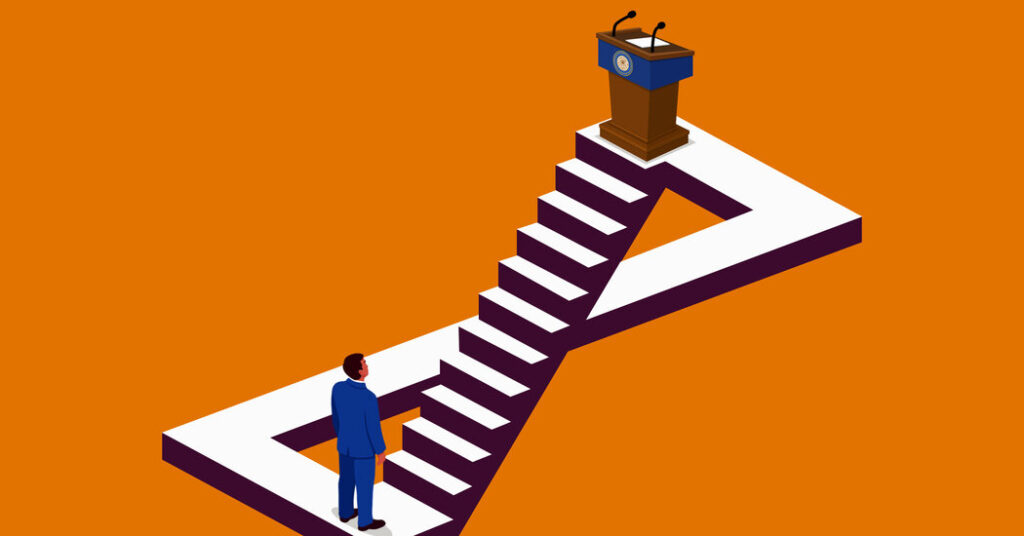
Some readers may recall the misery of rampant stagflation in the 1970s. The fusion of inflation and stagnant economic growth destroyed millions of jobs while eroding virtually everyone’s purchasing power, ensuring there was no escape from economic pain for most Americans. Now, stagflation is returning after decades of dormancy. How pervasive will it become?
The person most responsible for answering that question is the Federal Reserve chairman, Kevin Warsh. The newly installed chair won his job by convincing President Trump that they shared similar perspectives on lowering interest rates, a move almost guaranteed to boost the economy in the short term, even if it risks economic calamity down the line. If history offers any guidance, how Mr. Warsh responds to Mr. Trump’s demands will have major repercussions on our future.
There’s no doubt that stagflation has returned. Inflation remains elevated, with July’s reading, released Wednesday, coming in at 3.4 percent year-over-year. Simultaneously, the economy is showing more and more weakness, with gross domestic product growth slowing to 1.5 percent in the second quarter of this year. The job market has slowed. The housing market has stalled. And, of course, oil prices remain elevated. This is a classic case of a lackluster economy with problematic inflation.
The part of the economy that looks notably good is the part that should worry us the most: Our stock market is at a record high, with valuations for some shares reaching fantastical levels. While corporate earnings growth is strong, the multiple that the market is paying for those earnings is now two and a half times greater than the historical average — a sign that investors’ irrational exuberance has taken hold. Such elevated valuations introduce severe systemic risk, leaving equity markets very sensitive to macroeconomic disturbances and threatening a destructive decrease in wealth.
Mr. Trump points to the stock market as proof the economy can absorb rate cuts. But the outcome of such a monetary policy is deeply concerning. Bringing borrowing costs down encourages market participants to take on excessive leverage, pushing valuations that are already above historic norms even higher, increasing the risk of a financial meltdown. And that would, in turn, make stagflation much worse.
This is where the 1970s provides a lesson in what the Fed should not do. In the 1970s, like today, the U.S. was at war and running fiscal deficits. Then, as now, oil prices were pushed up by external factors. Five decades ago, it was the Arab oil embargo and the Iranian revolution. Today, it’s the Iran war and the closing of the Strait of Hormuz.
The parallels don’t end there. President Richard Nixon pressured the Fed chairman, Arthur Burns, to goose the economy to strengthen himself politically, just as Mr. Trump is pressuring Mr. Warsh to slash rates. Mr. Burns — who, like Mr. Warsh, also faced the prospect of a sluggish economy — followed Nixon’s lead and elected to rapidly and dramatically push interest rates lower, ignoring the fact that inflation was already elevated. Of course, this boosted economic growth and employment for a while, raising Nixon’s fortunes and helping lead him into a landslide victory in the 1972 election. But the chain of events leading to devastating stagflation had begun.
The suffering caused by Mr. Burns’s poor policy choices was widespread, reaching nearly every American household. Wages did not keep pace with inflation. Prices for everyday items like food and clothing soared, and families had to work harder each year to keep up. Investment returns were overrun by inflation, eroding the savings of retirees. By 1975, inflation had hit 12 percent, and unemployment climbed to 9 percent.
Yet the full costs of the stagflation were not clear until Paul Volcker took over as Fed chair in 1979. To rein in inflation, Mr. Volcker pushed the Fed Funds rate to over 20 percent (compare with 3.6 percent today). This drove mortgage rates up to almost 20 percent, cut the rate of new housing development in half, and triggered the loss of two and a half million jobs. Mr. Volcker received enormous pushback from the public, from Congress, and from then-President Ronald Reagan, but he persisted.
Mr. Volcker was able to act independently of political expediency. Eventually, his tough medicine worked, reducing inflation from 14.8 percent in March 1980 to under 3 percent in 1983, as measured by the year-over-year Consumer Price Index. During this period, the U.S. economy went through a profound restructuring, shifting away from old-line manufacturing toward a more resilient, service-oriented and technology-driven economy that persists to this day.
Today, all the pieces are in place for a repeat of Mr. Burns’s mistake, one that caused undue hardship on the country. Today’s economic setting is not as dire as the one he faced, but the conundrum Mr. Warsh faces is the same: A weakening economy could tempt him to ease interest rates before the inflation fight is over.
Of course, Mr. Trump’s pressure campaign puts Mr. Warsh in a difficult position, forced to choose between what the economy needs and what the president wants.
The lesson for Mr. Warsh to remember is that the longer the Fed accommodates inflation, for whatever reason, the more costly the eventual cure. He must ensure the Fed stays independent from politics and keep the inflation fight going, raising interest rates if necessary, even over the objections of our president.
Stagflation has arrived. Will Mr. Warsh keep up the inflation fight, or will he appease Mr. Trump? The midterms are coming, and with them the temptation to boost the economy now. While acting independently today might mean Mr. Warsh receives ridicule and rebuke from Mr. Trump, the consequences of not doing so are far worse.
Phillip Braun is a clinical professor of finance at Northwestern University’s Kellogg School of Management.
The Times is committed to publishing a diversity of letters to the editor. We’d like to hear what you think about this or any of our articles. Here are some tips. And here’s our email: [email protected].
Follow the New York Times Opinion section on Facebook, Instagram, TikTok, Bluesky, WhatsApp and Threads.
The post Stagflation, the Scourge of the 1970s, Is Back appeared first on New York Times.