Until Wednesday, I had never photographed a solar eclipse. But I knew that pointing my lens toward the sun at any time during partiality risked frying the sensor on my camera — and my eyeballs.
I was in the town of Castrillo de la Reina in northern Spain, which was in the path of totality, not to shoot the celestial event itself but to photograph the earthlings watching it. As I took images of people gazing skyward through the safety of protective glasses, the daylight gradually faded into a majestic coppery hue, and partiality began.
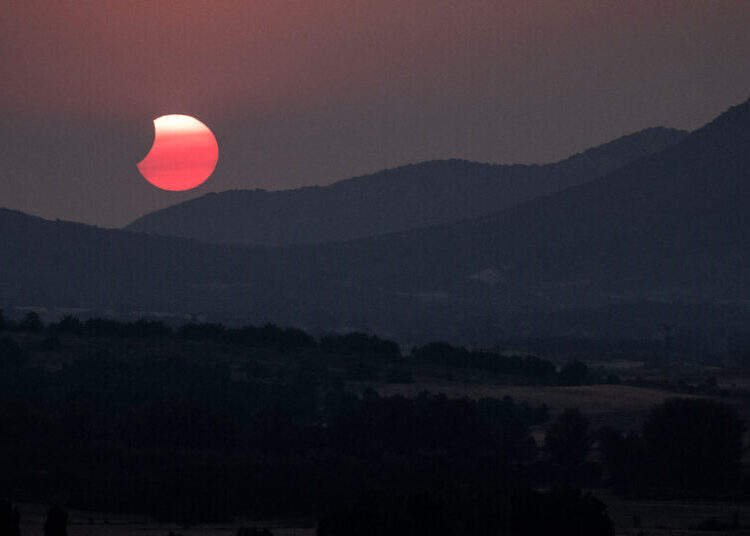
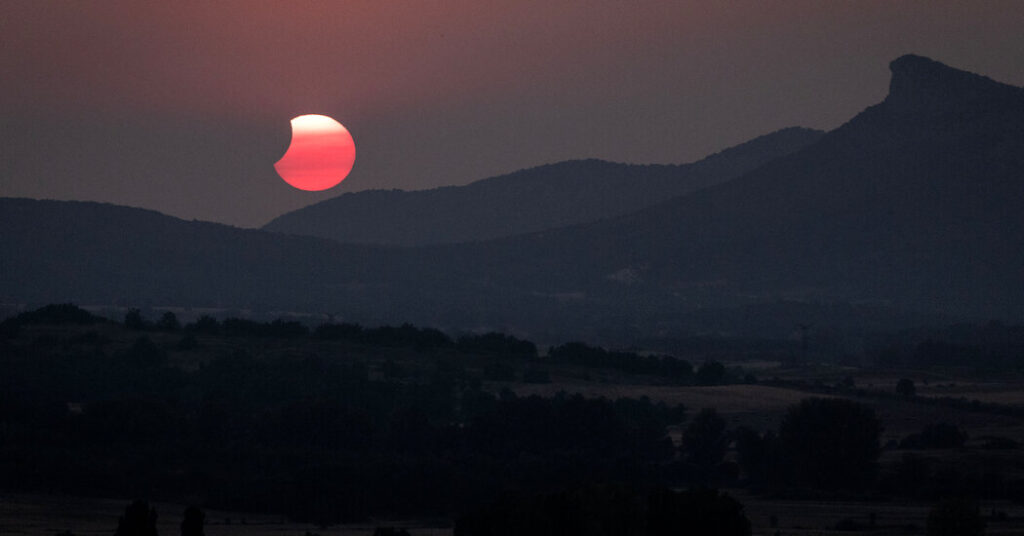
I decided to see if I could capture the eclipse, though I was sure I couldn’t do it justice. Photographing a solar eclipse requires careful planning, a solar lens to protect the camera and a tripod to stabilize the shot. Because I was there to photograph spectators, I didn’t have any of that. But I had brought a midrange 70-200mm telephoto zoom lens. My usual lens is around 28-35 mm, but these longer ones are used to photograph sporting events — or in this case, a celestial event.
As totality took effect, I turned to look upward during the one minute and 45 seconds in which the event could be safely viewed with the naked eye (and with a camera lacking a solar lens). I aimed my camera toward the heavens, underexposing to highlight the sun’s corona effect around the moon’s outline. Just to be safe, I composed the shot looking at my camera’s electronic screen rather than through the viewfinder. The flaming halo around the moon was breathtaking, a surreal spectacle that felt like looking through a portal into another dimension.
I snapped a few shots during totality, and then a couple more just as the sun emerged from behind the moon, creating a “diamond ring” effect with a sparkling glow on one side. To my surprise, both shots worked, providing a dramatic contrast to the scenes of entranced onlookers.
I tried to file the images to my editors from the hilltop I was standing on, but the signal was too weak. So I ran down to the village square. It was pretty chaotic: There was a D.J. party filled with onlookers, many of whom were using the precious service to upload their own pictures to social media. I ducked into the town hall to get Wi-Fi and began to transmit the images. Normally, a photo takes one or two minutes to send. Because service was weak, these images took up to 15 minutes each. (And I sent 18.) Luckily they got to my editors in time to land on the home page of The Times and in the live blog.
It was a magical moment, but if I ever have another chance to witness a solar eclipse, I may leave my cameras at home to fully enjoy the rare spectacle.
The post My Lens! My Eyes! What Not to Do When Photographing a Solar Eclipse. appeared first on New York Times.