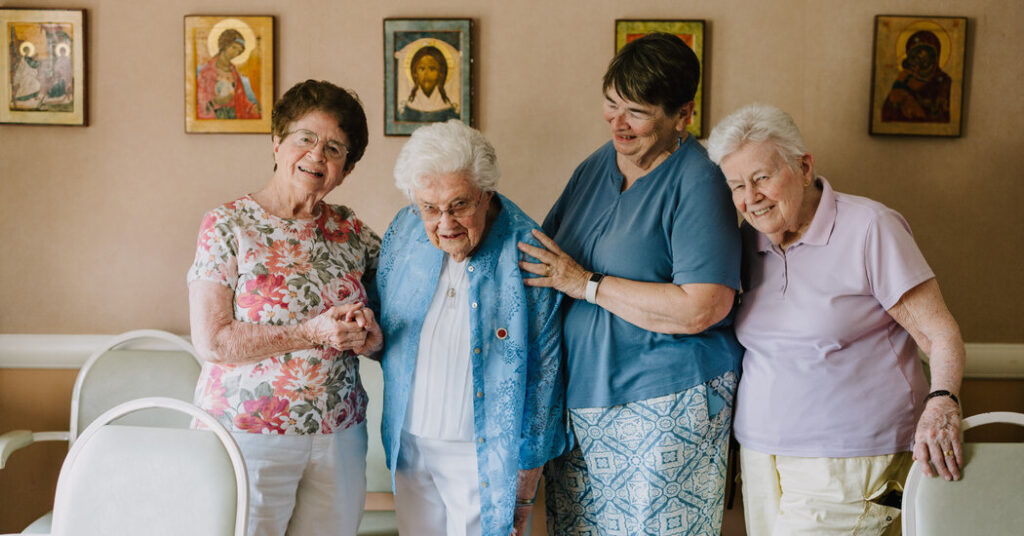
It was happy hour at the assisted living building, with snacks and a live entertainer, and Sister Stephen was doing her best to be happy. She clapped along to “Hello, Dolly!”
About 20 women and one man sat in a brightly lit activity room, some in wheelchairs. Here, happy hour comes every Friday at 2 p.m.
“You’re a sister?” a woman asked Sister Stephen. “You don’t look like a sister.”
“Well, what does a sister look like?” the sister asked. The woman did not have an answer. What does a sister look like?
“I’m going to get up and dance in a minute,” Sister Stephen said. At age 96, after two knee replacements, she is limited in her dance steps. But get up she did, using her walker for support, and swayed to “Save the Last Dance for Me.”
Still, she felt something was missing. For starters, there was no white wine.
“Only red,” said Sister Mary Martin, taking orders around the room.
But more than that, where were all the other sisters?
Sister Stephen looked around the room with some bafflement.
“It’s funny,” she said, surprised by what she saw. “Most of the people in this room now are not nuns.”
Because usually, she said, there were more. A lot more. Through a confluence of forces, the center has become one of the last places in New York where you can find an abundance of nuns.
In the mid-1960s, America was home to more than 180,000 Roman Catholic nuns; now there are only about 35,000, with an average age of over 80. Congregations have had to sell or close their convents, forcing these older sisters to find new places to live.
For many in the New York area, that has turned out to be an unlikely place: a Lutheran care center called Wartburg. Founded in 1866 as a farm school and home for Civil War orphans, the center spreads across 34 acres in Mount Vernon, N.Y., with care options ranging from independent living to skilled nursing and memory care.
Since the first wave of about 30 nuns from the Dominican Sisters of Hope, a congregation in Newburgh, N.Y., arrived in 2009, the number of sisters in the center has swelled to about 80, more than one-third of the residents.
“When the cardinal was here last year,” said David Gentner, the president of Wartburg, “he said there’s more consecrated women religious on this campus than anywhere in the archdiocese.”
The sisters at Wartburg, now mostly in their 80s and 90s, belong to a cohort of women who took their vows in the decades after the World War II in numbers never seen before or since. It was a boom time for American religion, when churches saw record attendance and the words “under God” were added to the Pledge of Allegiance. The sisters staffed schools and hospitals and social service providers; they marched for peace or against hunger. And they watched their numbers steadily diminish in the following decades, as fewer and fewer women followed them.
Now, as they navigate their own final chapters, they are also contemplating the end of their congregations, a process known as coming to completion. And they may be witnessing the end of sisterhood itself.
“In 10 years, children will not know what a nun is — was,” Sister Stephen said, correcting herself. “They’ll be gone.”
Yet to spend time among the sisters at Wartburg is to see a promising vision of old age: collective, purposeful, grounded in service to others — and above all, accepting of change. Having long ago taken vows forsaking so much of the world’s strivings, the sisters are perhaps uniquely prepared for the losses and separations of old age.
“Even just the fact of an elevator, we’re not used to,” said Sister Stephen, who ran a Catholic school for 59 years before she retired last year at 95. It was a warm March afternoon, and her small studio apartment in Wartburg’s assisted living building was decorated in paper shamrocks for St. Patrick’s Day. “I never lived like this before, to be honest,” she said. “I mean, three meals a day, your apartment is cleaned. I never had all this before. In fact, there’s too much, I say sometimes. But it’s OK.”
On a recent evening, the sister, whose full name is Mary Stephen Healey, had a question about the other sisters at Wartburg. She was talking with four members from her congregation, the Religious of Divine Compassion, or Sisters of Divine Compassion. The congregation, which once had almost 300 sisters, now has only 40, with a median age of 84, and no new novices entering. Of the 40 still living, 23 are at Wartburg.
The reason so many were missing from the happy hour, it turned out, was that they were at a funeral.
The “Divines,” as some at Wartburg have called them, had never lived among sisters from other orders. Now their neighbors at the center included sisters from seven other congregations, as well as lay people.
“How do you think we’re perceived here by the rest of the sisters?” Sister Stephen asked.
“I think we’re kind of an outgoing, very compassionate, social, fun group,” said Sister Mary Alice O’Brien, 81. Sister Mary Alice described herself, playfully, as “a high introvert.” She has a reputation as a particularly spirited presence at happy hour. “Truthfully,” she said, “I think we’ve brought life to the place.”
All insisted that there was no rivalry, friendly or otherwise, among the orders.
Absolutely not, Sister Stephen said. “Though I do think we’re unusual.”
The Sisters of Divine Compassion were founded in 1886 to serve the population of poor immigrant girls, many Irish or Italian, then arriving in New York City. Later the order shifted its focus to education.
Sister Stephen, whose name at birth was Clare, was born in the Bronx and attended Catholic schools, though she was asked to leave kindergarten after throwing peas at a nun. “I was always in trouble,” she said, not contrite at the admission. After her mother died when she was 10, she moved to a boarding school run by the Sisters of Divine Compassion in White Plains, N.Y.
She entered the order and moved into the convent at age 18, she said, because she was so moved by the sisters who taught her, and started teaching before she even finished college, a common practice in the 1950s and ’60s. As she taught, she returned to school for a bachelor’s degree and then a master’s.
When she arrived at Wartburg last July, she had a ready-made community of women who shared her experience and her congregation’s charism, or founding mission. Across the hall was Sister Joanne Fallon, 86, who worked with Sister Stephen for more than 50 years, teaching first and then fourth grade. They had retired together last spring, the last two sisters in their school, and the last two at the convent, which the order was turning into a community center.
For Wartburg, the influx of sisters has been a plus, said Mr. Gentner, the president. They’re the unpaid outreach workers, social hubs in a center where isolation and despair are always risks. Many only recently stopped working; Sister Stephen still teaches Spanish at her old school, driving there three days a week over two heavily trafficked highways. “They’re vital, they’re educated, they’re service-oriented,” Mr. Gentner said.
What they do is not dramatic, but in a community of older adults who have had to leave their homes and neighbors, a commitment to service and compassion can go a long way.
Sister Mary Martin Delahanty, 87, who worked as a teacher and school principal until she was 81, makes a point to welcome all new residents and visit those who are bedbound or frail, offering Communion and companionship. She serves drinks and snacks at happy hour.
Three years ago, other sisters from her order, the Dominican Sisters of Hope, urged her to move to Wartburg. “I said, Who’s paying for it?” she said, with a dry Massachusetts accent and the fatalistic humor that comes of being a Mets fan. “They said: ‘The community. So come on.’”
At Wartburg, she found her purpose in doing simple things for other residents, whether sisters or lay people. “I like to sit with people and talk to them and fool around with them,” she said. “That’s me. If they’re sad or lonely I’ll say, ‘Come on, you’re better than that.’”
The sisters’ move to Wartburg, like so much in New York, began with real estate. “We were paying for these big properties that we had, and we were finding that it wasn’t going to be sustainable,” said Sister Laura Donovan, 76, president of the Sisters of Divine Compassion. “And canonically, we’re responsible for every sister till the last sister dies.”
For 125 years, the congregation owned a 16-acre campus in White Plains, with a high school, college, convent and chapel. But as the order shrank, and the sisters’ medical needs grew, they sold it to a real estate developer for a reported $16.3 million in 2016.
They chose Wartburg, in part, because it wasn’t too luxurious, as “that was inappropriate to us for our vows,” said Sister Laura, who does not live at the center herself. The congregation pays for the sisters’ accommodations, which range from just over $5,000 a month for an independent living cottage to $11,845 a month for an all-inclusive apartment. (There is also a subsidized building for low-income residents.)
Sister Mary Alice had taught at the high school in White Plains until the congregation closed it in 2015. At the time, she was living with another sister — a “brilliant woman,” she said, who had been a university dean — who had early onset dementia and needed someone to care for her
Though she was not ready to give up teaching, she said, she decided that her next assignment was caring for her friend with Alzheimer’s, first in the apartment they shared, then — when the stairs became too much for Sister Mary Alice — in Wartburg. Now, Sister Mary Alice regularly visits her friend at a nearby skilled nursing home, where the woman no longer recognizes her.
There were advantages to living with sisters from other communities and with lay people, she said.
“More and more we see ourselves as one powerhouse of service and kindness and compassion and mercy,” she said. “When all the communities were larger, that maybe facilitated being separate, but now we see ourselves as sisters, and we have these common values and common goals and common beliefs for compassion in the world, peace in the world.”
Another Friday, another happy hour. Sister Jane sat with two lay women, both widows. Sister Mary Alice sat a little farther back at a table with other sisters, some from different congregations. Again, some sisters, including Sister Stephen, were missing because of a funeral.
Again, no white wine.
“Only red,” Sister Mary Martin said.
I asked the sisters if they had ever had any doubts or regrets about choosing their vocation. On a previous visit, Sister Stephen had said that she used to wish that she had a child. But over the years the children had changed, the world they inhabited had changed. “Now I wake up in the morning and say, Oh, thank you, God,” she said.
Sister Jane thought she had doubts at some point, but now she could not remember them. “I didn’t choose this” she said. “I had a whole lot of things I wanted to do with my life when I was a young person. I wanted to fly a plane like Amelia Earhart. I wanted to be a drummer in a band. So that’s how I know it was God saying no. And I haven’t flown a plane yet.”
Sister Mary Alice sang along to “Day-O” and “Can’t Help Falling in Love.”
Finally, during the Johnny Cash song “Ring of Fire” — not the holiest of songs — she walked over to a man in a wheelchair, one of the few men in the room, and danced beside him, holding his hand so he could move as well, even in his chair.
This, too, was part of her charism, what gave her life meaning and purpose in this stage, she said. “I mean, it just takes a little bit to put a smile on a person’s face,” Sister Mary Alice said. “And to me, that’s beautiful. That’s of God. That’s of the spirit. I feel I’m still giving and in service to other people.”
And in the end, sisters adapt. They had absorbed so much over the years, from Vatican II to Smart Boards in the classroom, incorporating all into their mission. Wartburg was just one more adaptation.
“I’m here because it’s my journey to the Lord,” Sister Stephen said. “I’m getting ready. I’m only 96 and I so have a few more years, probably. I think that this is where I’m to be, and this is the beginning of my journey.”
After the happy hour, Sister Jane found a quiet seat overlooking the lawn. She worried about another woman who looked like she might be disoriented walking nearby.
She regretted that she could no longer march in demonstrations, she said. At a monthly Peace Prayer the day before, a number of sisters had lamented that their canes and walkers now limited them to making phone calls or writing letters.
Yet there were also compensations. “I enjoyed my red today,” she said. “I don’t usually drink red, but it didn’t matter. It’s not what’s in the glass that’s important. It’s what’s in the spirit that we share.”
The post Happy Hour With the Vanishing Nuns of New York appeared first on New York Times.