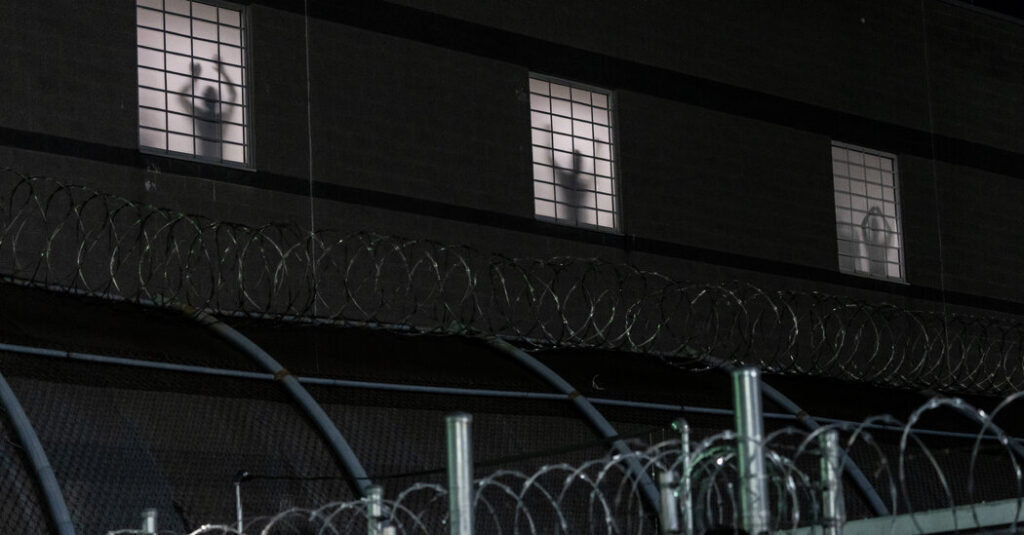
The first death came in December.
A 41-year-old immigrant from Haiti died after suffering a medical emergency within hours of arriving at Delaney Hall, a troubled, privately run immigration detention center in New Jersey.
Months later, a Delaney detainee from Guatemala had what appeared to be a seizure and died after being transported to a hospital, federal officials said on Wednesday. And earlier this month, a man from El Salvador, 41, suffered a medical emergency; the cause of his death remains unknown.
The deaths of three Immigration and Customs Enforcement detainees in less than eight months have raised urgent questions about the medical services provided at Delaney Hall and at other detention centers, with immigrants and local officials describing haphazard health care.
In interviews, immigration lawyers said that detainees at the 1,000-bed center have routinely encountered hurdles in receiving daily medications and comprehensive treatment for chronic diseases such as cancer. Injuries that were sustained by detainees during arrests by ICE sometimes go untreated, they said.
Dozens of detainees at Delaney Hall have complained about medical neglect there during the past year.
The Department of Homeland Security has repeatedly said that detainees receive good medical care. Geo Group, the private company that operates Delaney, did not respond to requests for comment for this article. The company has previously disputed allegations of substandard conditions included in federal and state reports.
Federal lawmakers have sought to make their own assessment but have received only limited access during their tours of Delaney.
Similar complaints have emerged about other detention centers. Congressional Democrats documented 85 reports of medical neglect in detention centers across the United States. In Texas, four detainees this year sued the country’s largest detention center, accusing it of human rights abuses.
“There’s a systemic problem of people having access to medical care” at the detention center, said Michael Musa-Obregon, a New York lawyer who has represented dozens of clients held at Delaney. “A lot of people are ignored when they request medical care, whether it’s for routine medical or even emergency medical situations.”
Details of the deaths tied to Delaney remain unclear, making it difficult to establish whether they stemmed from systemic failures, delayed care or unavoidable medical complications.
At least one family — the relatives of the Salvadoran man who died — has said that it believes he died because staff members failed to properly care for his underlying conditions, including epilepsy, high blood pressure and diabetes.
Federal standards of care require ICE to conduct a physical examination and mental health screening of detainees within 14 days of arriving. The same standards mandate that detention centers have a physician available around the clock, and prescription medication and other treatments are expected to be provided on a timely basis.
“It is a longstanding practice to provide comprehensive medical care from the moment an alien enters ICE custody,” homeland security officials said on Wednesday. “This includes medical, dental and mental health services as available, and access to medical appointments and 24-hour emergency care.”
The living conditions at Delaney have come under scrutiny by Democratic lawmakers and state investigators since the Trump administration opened the center last year.
Overcrowding, spoiled food, dirty living quarters, the acrid smell of body odor are among the complaints that have been lodged by detainees, prompting unrest and hunger strikes in protest.
The New Jersey Department of Health had tried to inspect the detention center’s infection-control protocols and practices, but was turned away in June. New Jersey’s attorney general sued to force the center to allow state health inspectors inside. The suit is pending.
After each death of a Delaney detainee, federal officials said that proper care had been provided to the men who died.
ICE officials said that emergency workers performed “lifesaving measures” on Jean Wilson Brutus, the immigrant from Haiti, before he was taken to a Newark hospital, where he died the next day of what appeared to be “natural causes.”
Delaney employees “responded immediately” when the detainee from El Salvador, Edwin Lopez-Cornejo, had a medical emergency, officials said.
And the man from Guatemala, Jose Chajon-Raxon, “was provided proper medical care from the nurse who reassured him he was safe” during his apparent seizure, officials said. His death had gone unreported for weeks until ICE officials acknowledged it in a statement late Wednesday.
At least 53 other people have died after being held at detention centers since President Trump took office last year, according to a New York Times analysis. The 33 deaths that were recorded in 2025 were the most ICE custody deaths in a single year. But because so many more immigrants have been detained as part of the Trump administration’s immigration crackdown, the rate of deaths is not as high as in the early 2000s.
Some immigration lawyers suggested that ICE may be struggling to provide adequate medical care because of the number of people it has detained, with little regard for factors such as age or medical conditions that might make them vulnerable in detention.
“Unfortunately, they have no shame in taking in people who are elderly, people who are sick, people who have pre-existing medical conditions, people who suffer from cognitive disabilities, people who are receiving ongoing treatment like dialysis or for diabetes,” said Reuben Kerben, a lawyer who has represented people held at Delaney.
At Delaney and elsewhere, some detainees say standards of care often go unmet.
Eleazar Garcia Nieto, 40, said he had to press Delaney staff members to receive his daily medication for a thyroid condition and high cholesterol.
Mr. Garcia Nieto, who migrated from Mexico two decades ago, was apprehended by ICE agents on June 27 outside the hotel in New Jersey where he works as a chef, according to court records. He was taken to Delaney, where he said he was kept for about a day inside a warehouselike room with about 100 other detainees who were being processed, all forced to stand, sit or sprawl out on the floor.
“Do you imagine having so many people packed in one place?” he said in an interview. “I was surprised they didn’t take precautions to protect not just us, but their employees, too.”
Over three days, he said, he was asked to fill out the same paperwork repeatedly for his medication.
“It’s a headache to obtain any type of medical help,” he said. “You have to plead and supplicate with whoever is in charge.”
He was eventually summoned to the infirmary, where he encountered a doctor and two women whom he believed to be nurses. About 10 other detainees waited for hours outside the infirmary. Some were older, and some had diabetes, he said. They stood or sat on one of the five available chairs.
In the end, Mr. Garcia Nieto received his medication — a day before he was freed after his lawyer filed an emergency lawsuit requesting his release.
Neither ICE nor the Geo Group responded immediately to a request for comment about Mr. Garcia Nieto’s experience.
Elora Mukherjee, the director of the Immigrants’ Rights Clinic at Columbia Law School, said that some of her clients had accepted deportation to avoid the dismal living conditions at Delaney Hall, where she said some other clients had been deprived of their medicine.
“They have been in pain, sometimes unbearable pain, for days,” she said.
Mark Bonamo, Nicole Hong, Allison McCann and Tracey Tully contributed reporting.
The post Deaths of 3 ICE Detainees Prompt Questions About Medical Care appeared first on New York Times.