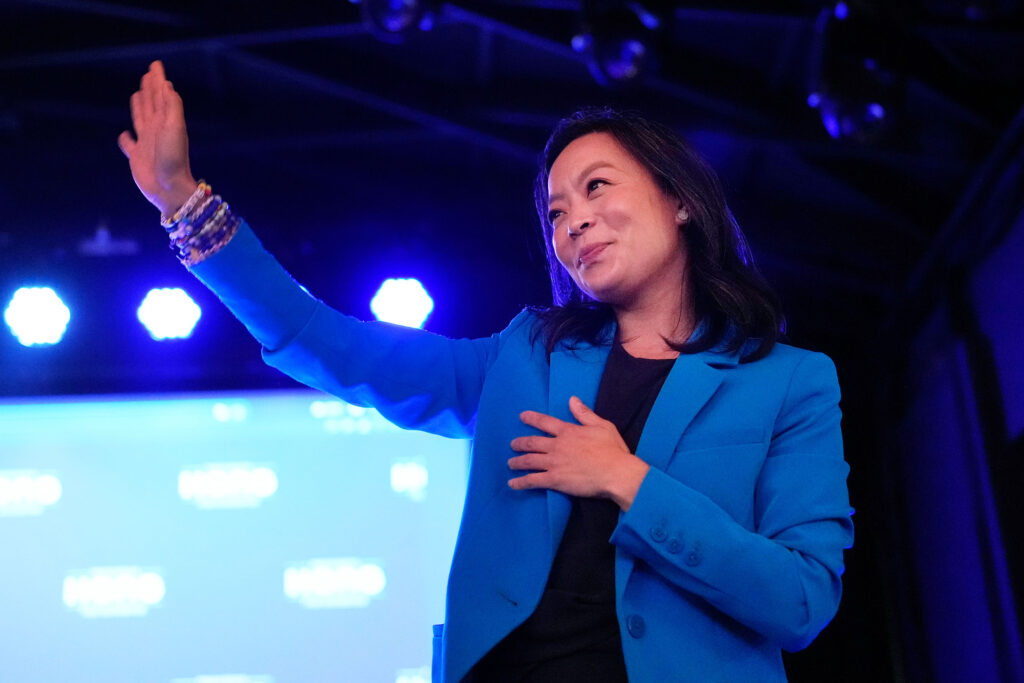
Francesca Hong’s upset loss in Wisconsin’s Democratic gubernatorial primary marks the second straight week that a progressive Democrat’s double-digit polling lead evaporated on election night.
Hong, a state representative and democratic socialist, led a scattered field by between 18 and 36 percentage points in polls over the past few weeks. She lost Tuesday’s primary to Milwaukee County Executive David Crowley by 0.5 percentage points.
Wisconsin’s surprise comes one week after Michigan progressive Abdul El-Sayed narrowly won the state’s Democratic primary for U.S. Senate after leading by 13 points in polls over the past month.
Together, the results raise questions about polls’ ability to gauge support for progressive candidates as well as Democratic voters’ resistance to nominating strongly liberal candidates in battleground states.
Several factors appear to have combined to lead polls far astray in the Wisconsin race.
What Wisconsin polls showed
The race itself was highly confusing. Crowley, the eventual winner, dropped out of the contest in early July. He jumped back in after Sara Rodriguez, the state’s lieutenant governor, quit the race. Then in late July, a third major candidate, Mandela Barnes, a former lieutenant governor, also dropped out. The state’s Democratic governor, Tony Evers, endorsed Crowley and barnstormed the state with him.
Seven polls in Wisconsin measured primary support in the campaign’s final three weeks, but only two were conducted after Barnes dropped out on July 30. Those found Hong with 42 to 44 percent support, with 22 to 24 percent supporting Crowley, and 18 to 22 percent supporting other candidates or undecided.
Hong won 39.3 percent of the vote, according to Associated Press tallies as of 1 p.m. Wednesday — underperforming polls by three to five points — while Crowley won 39.8 percent, about twice as much as polls had estimated.
Overenthusiastic Hong supporters?
“One candidate’s voters wanted to answer polls.” That was the conclusion of Chaz Nuttycombe, whose bipartisan group, State Navigate, conducted two polls in the final weeks.
After El-Sayed’s underperformance in Michigan, Nuttycombe wrote on X that the group “made our weights much, much more favorable to Crowley, and still couldn’t find him in the lead. Neither could his internal pollster.”
Specifically, in its final poll State Navigate down-weighted younger voters, a group that was heavily supportive of Hong but that also tends to turn out at lower rates in primaries.
Nuttycombe suggested that a pernicious dynamic may have been at play, one pollsters refer to as nonresponse bias. If Hong’s supporters were more likely to answer polls regardless of their age or other demographics, then adjusting the demographic makeup of the sample would fail.
“There’s no real data on the ideological breakdowns of the previous DEM primary electorates here, which you really need it seems just as you need party weights” in a general election, Nuttycombe wrote.
Late deciders?
Charles Franklin, director of the Marquette Law School Poll, which finished its final survey before Barnes dropped out, noted in a text message to The Washington Post that the poll was fairly accurate in gauging Hong’s support but didn’t anticipate voters uniting around an opponent.
“We had Hong at 38 percent, she’s at 39.55 percent. And 34 percent undecided [in the poll]. Pretty clear that Crowley + Barnes drop out + Evers endorsement moved the vast majority of undecided to Crowley,” Franklin wrote. “I didn’t think it would coalesce around one candidate that strongly in just three weeks, but it did.”
“Chaos in the race with 3 dropouts in July plus a reentry and endorsement. No wonder people decided late.”
The final polls showed ingredients for a late swing: State Navigate’s poll after Barnes dropped out found that 9 percent of likely voters were undecided and an additional 6 percent supported candidates who had dropped out of the race, including some voters who had already cast their ballots. And Marquette’s last poll found that 67 percent of Democratic voters said they had not heard enough about Crowley to judge him favorably or unfavorably.
Strategic voting is another potential factor in late swings, as primary voters weigh what they like about each candidate along with their perceived chances of winning in a general election in a closely divided state like Wisconsin.
Hong’s electability came into question in the campaign’s closing days because of her identification as a democratic socialist, as well as problematic statements she had made in the past that voters may have seen as extreme, including that Thanksgiving should be canceled.
Implications for 2026 and 2028
The past week’s primaries point to patterns new and old in poll accuracy and understanding what motivates voters. Primary polls have always been volatile and have never been precise, because voters can tune in late and need to choose between multiple candidates with similar views. Wisconsin and Michigan have also been particularly tough states for pollsters in general elections
Hong’s loss and El-Sayed’s narrow win suggest that supporters of strong progressive candidates are a passionate minority of the Democratic Party and that this enthusiasm may lead them to be overrepresented in polls. The elections also suggest many Democrats doubt that strong liberal candidates can win general elections — or simply prefer a moderate candidate.
Pollsters will need to get a better handle on these dynamics to understand support for the Democratic presidential candidates in 2028 and may also need to conduct surveys in the final days before primaries to capture late shifts.
As State Navigate’s Nuttycombe noted, some of those problems are less acute in general elections, where pollsters have more tools to ensure that samples are politically representative, including statewide estimates for partisanship and past presidential voting. Yet the Wisconsin and Michigan primaries are a reminder that in an era of low response rates, obtaining representative samples and accurately identifying likely voters continue to be difficult tasks.
Karen Tumulty contributed to this report.
The post Wisconsin surprise raises big questions about polls and Democratic voters appeared first on Washington Post.