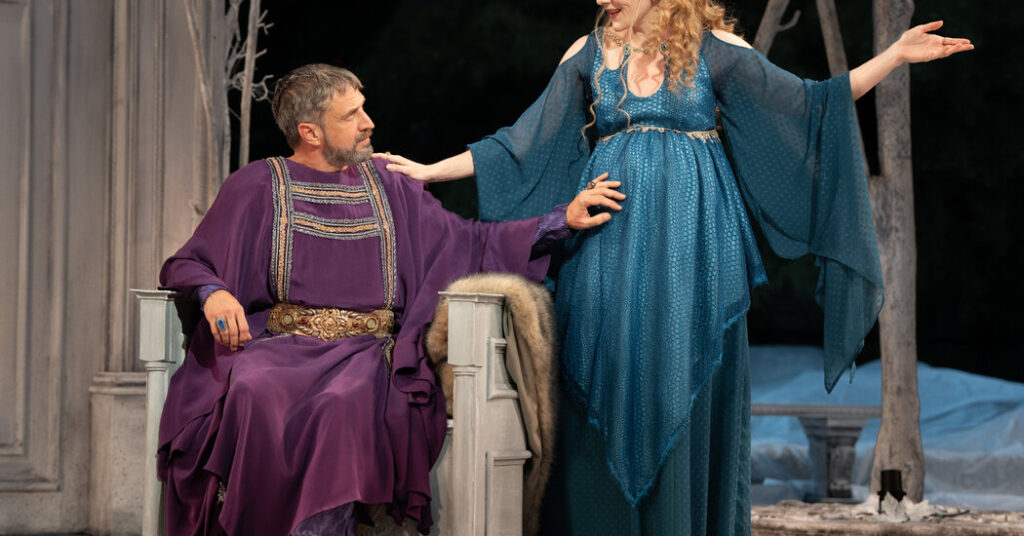
The ruler is a tyrant. He is irascible, paranoid, convinced of conspiracies that exist only in his mind. He punishes anyone he considers an enemy and listens only to those who affirm his worldview. This is Leontes, the king of Sicilia in Shakespeare’s “The Winter’s Tale,” this summer’s second show at the Public Theater’s Shakespeare in the Park. Though the director Daniel Sullivan sets the play in its fairy-tale of world of robes and furs and crowns, this “Winter’s Tale” brings the contemporary parallels bitingly close.
A melancholy romance and a tonal jumble, the play begins in Sicilia, where Leontes (Raúl Esparza) is entertaining a friend of his boyhood, Polixenes (Gilbert Owuor). When Polixenes means to leave, Leontes orders his pregnant queen, Hermione (Lily Rabe), to persuade him to stay. Polixenes agrees. Leontes, without cause, suspects adultery. That suspicion heaps tragedy on Hermione, their son and various courtiers. After an intermission, the action resumes 16 years later in Bohemia, which in Shakespeare’s imagination is somehow both pastoral and coastal. This is Polixenes’s kingdom, and now it is his volatility that threatens a new generation.
A tragedy, a comedy, a fable of forgiveness that includes an animate statue, “The Winter’s Tale” straddles both mythic time and, if a director wants it that way, our own. Though Sullivan is not a stridently political director or the kind of guy to put topspin on a classic, even he can’t resist the impulse to pull Shakespeare into the immediate present. When Steven Skybell’s Autolycus, a rogue and a peddler, crows, “I have sold all my trumpery,” Sullivan lets him emphasize the first syllable of that last word — to predictable applause.
If the production is uneven, well, so is the play. Sullivan, a faithful, fluent steward of the classics as well as a celebrated director of new plays, is most comfortable in its first acts and then again in the moving finale. He is aided here by Rabe, whom he directed in the 2010 “Merchant of Venice,” a luminous actress who invests Hermione with both charm and ferocity; and by Marsha Stephanie Blake, a tremendous presence as Hermione’s confidante, Paulina. She kindles the character’s scorched-earth speeches, bringing rigor to her righteousness. Esparza, too little seen onstage recently, plays Leontes with particular sensitivity, perhaps more than the king deserves. In his nimble hands, we see the price Leontes’s suspicions exact, the way that his obsession and mistrust harm everyone around him while also shriveling his own soul. It is almost impossible to sympathize with a character who does such harm so baselessly. And as Esparza plays him, it is almost impossible not to.
This “Winter’s Tale” sags in its lighter, Bohemian moments. Chuck Cooper gives a nicely restrained performance as a Bohemian shepherd, but Skybell has been encouraged to overplay Autolycus, crowding out the sweet young lovers — Florizel, played by Daniel Kyri, and Perdita, played by Isabela Ferrer. And whatever the country, the production is visually uninspired, with the stage, an enhanced clock face designed by Maruti Evans, perhaps too bare and the costumes, designed by Linda Cho, too layered and gathered. A pivotal storm isn’t especially stormy, and Shakespeare’s most famous stage direction, “Exit, pursued by a bear,” is rendered here as little more than a flash and a scream.
But who needs grand design when you have the riches of Central Park at your back? The sunset tops any of Bradley King’s lighting, though he manages a nifty effect in the final act. And the rustle of the breeze blowing through the leaves of the surrounding trees outperforms any sound or set design. No raccoon joined the ensemble on a recent Saturday evening, but you can’t have everything.
“The Winter’s Tale” is a fine choice for Shakespeare in the Park, though summer is the only season that the play doesn’t represent. It begins in winter, then resumes in spring and the final act has the warmth and chill of a sunny day in autumn. Still, summer is for pleasure, and if there is a greater pleasure on an August day than sitting in the Delacorte as the sun declines and the temperature cools, I don’t know it.
There’s pleasure, too, of a bittersweet kind, in the measured optimism that “The Winter’s Tale” offers and which so clearly appeals to Sullivan. There is real loss in this romance and pain that can’t be entirely assuaged. But the play also insists that healing is possible, redemption practicable and that what we might mistake for supernatural influence is, in fact, the steady, patient work of humans. There’s hope here, even when hope has felt beyond the reach of sense or reason. That can feel, for a night at least, remedy enough.
The Winter’s Tale Through Aug. 23 at the Delacorte Theater, Manhattan; publictheater.org. Running time: 3 hours 20 minutes.
The post ‘The Winter’s Tale’ Review: A Fable That’s Fit for Summer appeared first on New York Times.