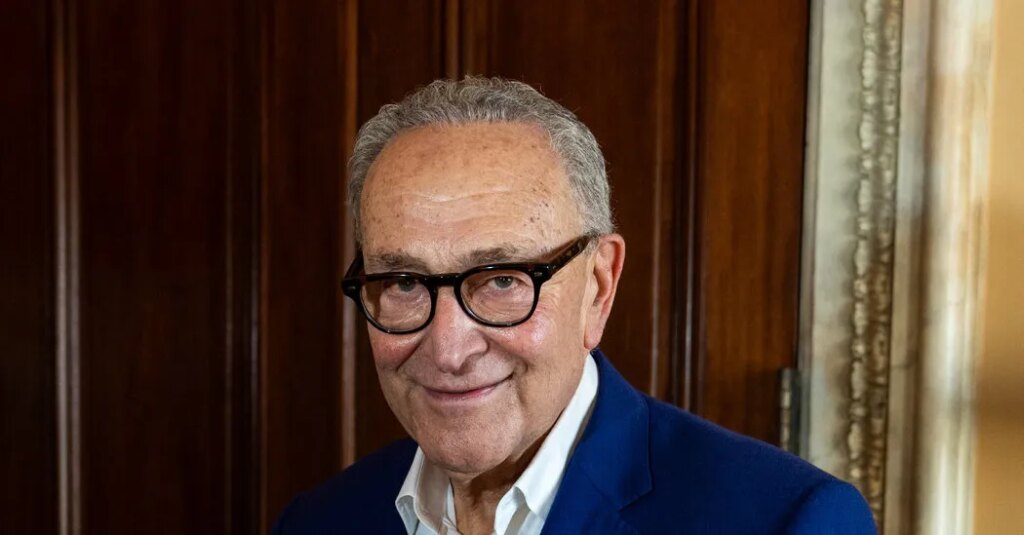
Last year, Democratic interest groups and voters berated Senator Chuck Schumer of New York, the minority leader, for backing off a spending fight with President Trump rather than forcing a government shutdown early in his term.
Activists called for Mr. Schumer’s ouster. Some Democratic lawmakers seethed. Protesters jeered outside his Brooklyn home. The outcry reached such a pitch that he postponed public appearances to promote a new book he had written and hunkered down amid questions about whether he could continue as the Democratic leader.
Twenty months later and in the wake of a sweeping electoral victory he engineered and funded, Mr. Schumer’s aides say he has locked down another term in that post, having secured commitments of support from enough Democratic senators to be elected majority leader in a private vote scheduled for next month.
Senate Democrats have gained at least seven and potentially nine seats to capture the largest majority they have enjoyed since Barack Obama’s presidency.
None of it has quelled the outcry from the left against Mr. Schumer, 75, who was viewed favorably in a May New York Times/Siena poll by only about one-third of Democrats. Among Democrats in the Senate, there is still some resistance to his continuing at the top — including by some of the newly elected members — but no Democrat has emerged to challenge him.
Between that implosion in March 2025 and the midterm exuberance, Mr. Schumer and his political team engaged in an all-out, $550-million push to put more Senate seats in play and increase their chances of regaining the majority — an investment that paid off handsomely.
But even the stubbornly optimistic Mr. Schumer did not foresee the extent of the Democratic victory or the Republican collapse.
“I did not,” Mr. Schumer said in an interview. “But I was confident we would get it back. My confidence did not waver in that.”
Not everyone had such certainty, given the Senate map for 2026. Democrats began the election cycle with six fewer seats in their caucus than Republicans had. It was a hole that threatened to get deeper.
Just one Republican seat — that of five-term incumbent Susan Collins in Maine — was up for re-election in a state that went for Kamala Harris in the presidential election. And Ms. Collins had proved in previous elections that she would not go easily.
Mr. Schumer set out to find candidates he believed could be competitive and who matched a winning profile in red states, drawing scorn from progressive activists who said his choices were too old and too moderate. His first target was Roy Cooper, the outgoing Democratic governor of North Carolina. Mr. Schumer said he called him immediately upon the expiration of his term as governor on Jan. 1, 2025.
Mr. Cooper initially demurred because he was embarking on a fellowship that was to run through May. The Democratic leader marked June 1 on his calendar to pester Mr. Cooper again. In late May, Mr. Cooper called Mr. Schumer instead.
“He said he was ready to go,” Mr. Schumer recounted. It was a critical get. Mr. Cooper won easily in a race that never really seemed in doubt, allowing Democrats to focus time and money elsewhere and giving them one sure pickup to start. And Georgia, the most endangered Democratic seat on paper, fell off the map as Senator Jon Ossoff showed early strength and Republicans there feuded and nominated a weak challenger.
Next up was Sherrod Brown, the three-term Ohio Democrat who lost in 2024, felled after a barrage of cryptocurrency industry money was spent against him. Mr. Schumer put on the hard sell, visiting the state three times to amiably work over Mr. Brown and his wife, the writer Connie Schultz. His closing message was a guilt trip: “If we lose the Senate by one vote, you and Connie won’t enjoy your retirement,” Mr. Schumer warned.
The next day, he was in. Senate Majority PAC, the political action committee allied with Mr. Schumer, spent $150 million helping Mr. Brown to victory.
Over a series of dinners, Mr. Schumer successfully enticed a strong challenger in Alaska: Mary Peltola, who had won statewide races for the House before being defeated in a re-election campaign. She is ahead of the Republican incumbent senator, Dan Sullivan, in the count there.
He also encouraged Josh Turek to enter the Senate contest in Iowa, then poured $67 million into his winning race. A veteran Democratic strategist told Mr. Schumer to take a look at Adam Hamilton in Kansas, and he became enamored, and would eventually spend $14 million in the upset win against Senator Roger Marshall.
The Democratic primary in Maine was a mess, and Mr. Schumer’s initial recruit, Gov. Janet Mills, dropped out. But the PAC affiliated with him pushed a steady anti-Collins message with $65 million in spending that was focused on her, not the Democratic contender.
Michigan was tricky for Mr. Schumer as he leaned toward the centrist Representative Haley Stevens while her ultraprogressive primary opponent, Abdul El-Sayed, was among a group of candidates who said they would not back Mr. Schumer for leader. Still, the day after Mr. El-Sayed won the primary, Mr. Schumer began injecting funds to help him win.
“We never hesitated,” he said. “We put in from Day 1.” Michigan ended up as a top state for spending by the Schumer-affiliated super PAC, essentially tied with Iowa and behind only Ohio.
And in a race that was seen by many as a pipe dream, Mr. Schumer recruited Scott Colom, a Black prosecutor, to oppose Senator Cindy Hyde Smith, the Republican incumbent, hosting Mr. Colom and his father, a well-known Mississippi Republican, for lunch in Brooklyn. Mr. Colom is slightly ahead in what would be a monumental upset.
At the same time, Mr. Schumer and Senate Democrats were setting legislative traps on the Senate floor, forcing Republicans to take tough votes on unpopular tariffs and the war with Iran. The second time a spending dispute threatened a shutdown, Mr. Schumer did not hesitate to force one as Democrats dug in against ending subsidies for health insurance under the Affordable Care Act.
The shutdown eventually ended, but Democrats won individual votes on protecting the health care aid, which Republicans opposed. When the subsidies expired at the end of last year, Mr. Schumer had new fuel for a message that Republicans had ignored rising costs on Americans and made the problem worse.
“In retrospect, even though we hated shutting down the government, it helped us,” Mr. Schumer said.
Then, after the president initiated the war against Iran, Democrats forced Republicans on the record repeatedly in support of the war and its accompanying increases in fuel and fertilizer prices that were ravaging the economy in agriculture-reliant states. Democrats also resisted Mr. Trump’s push to enact a restrictive voting law that they feared would suppress eligible voters inclined to support them.
The mix of legislative strategy, solid recruitment, missteps by Republicans and a dismal approval rating for Mr. Trump added up to a Democratic rout, marking the third time Mr. Schumer had overseen a successful effort to retake the Senate majority after wins in 2006 and 2020.
Even with Tuesday’s remarkable showing, Mr. Schumer’s future as leader is being questioned. Senator Chris Van Hollen, Democrat of Maryland, has publicly urged a discussion about the direction of the party’s leadership, though Mr. Van Hollen himself has shown more interest in a presidential bid.
“I am pretty confident that he is going to be re-elected as leader,” Senator Chris Coons, Democrat of Delaware, said of Mr. Schumer, given his “particular talent” of recruiting good candidates, raising lots of money and advising candidates on messaging. “He revels in winning elections. That makes a good case of why he should continue in leadership.”
But Mr. Coons said Democrats should have a “big conversation about what future leadership should look like,” and take an expansive approach that allows more voices to be heard.
Mr. Schumer said he intends to capitalize on this year’s success in Republican-leaning territory to fortify and expand the Democratic electoral presence.
“We’re going to make a durable majority by delivering and by focusing on good Democrats who are now in office in red states,” Mr. Schumer said. “I spent decades working to change the Senate map. The election proved we could. Now we have to make sure what we built lasts.”
The post Schumer, Once Besieged, Is on Track to Remain Leader After Election Blowout appeared first on New York Times.