This is an edition of The Atlantic Daily, a newsletter that guides you through the biggest stories of the day, helps you discover new ideas, and recommends the best in culture. Sign up for it here.
One of the more charming moments in the deliriously charming 1964 Beatles movie, A Hard Day’s Night, has the boys in the band trying to evade screaming fans and the paparazzi. They duck in alleys, they dodge around corners, and in one scene, they all jump into a taxi and then climb out the other side and get in a different taxi. It’s a wonderful, exhilarating sequence.
It seems less fun when the president of the United States does it.
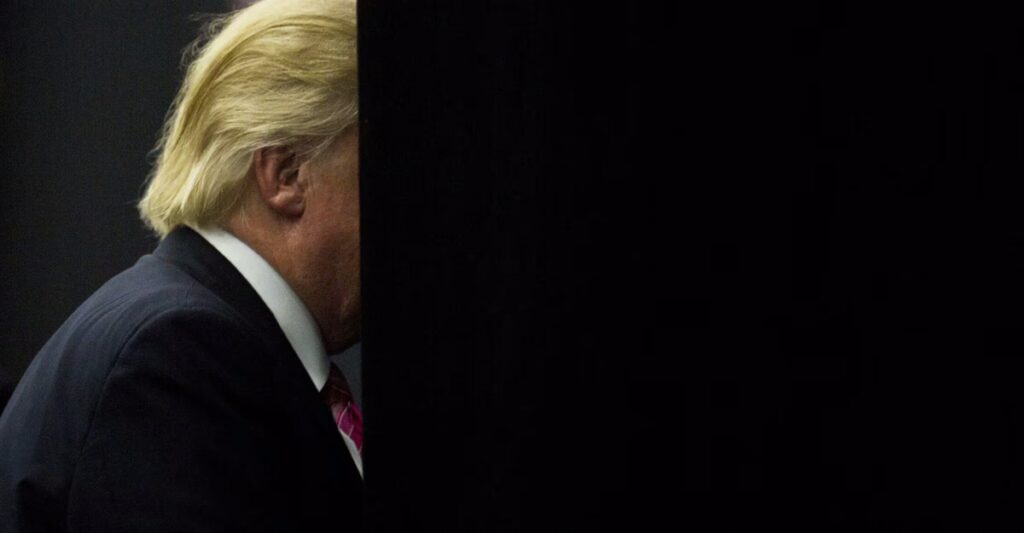
A few days ago, Americans learned that Donald Trump had to do something like the Beatles car switcheroo to evade not admirers or photographers but an Iranian assassination plot. When the Secret Service got wind of a plan last month to kill Trump—apparently by taking out Air Force One—it engaged in a clever bit of misdirection: Trump boarded the usual Air Force One 747 in full view of the cameras, and then everyone shut the window shades as Trump surreptitiously climbed into one of the large containers that delivers food to an airplane galley.
That container was then trucked over to a smaller C-32A aircraft, where Trump exited the container and boarded the plane (which, because of the president’s presence, instantly became the real Air Force One). The C-32A and the 747 then both flew to the United Kingdom, with the 747 continuing the ruse by identifying itself as “Air Force One.” Trump got off the smaller plane in Britain, snuck back on to the 747, and then exited from it as if he’d been on board the whole time. He then got on another 747, the lavish new Air Force One 2.0 given to Trump by the Qatari government, to fly home.
We learned about the plane swap in Turkey in a scoop from the Washington Post reporter Dan Lamothe and his colleagues, but more reporting now suggests that this whole escapade went from a Beatles movie to a Marx Brothers comedy.
Trump, as it turns out, was not alone on the food truck. While the press and some others on the plane were told nothing about a threat, Trump reportedly climbed into the catering container with three of his White House footmen: Dan Scavino (his former caddie) and Walt Nauta (his former butler), both of whom are now White House aides, and Natalie Harp, his executive assistant.
Meanwhile, military officers, enlisted staff, and several American civilians were left on a plane that was deemed too dangerous for the president. Secretary of Defense Pete Hegseth, according to reports, was waiting for Trump on the C-32A, but Secretary of State Marco Rubio and Secretary of the Treasury Scott Bessent were on the original 747, and they were aware that Trump was on the other, secret plane. Several White House aides were reportedly on the decoy flight, including Stephen Miller, Steven Cheung, and others. The pool report from the 747, however, says that there were “no visitors to the press cabin” during the flight from Turkey to the United Kingdom.
The commander in chief is the most important person on any American aircraft, and his safety must take precedence over all other concerns or interests. If the Secret Service wanted Trump spirited out of Turkey for his security, then no one should second-guess that decision. But now that we know that Trump was getting shuttled around a Turkish airport in a food-supply crate with three of his courtiers, we also know more about this White House—and about the war in Iran.
One immediate question: If the situation was that dangerous, why send up the first 747 at all—and with two men fairly senior in the line of presidential succession aboard? Perhaps the threat wasn’t quite so dire, or its parameters were not well-enough defined, and the Secret Service acted out of a superabundance of caution. Or perhaps the president thinks it’s acceptable to send up an airplane full of innocent Americans as a decoy to draw fire so that he can evade enemy action.
It’s true, of course, that anyone takes a risk flying near active hostilities on a government aircraft. Back in late 1990, I accompanied the U.S. senator I was working for, John Heinz, on a visit to the Desert Shield operations area during the Gulf War. A group of senators had borrowed what was usually the vice president’s official plane, and during a security briefing before the trip, another Senate staffer asked: “Will we be in any danger?” The briefer, with a bit of exasperation, said: “You’ll be flying through an active war zone in a plane with United States of America in giant letters on the side, so yeah, there’s some risk.” But that’s not the kind of risk that was ostensibly facing those on board the 747. Trump and his people had information about a threat clear enough that the president, the defense secretary, and a few cronies were diverted from the aircraft.
The way the Great Food-Truck Escapade unfolded—including who Trump chose to take with him—also reveals much about the president’s priorities. And why didn’t Trump take the press into his confidence, even if he couldn’t take them all on the safer plane? Granted, the president seems to resent most of the media, so maybe he just didn’t care about their fate, but what about his staff? Not only was it morally appalling to keep so many people in the dark about the threat; it was politically inept, on two levels.
First, imagine if something had actually happened to the decoy. Trump would later end up either having to lie or having to explain that he’d known that such a disaster was possible, and that he’d sent Air Force personnel and several American civilians—possibly including two Cabinet secretaries—to their death to cover his own escape.
And second, Trump missed a major opportunity. Had he brought a few reporters with him, they could have told the story of a clever evasion. The 747, meanwhile, could have been temporarily held and its passengers delayed until Trump emerged in Britain, when the Iranians would find out they’d been had.
That’s not how this White House works. Trump and his people operated under the kind of paranoia and callous disregard for military and civilian lives that have characterized the president’s time in office. The White House might argue that it cannot trust the media, but John Kirby, the retired rear admiral who served as a spokesperson in two administrations, noted yesterday on MS NOW that he often took the press into his confidence on similar classified matters and was never, in his word, “burned” by the decision to keep the American people informed.
The larger issue is that Trump likely wanted this story buried because it makes him look cowardly and puts the lie to all his happy talk about the war. Trump has crowed—as he did at the time in Turkey—that the Iranians are beaten and pleading for a deal. In truth, the Iranians might have been planning to blow the president of the United States and some of his top officials to smithereens.
When Trump ducked out of that 747, he was not channeling John Lennon or Groucho Marx. Instead, he affirmed that the character he most resembles is Greg Stillson, Stephen King’s cowardly presidential contender in the novel The Dead Zone. Stillson’s candidacy ends when he tries to shield himself from an assassin by holding a childin front of him. Trump, to his credit, did not grab a small child. He just sent a giant decoy filled with innocent Americans into the sky.
Related:
Here are three new stories from The Atlantic:
- A silver lining in Afghanistan
- Matteo Wong: It may be time to panic about AI.
- AOC knows a lemon when she sees one.
Today’s News
- Milwaukee County Executive David Crowley narrowly defeated State Representative Francesca Hong in Wisconsin’s Democratic primary for governor last night. Crowley, who reentered the race after outgoing Governor Tony Evers’s endorsement, will face Donald Trump–backed Republican Representative Tom Tiffany in November.
- White House Press Secretary Karoline Leavitt will be stepping down from her role at the end of the month to spend time with her family, Trump said.
- Millions of people gathered in Iceland and Spain today for Western Europe’s first total solar eclipse in 27 years.
Evening Read
Shopping Is Impossible
By Rachel Sugar
For several months, I had been on the hunt for new T-shirts. I vaguely had a vision of what they should look like: not so different from my current T-shirts, except in some way elevated and, more urgent, free of stains or holes. Perhaps they could come in interesting colors? Ideally, they would not be made in sweatshops. There were many, many shirts that seemed to meet these criteria—and with a few clicks, they could be delivered to my doorstep, maybe even by tomorrow. And still, I had purchased none of them.
The problem is the overabundance of options. The problem is too much information, or too little information. The problem is inflation, which has eroded any sense I had of what a T-shirt is supposed to cost. Yet none of them alone can explain why shopping is sucking up more of my time—and maybe yours too.
More From The Atlantic
- Nobody knows what ultra-processed food is.
- Mark Zuckerberg’s convenient truth
- Where has all the testosterone gone?
- What do sex and gender even mean now?
Culture Break

Watch. A new film stages a generational war over sex—and suggests a surprising way for Gen Z to get around its inhibitions, Faith Hill writes.
Read. After two works of fantasy, the writer Marlon James has returned to Jamaica, Stephanie Burt writes. His new novel, The Disappearers, follows men who have sex with men struggling for survival in Kingston.
PS
I’ll be at The Atlantic Festival, in New York City, and you can join us September 17 through 19. The festival brings together influential and provocative political, cultural, business, tech, and climate leaders for in-depth interviews, timely forums, book talks, screenings, and networking opportunities. This year’s participants include Senator Mark Kelly, Pete Buttigieg, Karl Rove, Emily Wilson, and many more.
They’ll be joined by Atlantic writers including Tyler Austin Harper, Ashley Parker, Tim Alberta, Sophie Gilbert, and others; I’ll also be in conversation with my colleagues David Frum and Anne Applebaum.
You can see the full schedule and get your pass here.
Join us!
— Tom
Explore all of our newsletters here.
Rafaela Jinich contributed to this newsletter.
When you buy a book using a link in this newsletter, we receive a commission. Thank you for supporting The Atlantic.
The post The Flawed Logic of Trump’s Airplane Escape appeared first on The Atlantic.