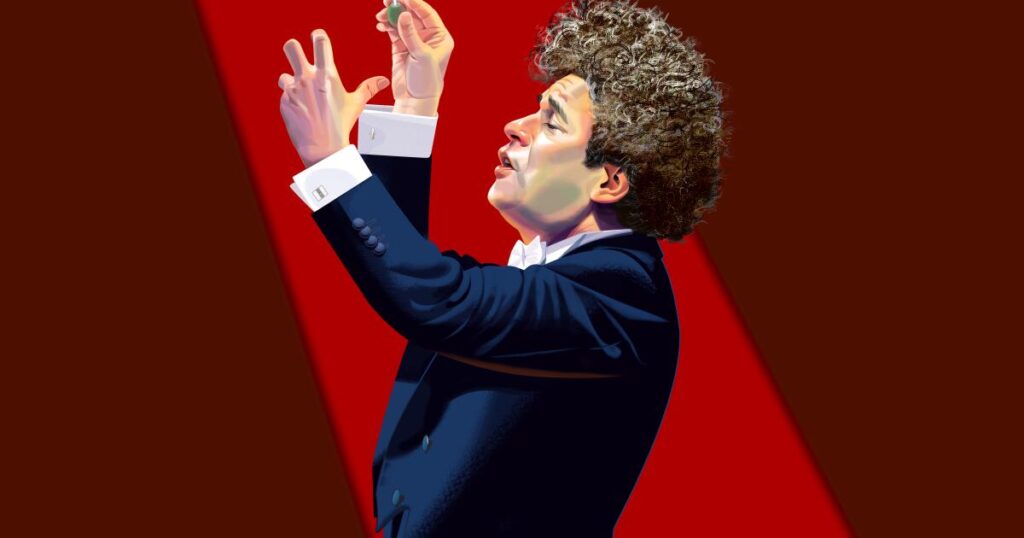
In early April 2007, I was invited to a surreptitious dinner with the Los Angeles Philharmonic’s music director Esa-Pekka Salonen and the orchestra’s president, Deborah Borda. We gathered in Salonen’s kitchen and over take-out sushi discussed how in three days, Easter Sunday, the Los Angeles Times would be the first to tell the world that Salonen had decided to step down in two years and that Gustavo Dudamel would become L.A. Phil music director beginning with the 2009-10 season.
Although now Dudamel is perhaps the best known name in classical music and will end his 17 seasons as L.A. Phil music and artistic director with four varied programs at the Hollywood Bowl Aug. 20-23 before taking on that role with the New York Philharmonic next month, he was still very new on the scene back then. He first came to attention after winning a new conducting competition in Bamberg, Germany, in 2004, when he was 23. Yet by 2007 he was enough of a sensation that major news agencies in the U.S., Europe and South America picked up the front-page story. Al Jazeera and a radio station in Mumbai tracked down my cellphone number and called for comment.
Dudamel’s dynamic debut in L.A.
There was no question that Dudamel was a once-in-a-generation talent and that his signing had been an L.A. Phil coup. The orchestra was riding high. It had triumphantly opened Walt Disney Concert Hall four years earlier, and over the past 15 seasons Salonen had made it the most farseeing orchestra in the land — and beyond.
The L.A. Phil also knew a thing or two about developing young talent from unlikely lands. In 1961, the 24-year-old Zubin Mehta from Mumbai (then Bombay), India, made his L.A. Phil debut and the next year became music director and remained so for 16 seasons. Salonen was an unknown 26-year-old Finnish composer and conductor when he made his U.S. debut conducting the L.A. Phil in 1984, before becoming music director in 1992.
Yet this young Venezuelan seemed somehow uniquely fated to come to L.A.
Salonen was on the jury of the Gustav Mahler Conducting Competition that Dudamel won and phoned Borda from Bamberg, famously describing the boyish Dudamel as “a conducting animal.” Dudamel subsequently made his U.S. debutwith the L.A. Phil at the Hollywood Bowl in 2005, electrifying orchestra and audience. His Disney Hall debutfollowed in early 2007, and that settled it for Salonen, who was eager to spend more time composing. He had found his successor.
Three months later, after having single-mindedly “stalked Dudamel,” as she called it, Borda left a sick bed to hop on a plane to Lucerne, Switzerland, contract in hand. Dudamel had gone from rising star to star to savior, seen as the conductor who brought new vitality to everything he touched.
But like all coups, the L.A. Phil Dudamel one came with considerable risk and unknowns. Was Dudamel’s dynamism the product of a Leonard-Bernstein-level-gift, or was “The Dude,” as some in the press dubbed him, all flash?
Would fame go to his head? Did Pink’s gloppy “Dudamel Dog” (layered with guacamole, American cheese, grilled onions, jalapenos, tortilla chips and heaven knows what else) define Dudamel? Big shots in the establishment, and particularly on the East Coast, rolled their eyes.
A Venezuelan’s vision becomes reality
At the dinner, Salonen gave a loving account of what it meant to be a music director and why he thought Dudamel was the right conductor at the right time. Salonen felt that, in his ongoing efforts to revolutionize the orchestra, it was time for change.
“We just have to let him be him,” Borda said. With caveats aplenty, that is pretty much what happened.
Seemingly unfazed by anything and immune to culture shock, Dudamel instantly jumped in, insisting that he felt right at home in L.A. Like L.A., Venezuela’s capital, Caracas is a car culture. Dudamel initially spoke little English, but the Latino community welcomed him with open arms. He had grown up enthralled by “Star Wars” films, and he became an instant champion and friend of John Williams, as he did of Frank Gehry(whom he nicknamed Poncho).
But Dudamel also arrived with a vision of music that he had absorbed from El Sistema. His revered mentor, José Antonio Abreu, who founded the educational program in 1975 with the conviction that learning music can, in bettering lives, lead to profound social change. Abreu lobbied to make El Sistema part of the Venezuelan government, formalizing music education as a human right. Now, eight years after Abreu’s death, it serves more than a million students throughout the country.
El Sistema’s spectacluar Simón Bolívar Youth Symphony was the only orchestra of which Dudamel had been music director when the L.A. Phil signed him. But thanks to El Sistema, thinking big became his calling card at the L.A. Phil.
While still music director designate, he followed in Abreu’s footsteps and created YOLA (Youth Orchestra L.A.) which is now a major component of the L.A. Phil with its own home in Inglewood designed by Gehry. Over the years Dudamel has further made it his mission to include the kids in all kinds of projects in Disney Hall and at the Hollywood Bowl, the Super Bowl halftime as well as on tours to London, Tokyo, Mexico City and more.
Dudamel’s fame, moreover, alerted the classical music world around the globe to the rich talent El Sistema has produced. Domingo Hindoyan, Los Angeles Opera’s new music new director and also music director of the Royal Liverpool Philharmonic and principal guest conductor of Polish National Radio Symphony, as well as San Diego Symphony and Montreal Symphony Orchestra music director Rafael Payare grew up together with Dudamel in El Sistema.
Making L.A. his orchestral playground
For Dudamel, L.A. became the place that let him try just about anything. Perhaps he brought up even more daring notions in planning meetings (nobody’s saying), but here is where he’s been able to experiment and get away with murder, not just with the support of the orchestra but also the community. He became a symbol for an L.A. in which, as with YOLA, anything is possible. Audacity was written into every one of his seasons.
That began with his first concert as music director in 2009, a daylong event at the Hollywood Bowl that featured YOLA and the L.A. Phil and ended with Beethoven’s Ninth Symphony. All tickets were given out for free; the seats closest to the stage reserved for families of YOLA musicians.
One lavish project followed another. In his first years, Dudamel explored standard symphonic repertory with immersions into the symphonies and worlds of Beethoven, Schubert, Schumann, Brahms, Tchaikovsky, Rachmaninoff, Dvorak and Ives, often in context with new music. He often made it seem like it was an education for him as well as for an eager audience.
The wildest of all was Mahler. Dudamel was the first and thus far only conductor “crazy” (his word) enough to conduct all nine epic symphonies over two weeks, which he did in collaboration with the Bolívars both in L.A. and Caracas. All, except the Eighth Symphony, were led by memory. The Eighth is known as “Symphony of a Thousand,” yet a thousand musicians, chorus members and vocal soloists were too few for Dudamel. He added a couple hundred more at the Shrine Auditorium and many more than that in Caracas, with student singers on benches that rose precariously to the top of a tall concert hall. By the end of the project, Dudamel was so exhausted he could barely speak a coherent sentence in what described as a state of transformation.
Under Dudamel, the L.A. Phil became an opera company and Disney an almost fullfledged opera house, staging Mozart’s three Da Ponte operas with sets by famed architects, beginning with Gehry, and costumes by edgy designers. A revelatory production of Beethoven’s “Fidelio” in which opera singers were joined by actors from L.A.’s Deaf West Theatre and El Sistema’s hearing-impaired White Hand Chorus. Gehry’ added new architectural wonders to his hall for Wagner’s “Das Rheingold” and “Die Walküre,” the start of a “Ring” Cycle that Dudamel is lobbying to finish in L.A.
There have been collaborations wherever Dudamel could find them. He filled Disney (and the Bowl) with ballet and modern dance. His attitude has been you can never include too much pop, folk, Latin music and film music onto the L.A. Phil stage. Or too many or varied visual artists. He followed Salonen’s lead in creating new work with director Peter Sellars, and added opera director Yuval Sharon and film director Alberto Arvelo to his list of regulars.
And then there were the composers. Dudamel had little experience conducting new music when he arrived. But contemporary music had always been in the orchestra’s DNA. That grew greatly under Salonen and with the new hall. Disney turned out to be an environment where you expect the here and now.
Dudamel jumped right in. On his first season opening gala, he premiered John Adams’ “City Noir,” written for the occasion. He then made it a tradition to include in every gala the premiere of a major new work.
His legacy lives on, at Coachella and beyond
Before long, Dudamel was conducing new music left and right. He’s racked up more than six dozen premieres of new works, and he’s not done yet. There are still the Hollywood Bowl concerts. Plus, he’s already begun generating co-commissions with the New York Philharmonic and L.A. Phil.
Not everything worked. In Dudamel’s early days, especially when he was learning repertory, he would constantly experiment. I got an earful of complaints from players about this. Even so, the Angeleno way was to let him be him. If he learns from his mistakes, he could become great. If not, no one dies.
Maybe the best way to understand what Dudamel has meant to L.A. and what L.A. has meant to Dudamel was his unimaginable schlepping of the L.A. Phil to Coachella. Classical musicians are not native species of massive pop festivals in the desert. Yet at the end of a long, hot day, a crowd estimated to be around 100,00 stood and chanted the unthinkable “L.A. Phil, L.A. Phil, L.A. Phil, L.A. Phil.”
The post How letting Dudamel be Dudamel led to unpredictable, wonderful L.A. music appeared first on Los Angeles Times.