Six months ago, exporting oil from the Persian Gulf was fairly straightforward: Produce crude at the cheapest price possible, export it through the fastest route and sell it to the countries that can pay the most.
Those days are over.
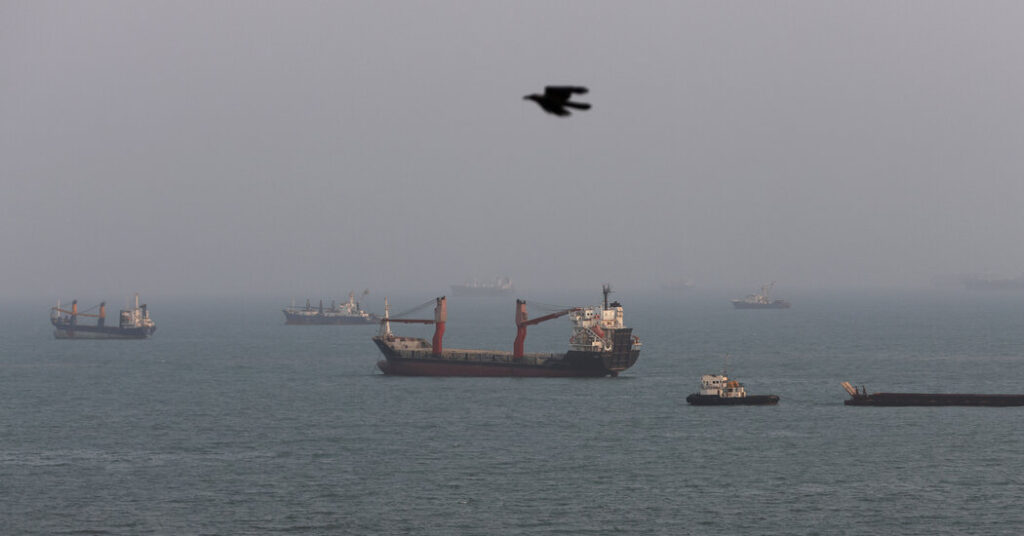
Shipping through the Strait of Hormuz, long the most efficient path for exports, remains greatly curtailed because of the war in Iran. Much of the oil getting through the strait is on tankers navigating a treacherous gantlet of Iranian attack drones, or running dark with their location devices turned off. At least 17 seafarers have been killed in the region.
Gulf countries that have for decades produced much of the world’s oil are now intent on breaking their dependence on the narrow waterway. They are building or expanding pipelines and other infrastructure that can bypass it, and vastly expanding storage capacity in places like Asia.
These endeavors show how the war is changing the oil business in the Persian Gulf. They will cost billions of dollars and take years to complete, but companies and governments consider them essential hedges in an increasingly volatile region. Even if a cease-fire between the United States and Iran materializes, Gulf exporters recognize that relying too heavily on a single transit route is a risk they can no longer afford to take. And the moves, over time, could diminish Iran’s clout in the region.
“A lot of people assume the Strait of Hormuz will never carry the same share of oil exports as it did before the war,” said Ben Cahill, an energy analyst at the University of Texas at Austin. “No country in the world wants to rely as heavily on that transit point again.”
Energy producers, he said, have begun to put greater stock in making their infrastructure secure, even if comes at greater cost and less efficiency.
Before the United States and Israel began conducting military strikes on Iran on Feb. 28, about 20 million barrels of crude a day sailed through the Strait of Hormuz, which connects the Gulf of Oman with the Persian Gulf. But overlapping U.S. and Iranian blockades, sea mines, missile strikes and skyrocketing insurance costs have effectively shuttered the strait.
Crude exports through the strait have fallen to about 3.7 million barrels a day as of last week, according to Kpler, a maritime tracking firm. To be sure, more oil than that is being exported from the gulf, partly via vessels that take steps to make them hard to track. Millions of barrels a day are also exiting through existing routes like pipelines not dependent on access to the Strait of Hormuz.
Still, the frenzy of activity for lasting workarounds to the strait is evident throughout the region. For example, in Fujairah, a United Arab Emirates port city facing the Gulf of Oman, construction crews are working around the clock to lay a secondary crude line parallel to an existing pipeline that delivers oil from onshore fields in Abu Dhabi.
The ambitious project aims to double the country’s bypass capacity to 3.6 million barrels per day, allowing nearly all of Abu Dhabi’s onshore crude to reach international tankers without ships having to use the Strait of Hormuz.
In addition, the Emirates’ state-owned energy giant, Abu Dhabi National Oil Company, or ADNOC, said this week it planned to spend $8.2 billion to expand its natural gas business. The company is also considering plans for a liquefied gas export facility on its eastern coast as a way to bypass the Strait of Hormuz, Peter van Driel, ADNOC’s chief financial officer, told Bloomberg Television.
In neighboring Saudi Arabia, the state oil giant Aramco is accelerating a multi-billion-dollar expansion of its East-West Pipeline.
Designed during the Iran-Iraq war in the 1980s, the 1,201 kilometer-long (746 miles) pipeline crosses the Arabian Peninsula to the Red Sea port of Yanbu. Aramco’s chairman, Yasir O. Al-Rumayyan, this year called it the kingdom’s economic “lifeline,” successfully rerouting some seven million barrels per day since Iran effectively closed the Strait of Hormuz after U.S. and Israeli military strikes.
Saudi officials are working to add another one to two million barrels a day, and they also are considering a smaller parallel second pipeline for refined oil products.
“In terms of exporting our crude, we are looking at actively increasing optionality right now,” Amin Nasser, the chief executive office of Saudi Aramco, said last week.
The uncertainty in the Strait of Hormuz is also prompting ventures among Gulf producers.
Kuwait is in discussions with Saudi Arabia and other Arab nations to build a pipeline that would connect the country’s oil fields to ports on the Red Sea or Oman. Iraq and Jordan have revived long-delayed plans for a pipeline that could carry up to one million barrels per day to the Port of Aqaba off the Red Sea, according to state television reports in Jordan. And Iraq is speeding up plans to rebuild a damaged oil pipeline to ship crude oil from the Iraqi fields in Kirkuk to Syria’s Mediterranean coast.
Yet many of these solutions come with enormous friction. Rerouting Saudi Arabia’s trade route has shifted the security burden toward the Red Sea and the Bab-el-Mandeb strait — where the Houthi militia group in Yemen have been attacking vessels. On Tuesday, six people were killed when a ship was hit by the Houthis in the Red Sea.
In addition to new pipelines, Gulf nations are building physical insurance policies thousands of miles away by expanding storage in places like South Korea, Japan and India.
The logic is simple: If the Strait of Hormuz is closed, the oil is already on the other side of the gate.
“Everybody is trying to add additional storage,” Mr. Nasser of Aramco said, adding, “Energy security is becoming a priority now.”
And yet analysts noted that while the war in Iran has exposed Gulf nation’s reliance on the strait, it won’t ever be eliminated entirely.
“They definitely need the Strait of Hormuz because it brings them so many advantages and the infrastructure is there,” said Carole Nakhle, chief executive of Crystol Energy, an advisory firm. But, she said, “It was foolish for them to put their faith in Hormuz entirely.”
The post Gulf Oil Giants Are Spending Billions to Build Ways Around Strait of Hormuz appeared first on New York Times.