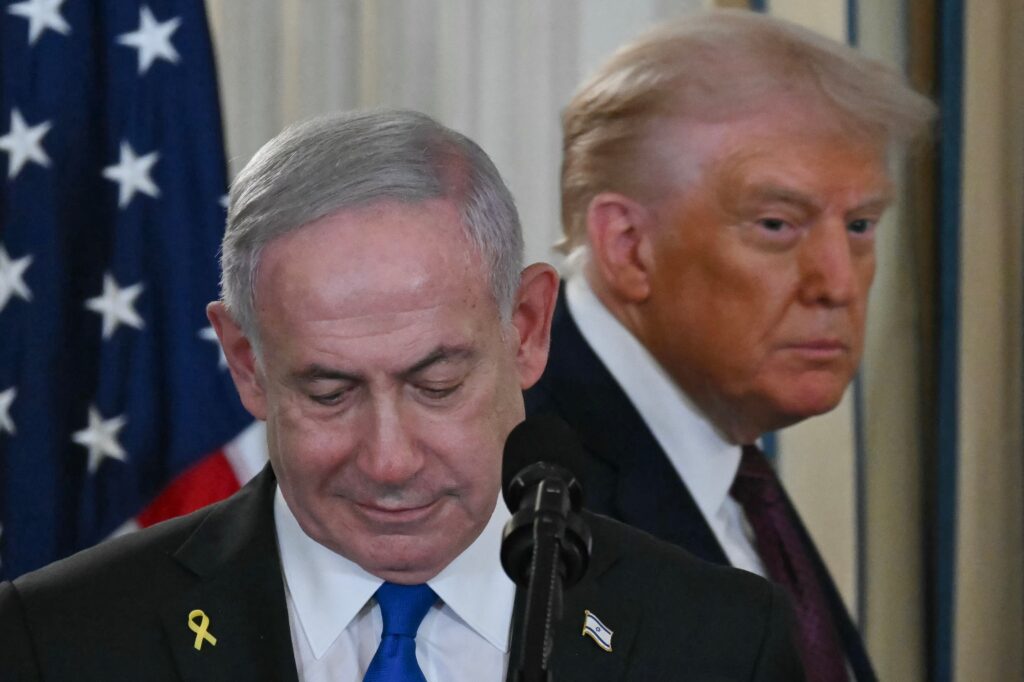
With less than three months remaining before critical elections in the United States and Israel, President Donald Trump and Israeli Prime Minister Benjamin Netanyahu are being pulled in opposite directions by their domestic political imperatives.
On Sunday, Netanyahu delivered an unusually public and blunt rebuke of the White House, rejecting a U.S.-approved plan for implementing the next stage of Trump’s Gaza peace proposal.
Trump had earlier announced agreement by both Hamas and Israel to the plan, a step-by-step, reciprocal process in which the militants would gradually give up their arms in exchange for the incremental withdrawal of Israeli troops from the more than 60 percent of Gaza they occupy.
Speaking Sunday at a government meeting, Netanyahu presented himself as someone capable of saying no to the U.S. president. The process, he said, was unacceptable and there would be no Israeli withdrawal until every Hamas weapon and tunnel was first surrendered.
“We can and know how to stand our ground, even against our best friends when necessary,” Netanyahu said.
Trump, who had hailed the demilitarizing framework as a “historic” breakthrough, faces mounting political pressure to demonstrate progress as public dissatisfaction with his handling of international affairs grows, including over the increasingly unpopular war with Iran.
“Trump needs to show achievements ahead of the midterm elections, particularly given the lack of progress with Iran and Ukraine,” Michael Milshtein, a senior analyst at the Moshe Dayan Center at Tel Aviv University, said.
The disagreement marked an unusually overt display of tensions that have long simmered between Israel and the United States over the future of Gaza and, more recently, the war in Iran.
Aaron David Miller, who worked as a Middle East negotiator through several Democratic and Republican administrations and is currently at the Carnegie Endowment for International Peace, said he has never seen the U.S.-Israeli relationship “under greater stress” as both play to their domestic electorates.
But Trump and Netanyahu, he said, are “two politicians very adept in the art of the con, and they still need one another — Bibi more than Trump, for sure.”
Miller and other experts with long experience in the region portrayed the current situation as still at the stage of what former U.S. ambassador to Israel Tom Nides called “performance art,” which hasn’t yet affected the fundamentals of the U.S.-Israel relationship.
But that could change, they said.
Both leaders are “such power-hungry chameleons who want to stay in power, I think they’ll just adjust according to the circumstances,” said Brian Katulis, who served in a number of government defense and foreign policy positions and is now at the Middle East Institute.
The White House has not publicly responded to Netanyahu’s Sunday remarks. A U.S. official, speaking on the condition of anonymity to describe sensitive matters, said Trump “has a strong relationship” with Netanyahu and said Israel “has always been a great ally to the United States.”
“The Roadmap is between the Board of Peace and Hamas, and discussions with Israel are continuing,” the official said. “Israel is not being asked to rely on trust or to make irreversible moves before verified steps are taken on the ground. The objective remains the full decommissioning of weapons and ensuring Gaza can never again pose the kind of threat Israel faced on October 7,” when a Hamas attack left more than 1,200 Israelis dead and dozens taken inside Gaza as hostages.
Still, strains in the relationship are showing, over Gaza and also the Iran war.
In a an expletive-laden June 1 telephone call with Netanyahu, reported by Axios and later confirmed by Trump, Trump called the prime minister “crazy” and criticized Israel’s military strikes in Lebanon as a threat to negotiations with Tehran.
“If I tell him to do something, he does it,” Trump said of Netanyahu in a follow-up call with the BBC.
Netanyahu has pressed Trump to expand attacks against Iran, but “Trump has told him, it’s not your war any more,” Miller said. “I think Trump has defaulted into an economic strategy now which, if it lasted six or eight months, maybe could break the Iranian economy.”
As Trump’s domestic approval level falls and the U.S. public grows more disillusioned about Israel, allied Arab governments have become more skeptical of the president’s foreign policy prowess.
“This war of choice [in Iran] has embroiled him in a relationship with the Persian Gulf states that I think is not creating a whole lot of confidence in Trump’s ability to strategize. … He has opened up this box without any way to try and close it,” Miller said.
“Across the Middle East,” Katulis said, “the perception is that Trump actually can’t get things done … in part because of the characteristic he prides himself on — his unpredictability. … His ability to get outcomes is diminishing.”
If Iran retreats from the headlines, political pressure on Trump — and Trump’s pressure on Israel — to get to the next phase of the Gaza peace plan is only likely to intensify.
Many Trump voters want to see Trump pursue an “America First” agenda abroad and are dismayed that he started a conflict in Iran after running on promises to keep the United States out of foreign wars, said Brent Buchanan, the president and founder of the Republican polling firm Cygnal.
“Almost nobody in America wants us putting energy toward foreign issues right now,” Buchanan said, adding that voters are far more concerned about affordability and the economy.
Netanyahu, meantime, faces intense pressure from the far right of his coalition. Immediately after Trump hailed the new plan for Gaza, several prominent ministers in Netanyahu’s government attacked it. In a letter addressed to the prime minister, Finance Minister Bezalel Smotrich called it “dangerous for Israel,” saying that full disarmament from Hamas must come before any Israeli withdrawal from the enclave.
“The person actually setting Netanyahu’s policy is Smotrich and the far-right settler lawmakers,” said Hebrew University political scientist Gayil Talshir. “Netanyahu is torn between promises he made to Trump and the policy of the far right, which refuses to pull back even to the Yellow Line,” the line separating occupying Israeli forces from territory under Hamas control in Gaza.
Trump’s peace plan originally allowed Israel to control roughly 53 percent of Gaza. The Israelis expanded that to more than 60 percent, and Netanyahu recently said he has directed the army to move its lines to include 70 percent of Gaza.
There are some signs on the ground, however, that parts of the plan are taking shape. According to Israeli media, Israel Defense Forces (IDF) will now be required to obtain approval from its chief of staff for any targeted killing of a militant who does not pose an immediate threat.
Nickolay Mladenov, the top diplomat overseeing the Gaza ceasefire, said in a Sunday interview with Israel’s Channel 12 that “nobody is required to do anything, last of all, Israel, before we actually have verified steps on the ground.”
The process, he said, “at each stage can be stopped.”
Milshtein, who is also a former adviser to the IDF on Palestinian affairs, estimates that the withdrawal back to the original Yellow Line and the start of Gaza’s reconstruction could begin without the complete disarmament of Hamas.
“There is less patience [on Trump’s part] for what took place over the last year … where Israel holds the Yellow Line, continues to strike, and fails to advance” to the next phase of the peace deal, he said. “Netanyahu will try to convince Trump to discuss a withdrawal only after the elections. The key question is whether Trump will agree to that.”
Many Israelis view the October elections, the first since the 2023 Hamas-led attack, as a pivotal moment. If the election results mirror recent Israeli media polls or worsen for Netanyahu, he would be unable to form the next coalition. Many Israeli voters remain angry that Netanyahu has avoided accepting full personal responsibility for the Hamas attack and has sought to distance himself from the military failure to prevent the assault.
His key rivals, including former military chief Gadi Eisenkot and former prime minister Naftali Bennett, threaten his grasp on power. Polls show opposition parties have a stronger chance to cobble together the 61 seats needed to control the 120-seat Knesset.
But Netanyahu, Israel’s longest-serving prime minister, is a political survivor. The stakes are also deeply personal given his ongoing legal proceedings, as he faces charges of fraud, breach of trust and bribery in three separate cases brought to court more than six years ago.
The post Trump-Netanyahu rift widens as election pressures pull them in opposite directions appeared first on Washington Post.