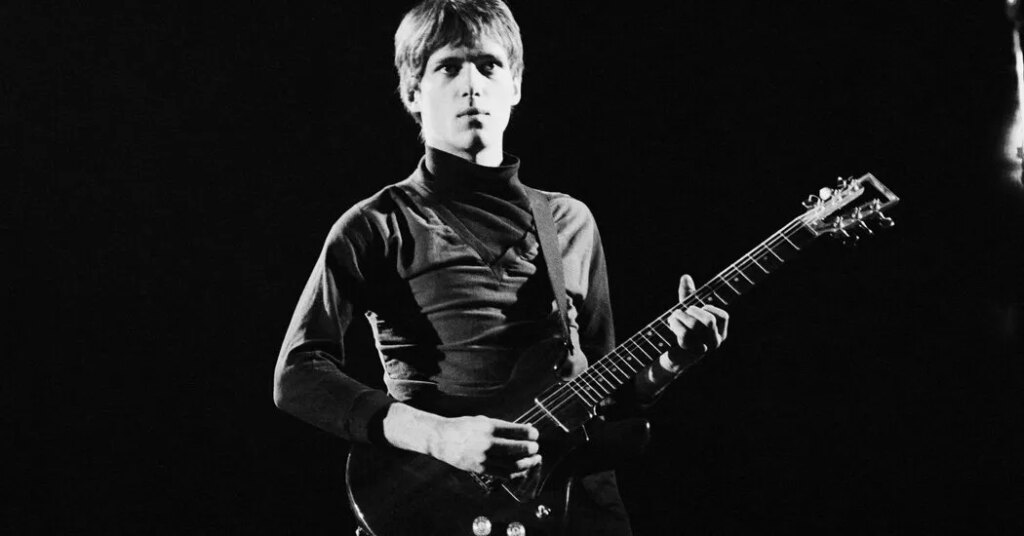
Richard Lloyd, half of the fierce yet intricate twin-guitar assault of Television, a defining if short-lived band of the New York City punk and New Wave movements of the 1970s, died on Saturday at his home in Chattanooga, Tenn. He was 75.
A statement from his family said that he died of cholangiocarcinoma, a bile duct cancer, with which he was diagnosed in March.
Formed in 1973, Television was a pioneering part of the punk rock insurrection that coalesced around the Bowery club CBGB. The band was among the first of its kind to play at what had once been primarily a venue for country music and bluegrass and would only later become a springboard for acts like Blondie, Talking Heads and the Ramones.
For its raw, unbridled energy, Television — featuring Tom Verlaine (lead vocals and guitar), Richard Hell (bass) and Billy Ficca (drums), along with Mr. Lloyd — was often called a garage band, though that garage contained the equivalent of a vintage Porsche. Marked by jagged rhythms, imagistic lyrics and jazz-inflected chord structures, the group’s cerebral art rock stood out among punk’s three-chord grinders.
Perhaps the band was a bit too arty: It released only two albums during its late ’70s heyday. While its 1977 debut, “Marquee Moon,” is widely considered a masterpiece — it was No. 107 on Rolling Stone’s 2023 list of the 500 greatest albums of all time — neither that nor the group’s 1978 follow-up, “Adventure,” cracked the Billboard 200 chart.
“Television,” Mr. Lloyd later observed, “would be out of place anywhere.”
Anywhere but the music collections of the rock cognoscenti, that is. An enduring critical darling, the band has been hailed as an inspiration by R.E.M., Sonic Youth, U2 and Pavement and other artists.
Unusually for the punk scene, its sound was built, like that of the Rolling Stones and the Allman Brothers Band, around the sophisticated interplay between its two guitarists.
“With Richard Lloyd on Strat and Verlaine on Jazzmaster,” Rob Sheffield wrote in Rolling Stone in 2023, “they jammed like CBGB’s answer to the Grateful Dead.”
Mr. Verlaine, who died in 2023, was the band’s frontman and acknowledged auteur — and was often cast as the resident guitar god, too. But as The Guardian noted in 2005, Mr. Lloyd’s guitar “was the louder in a lopsided sound mix, so it was impossible to overlook the amount of ground he was covering. Crisp, crunchy chords, dexterous fills and torrential Van Halen-style solos tumbled from his fingers.”
Richard Meyers Lloyd was born on Oct. 25, 1951, in Pittsburgh. In his 2018 memoir, “Everything Is Combustible,” he wrote that his father sold wristwatches in a strip club and his mother was a soda jerk. They married young and split when Richard was an infant, and he and his mother eventually moved to New York City.
Growing up in Greenwich Village, he first got his hands on a guitar during a sleepover at his cousin’s when he was about 7, he recalled in an interview earlier this year with Guitar World. He spent the rest of the night in the bathroom, practicing the same three chords over and over, as the other children pounded on the door.
As he got older, he dove deeper into music, taking in shows by the Grateful Dead and the Doors at the Fillmore East and attending the Woodstock festival. He also faced mental health issues, struggled with substance abuse and landed in a series of mental institutions.
Despite his challenges, he attended the prestigious Stuyvesant High School in Manhattan, but dropped out just before graduation. “I didn’t want a diploma,” he recalled in a 2023 interview with the site NJArts.net. “I had a guitar.”
After stints in Boston and Los Angeles, he returned to New York — sporting a flashy wardrobe and a spiky blond haircut — to join the scene forming around groups like the proto-punk glam band the New York Dolls.
His early days back in New York were spent chasing women and making ends sort-of-meet as a male hustler. He eventually found a place to crash at the Chinatown loft of Terry Ork, an Andy Warhol acolyte who managed a movie-memorabilia shop called Cinemabilia, where Mr. Verlaine (born Thomas Miller) and Mr. Hell (Richard Meyers) worked.
The two of them had formed a band called the Neon Boys with Mr. Ficca. They eventually brought Mr. Lloyd into the fold and changed the name to Television. Mr. Hell left in 1975 and was replaced by Fred Smith, formerly of Blondie.
With Mr. Ork as manager, the group approached Hilly Kristal, the owner of CBGB, looking for a place to play. When Mr. Kristal informed them that the club’s name stood for country, bluegrass and blues, Mr. Lloyd assured him disingenuously, “Oh yeah, we play a little of that.”
Television built its reputation at CBGB and other clubs, including Max’s Kansas City. Never mind that Mr. Verlaine’s voice sounded like “an intelligent chicken being strangled,” as Rolling Stone put it. Stars like Paul Simon and Lou Reed were soon dropping in on gigs, and David Bowie called Television “the most original band I’ve seen in New York.”
The band signed to Elektra Records, and in February 1977 released “Marquee Moon,” which announced its ambition with a title track that was around 10 minutes long, highly unusual in the rat-a-tat punk world. The album made little impression on charts dominated by the Eagles and Fleetwood Mac. But those who got it, got it in a big way.
“Sometimes it takes but one record — one cocksure magical statement — to cold-cock all the crapola,” Nick Kent wrote in New Musical Express, the influential rock publication in Britain, where Television would score three Top 40 singles and a Top 10 album. “Adventure,” marked by its wistful single “Days,” hit No. 7 on the British charts, but failed to make a dent with American record buyers.
By 1978, Mr. Lloyd was a “full-blown junkie,” as he later put it. At odds with Mr. Verlaine, he left the band, which subsequently broke up.
“We were both straining,” Mr. Lloyd told Guitar World. “I wrote songs, but none of them fit Television; I recognized that. I tried to present ideas — but when I did, he took writing credit” for the whole thing.
The next year, Mr. Lloyd released “Alchemy,” his first of nine solo albums. The Trouser Press record guide said it pursued “the melodic, sensitive side of late-period Television, leaving all the rough edges and manic intensity to Tom Verlaine.”
Mr. Lloyd also played on albums by the 1990s troubadour Matthew Sweet, as well as “Meet John Doe,” the 1990 solo effort by John Doe, of the Los Angeles band X.
Television briefly reunited in the early 1990s, performing at the 1992 Glastonbury Festival in England. The same year, the group released a new album, “Television”; its single “Call Mr. Lee” reached No. 27 on Billboard’s alternative chart.
Mr. Lloyd’s survivors include his wife, Sheila O’Keefe Lloyd, and a brother, Eric.
Despite their fertile musical partnership, Mr. Lloyd and Mr. Verlaine had no personal contact for many years. Still, Mr. Lloyd never failed to give the band’s most famous member his due — up to a point.
“There’s no denying that Tom was a genius,” he told Guitar World. “He was a poet. I’m not poetic. His double and triple entendre was better than mine.”
“But,” he added, “in the realm of our magic, my guitar playing was on another level.”
The post Richard Lloyd, Torrential Guitarist of Television, Has Died appeared first on New York Times.