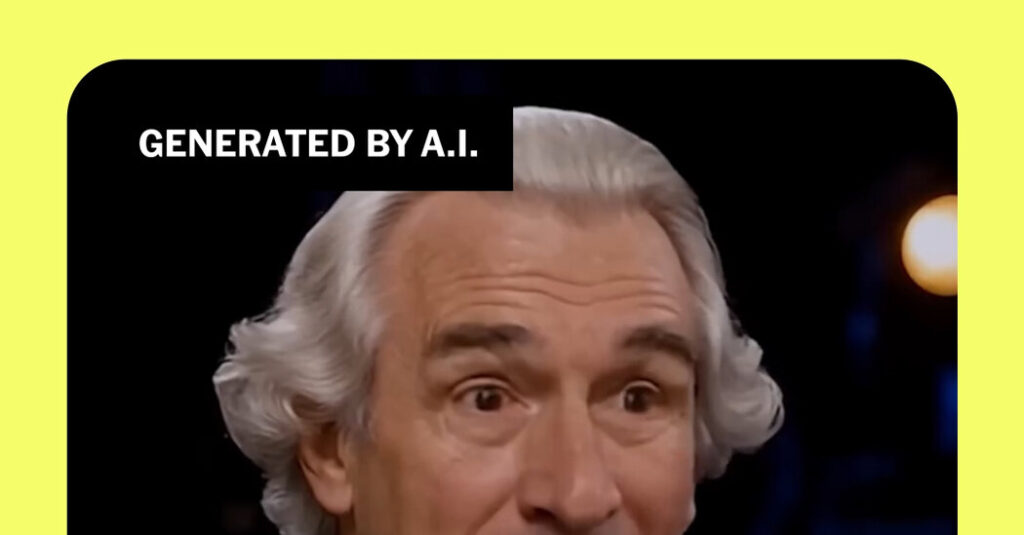
Late last year, Glenn Beck — the conservative commentator — was able to live out a longstanding right-wing fantasy: to bring back a founding father from the dead. In a video, set in what appeared to be a well-appointed podcast studio, sat George Washington across a table from Beck. This was not the George Washington of iconic portraiture but a George Washington who could have launched a CBD supplement company on the “Lex Fridman Podcast.” His body bulged lightly under a tight T-shirt; his hairstyle looked like a lacrosse-playing Goldman Sachs bro updating the powdered wig. This was George A.I.
The promise of George A.I. — and any A.I., for the technology’s evangelists — is truth, the irrefutable kind that lies beyond the comprehension of any one individual. But any A.I. is the sum of its inputs. The large language model, devised by Beck, was apparently backed by primary sources from Beck’s personal library of founding documents — which, he claims, is the third-largest in the world. George A.I. also included what Beck determined are the founders’ immediate influences, or what they would have supposedly read or encountered, from the Bible to Blackstone’s ratio. (A casual aside from Beck on one George A.I. video interview mentions that George can be “dumbed down” as necessary.) George is described as a “librarian” of this collection, but for now he’s mostly capable of producing Ken Burns-lite podcasts on rather banal questions of America’s founding.
When Beck does ask his George A.I. a question on contemporary society — on what is currently “the biggest problem, or where we should start to fix things” — George A.I. responds by describing what he sees as a “moral failing.” In George A.I.’s estimation, today’s Americans are spendthrifts, quick to abolish institutions they don’t understand and skeptical of “truth.” (The last bit is overlaid with imagery of a protest sign about trans children.) This seems like a headline ripped from the opinion page on Blaze Media, part of Beck’s vast portfolio, but he has claimed that his alignment with the founders is so snug, he’s more of a direct product of George Washington than George A.I. is a product of him.
In early March, a few days after the first U.S. strikes against Iran, Beck posted another clip of George A.I. — this time setting it up as an investigation into what Washington would think about the war. In the video, Beck challenges George’s original warnings against foreign entanglements, wondering if there might be the need to demonstrate “strength” to “prevent conflict,” to which George A.I. offers an analysis remarkably similar to Beck’s framing. (To highlight George’s pure inspirations, Beck mentions a more than 200-year-old precursor to the conflict with Iran: Thomas Jefferson’s war against “radical Islamic” Barbary pirates.)
In a time of public point-scoring and performative debate, invoking the founders to rail against contemporary cultural boogeymen has become an almost reflexive move on the right: Candace Owens talks about the founders as a moral compass for Black Americans, who were “set free then voluntarily chose to resubmit themselves to slavery” through “father absence” and “welfare”; Ben Shapiro has invoked their originalism to oppose the legal basis for same-sex marriage.
Lately, A.I. has supercharged this rhetorical trick. Now, conservatives can invoke the gravitas of the founding fathers without having to read an actual page of their writing, bypassing all knotty particularity. It’s a quick way to yank the founders from their historical contexts and turn them into time-traveling, all-powerful avatars.
Take the A.I.-based collaboration between the Trump White House and PragerU, a conservative educational nonprofit providing “pro-American content online.” That initiative, called the Founders Museum, has resulted in presidential portraits linked to chintzy A.I.-generated videos offering heavily editorialized capsule biographies. A.I. John Adams, while delivering quotes about liberty’s delicacy and his own principled inflexibility, parrots a line from Ben Shapiro: “Facts do not care about your feelings.” The unattributed citation is treated as almost incidental, the two figures part of the same continuum — past and present merely blurring together through cheeky aside.
What the creators of these founders videos seem to want out of Adams, Jefferson and others mirrors what many want out of the technology used to animate those figures. Both are meant to be faithful and accurate yet infinitely pliable and surprising; supposedly objective yet highly personal; concrete and fixed yet nimbly applied to a breadth of philosophical questions. The questions can veer into the obsessively particular, as they do in the videos of a right-wing streaming video creator called @historydad_ai. One clip involves Jefferson traveling to the modern-day Federal Reserve to learn why the central bank was created against his wishes; another shows a baffled Ben Franklin learning about the loss of the gold standard and the introduction of the income tax. In both videos, the founders throw in edgy jokes befitting the trollish podcasters they’re meant to emulate: Jefferson asks a supposed Fed chair, “Which one of you made Epstein hang himself?”
These videos are more outlandish than instructional. But both L.L.M.s and the fetishization of the founding fathers reveal a craving for absolute truth — the kind that had Joe Rogan and Sam Altman discussing the possibility of a “completely unbiased” A.I. president — that is blind to context or subjective motivations. This unseen background could be the blindness of 18th-century attitudes on personhood, or what leads to X’s Grok bringing up white genocide in South Africa unprompted.
Yet this belief in a neutral, mechanical arbitrator ignores the fact that L.L.M.s are tissues of text as subjective as “Don Quixote.” And as Don Quixote — stepping beyond Shapiro — says himself in “Man of La Mancha”: “Facts are the enemy of truth.”
Casey Michael Henry is a writer based in New York City. He publishes the cultural newsletter Slim Jim.
The post The Right Loves the Founding Fathers. They Might Love the A.I. Versions Even More. appeared first on New York Times.