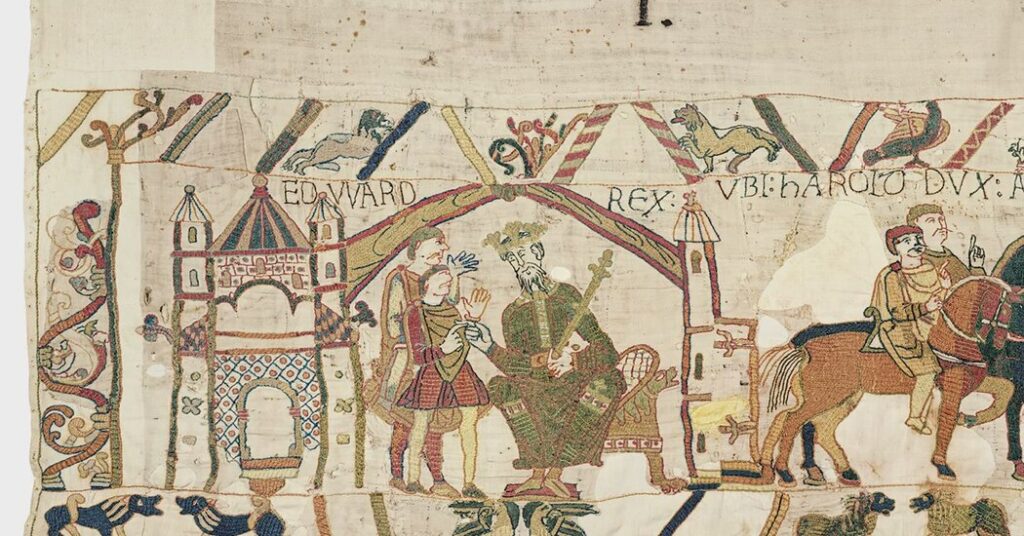
When Elizabeth II was about to be crowned in 1953, British officials decided on the perfect gift for the monarch-to-be: They would bring home the Bayeux Tapestry.
For over 900 years, the 220-foot-long embroidery depicting the 1066 invasion of England by William to Conqueror had resided in Bayeux, France. A celebratory loan of one of Britain’s most important cultural artifacts would have made an ideal coronation present, but there was a problem: French art experts wouldn’t let the tapestry travel. It was too fragile to move, they said.
French experts scuppered another British plan to borrow the tapestry in 1966 for the 900th anniversary of the invasion. Then again in 1980. Last year, too, the tapestry’s handlers insisted a loan was impossible.
And yet, against the odds, the tapestry is now in London. On July 9, at 6:15 p.m., a bright yellow truck carrying the masterpiece, sealed in a climate- and vibration-controlled case, left Bayeux in a secretive overnight operation. Accompanied by members of the French security services, the truck drove onto a Eurostar train that took it under the sea through the Channel Tunnel.
Once in England, the truck crawled through the night to the British Museum in London, where its cargo will be the star of a blockbuster exhibition that opens Sept. 10 and runs through July 11. Tickets are already sold out through Dec. 31, and the British Museum hopes attendance will rival the 1.6 million who flocked to its “Treasures of Tutankhamen” show in 1972.
When a decades-long no suddenly becomes a yes, something is clearly afoot. Since 2018, a legacy-seeking President Emmanuel Macron of France was among those leading the charge for the loan. King Charles III was a key encourager, according to Macron. So were several British prime ministers. The British government stepped in to insure the process for 800 million pounds, or over $1 billion.
Is the about-face over the tapestry a sign that political power can trump the concerns of curators and scholars? Or have conservation techniques developed so much that the impossible is now possible?
For those who oppose the loan, the answer is clear. Conservation teams may have done “everything possible to reduce risk,” said Didier Rykner, the founder of La Tribune de l’Art, a French art publication, but in the case of the tapestry, “everything is not enough.”
The loan had happened only because Macron wanted it to, Rykner said. “He thinks he knows better than experts.”
Scenes of Conquest
The list of reasons that the Bayeux Tapestry is so important is almost as long as the tapestry itself. Whereas many surviving medieval textiles are faded fragments, the Bayeux Tapestry is almost whole, and its red, blue and green threads still have an unexpected vibrancy.
Then there’s the story it tells: how William the Conqueror, a duke from Normandy in France, invaded England in 1066, deposing its last Anglo-Saxon monarch at the Battle of Hastings. Those events changed the English language, reshaped the country’s laws and upended its royal line. To many in England, the tapestry is a key symbol of British identity, like Stonehenge, Shakespeare’s plays or even the monarchy itself.
In 58 scenes that resemble plotlines from “Game of Thrones,” the tapestry’s narrative twists and turns, before climaxing in an epic battle between the armies of William the Conqueror and England’s king, Harold Godwinson. Calvary charge. Arrows fly. Swords cut through flesh, and heads tumble to the ground. In the tapestry’s best-known scene — depicting Godwinson’s death — the deposed monarch clasps an arrow that has thwacked into his eye.
It’s clearly a history told by the victor that establishes William the Conqueror as England’s rightful king. But it has also been used as a powerful symbol by the likes of Napoleon, the Nazis and now today’s political leaders.
The tapestry was likely embroidered in Canterbury, England, at some point in the 11th century, and historians aren’t sure how, when or why it made it to Bayeux, a city in northern France. It does not feature in historical records until 1476, when it appears in an inventory from Bayeux cathedral as “a very long and narrow hanging of linen, embroidered with figures and inscriptions representing the conquest of England.”
Although it was often stored in a cedar chest to guard against moths, the tapestry wasn’t always treated as a fragile masterpiece, even as, over the next few hundred years, its reputation grew.
In 1803, Napoleon ordered it moved along bumpy roads from Bayeux to the Louvre museum in Paris to help drum up support for his planned invasion of Britain. It later returned to Bayeux, from where some 19th-century English visitors wrote that the tapestry was “already ragged” and predicted that it would “be wholly ruined in the course of half a century.”
When France was under German occupation during World War II, the Nazis brought the tapestry back to the Louvre on the orders of Heinrich Himmler, who ultimately wanted it in Germany. But the Allies liberated Paris before the tapestry disappeared into a Nazi treasure trove. It went back to Bayeux, and in the decades afterward, the tapestry’s guardians all seemed to agree on one thing: It shouldn’t leave town again.
Down on One Knee
The centuries of rough handling had an impact: A study from 2020 found that the tapestry had 24,204 stains, 16,445 wrinkles, 9,646 holes and 30 tears. By that time, ideas about art conservation had changed drastically.
Ella Hendriks, a professor of conservation at the University of Amsterdam, said that conservation had emerged as a profession in the 19th century, when there were two schools of thought. Some artists and philosophers, exemplified by the English critic John Ruskin, thought that artifacts should be maintained as they were or left to naturally decay, arguing that the “golden stain of time” added aesthetic value. Yet the majority of incipient conservators and restorers felt a duty to keep artworks looking brand-new.
If a painting had faded, these conservators “wouldn’t hesitate to over-paint an area,” Hendriks said. If a textile was worn, they would happily re-embroider it. That led to some dramatic interventions, maybe even for the Bayeux Tapestry. Many historians think the arrow thwacking into Godwinson’s eye isn’t an original detail but one of several 19th-century modifications.
It was only in the early 20th century, Hendriks said, that conservation became as much a science as a craft. Temperature and humidity controls became commonplace in museums, as did the practice of keeping artworks behind glass. Conservators refused loan requests from institutions that didn’t meet their standards, and although they developed techniques to let many artworks crisscross the globe safely, they considered some pieces too precious to ever move.
But political power could overcome that stance.
In 1962, when Jacqueline Kennedy asked André Malraux, France’s culture minister at the time, if he would allow the Mona Lisa to tour the United States, he agreed despite stiff opposition. A group of the Louvre’s curators threatened to resign, and French newspapers published articles aghast at the idea.
Malraux ignored their objections, and later that year, the Mona Lisa crossed the Atlantic in a climate-controlled container onboard an ocean liner. After a sojourn in Washington, it headed to the Metropolitan Museum of Art in New York. It was on display there for only a few weeks, but over one million people caught a glimpse of the smiling beauty. It was the must-see show of the season — just as the British Museum hopes the tapestry will be.
For many of the tens of thousands of art lovers who signed a petition opposing the tapestry loan, its journey to Britain is reminiscent of the Mona Lisa’s 1960s travels — an event driven more by diplomatic posturing than by conservation expertise.
Macron first pledged to loan the tapestry to Britain as a gesture of friendship during a 2018 French-British political summit. As the two countries dealt with the fallout of Britain’s exit from the European Union, they could still make “a new tapestry together,” Macron told reporters at the time.
Isabelle Attard, the director of the Bayeux Tapestry Museum from 2005 to 2010, said in an interview that she had assumed it was an empty promise. When she joined the museum, she recalled, she had wanted to loan the tapestry to foreign institutions. “I was quite naïve and optimistic,” she said, but soon “everybody in Bayeux told me that was insane — that it was not possible for it to travel.”
Indeed, chatter around a loan soon died down after Macron’s 2018 pledge. Not long after the summit, relations between Britain and France soured over issues including illegal immigration and rival military deals.
By mid-2021, the Bayeux Tapestry loan was “in the deep freeze,” recalled Menna Rawlings, a former British ambassador to France. She said she had kept pushing for it, and recalled that Macron was supportive during a 2023 World War II commemoration event in Normandy. But by spring 2025, Rawlings said, a deal looked unlikely. She recalled a meeting at the French culture ministry that involved “a load of very senior civil servants saying, ‘This can’t happen. The tapestry is too fragile. The scientists say so.’”
Things suddenly changed at last year’s Cannes Film Festival. Chris Bryant, a senior British government culture official, traveled there for a half-hour hotel meeting with Rachida Dati, France’s culture minister at the time. Bryant said that the pair were supposed to discuss a loan, but Dati arrived 25 minutes late. It seemed like a bad sign, Bryant said, and he assumed that any deal was off.
Yet when Dati breezed in, she told Bryant she had some good news — but first he had to get on his knees and propose.
“I said, ‘I’ve already got a husband,’” Bryant recalled. “So do I,” Dati replied, according to Bryant: “What’s wrong with polyamory?” So Bryant went down on one knee. (A spokeswoman for Dati did not respond to requests for comment.)
A few weeks later, in July, Macron announced the loan during an event at the British Museum. France had blocked all previous attempts to borrow the tapestry by finding “the best experts in the world to explain in perfect details why it was totally impossible,” Marcon said. “We went beyond the experts,” he said, “and managed to find great solutions.”
A president who loves a grand gesture — particularly one achieved in the face of opposition — had secured the impossible loan. It would be part of his legacy.
‘Tac, Tac, Stop!’
Undoubtedly, one logistical factor played a role: The Bayeux Tapestry Museum was scheduled to close temporarily for a much-needed renovation.
Since 1983, the museum had displayed the tapestry in a U-shape, hanging from curtain hooks attached to a rail. That arrangement had put unnecessary strain on the embroidery, and conservators said it should be displayed laid out flat after undergoing a restoration. By the time the museum shut last fall, technicians — led by SMACH, a French conservation company — had spent years working on a plan to get the tapestry off its hooks and into storage.
Their operation played out one day last September, when about 100 technicians lined up along the tapestry’s length and carefully slid it along its rail, about two inches at a time, detaching it from the hooks and fastening it to a new railing on a series of panels that form a loose concertina. One of the French museum’s curators rhythmically intoned “Tac, tac, stop!” to guide each movement in a process that took six nerve-racking hours.
Hizkia, an art transportation company, working with experts in vibration engineering, then put the folded panels into a climate-controlled case suspended in a spring-mounted metal cage. Geert Verhoeff, an operations manager at Hizkia, said that the springs, known as “wire rope isolators,” functioned like “an old-school baby carriage” and had allowed his company to safely move incredibly fragile items like porcelain and paintings.
Once the tapestry was moved from the museum to a nearby storage location, the Hizkia team and other conservators undertook two trial runs in which they drove a mock tapestry to the British Museum, hoping to work out the route and collect vibration data so they could improve the design of the protective crate. (The British Museum declined to say how much the move had cost.)
When the tapestry set off for London on July 9, nothing had been left to chance.
Unraveling the Risk
For some critics of the loan, however, the move was still too risky.
Rykner, the Tribune de l’Art editor, said that the Bayeux authorities were taking a reckless gamble. A 2022 French government feasibility study said that moving it would “inevitably” subject the artifact to “further stress.” And a 2026 study said that too little was known about the tapestry’s “mechanical properties” to set a “scientifically robust” vibration limit for transportation.
Shirley A. Brown, an art history professor at York University in Toronto who is an expert on the tapestry, said in an email that she knew some French conservators “were dead set against the loan” but that, as employees of French state, they had to keep quiet.
Yet many conservators support the loan, not least because it means the tapestry will inspire thousands of people who otherwise wouldn’t see it. Hendriks, the conservation professor, said that many in the field now aimed to give artifacts the “best life” possible, rather than simply limiting damage. That could include allowing loans to museums with slightly worse temperature and humidity controls if it meant more public exposure and greater interaction.
On a Friday morning last month, as the British Museum prepared for its blockbuster show, the Bayeux Tapestry was lying flat on a 220-foot-long table, its tableaux of kingly warfare hidden beneath black protective sheets. To get ready for a visit from France’s culture minister, two conservators began unrolling the sheets one at a time, exposing scene after vivid scene.
At one end, a royal messenger raced on horseback, his hair flowing in the wind. In the center of the tapestry, two lumberjacks swung axes into trees to build William the Conqueror’s naval fleet. At the other end, the invading army clashed bloodily with its Anglo-Saxon rivals.
The tapestry had been removed from its transit case a day earlier, in an operation involving about 100 people that lasted from 7 a.m. until 3 the following morning — an intense 20 hours of focus. The team had connected the tapestry onto a rail, hoisted it skyward, then lowered it onto the specially constructed table.
It seemed like a success. Yet Cécilia Gauvin, one of the engineers involved, said that her team had found a “really small amount of threads” when unboxing the tapestry, although it was unclear if they were from the handlers’ clothes or from the embroidery itself.
Michael Lewis, the British Museum curator overseeing the show, didn’t seem worried about the threads. “Obviously you don’t want any damage,” he said, “but my colleagues seem very ‘Whatever’ about that.” His team and its counterparts from Bayeux had managed “a one-off,” he said, and set a new bar for how to move and display a historical treasure.
“To protect an object,” Lewis said, “sometimes you have to show it.”
The post The Bayeux Tapestry’s Long and Bumpy Road to London appeared first on New York Times.