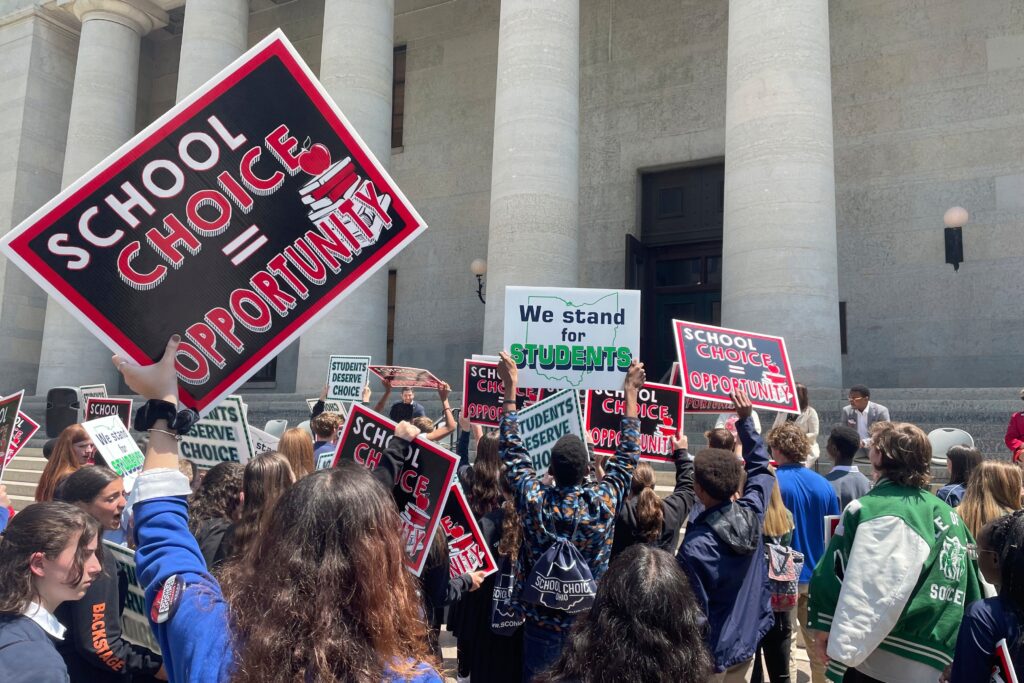
School-choice advocates have spent decades persuading one state after another to establish vouchers and other publicly funded programs to help families pay for private education.
But after the blue wave in the midterm elections this month, Democrats are vowing to eliminate or overhaul many of those programs, including in Texas, New Hampshire, Ohio and Arizona. A new voucher-style federal tax credit for K-12 scholarships could be at risk, too.
“We are definitely going to be in defense mode. There is no doubt,” said Robert Enlow, chief executive of EdChoice, a nonprofit that advocates school choice.
Vouchers have typically been pushed by Republicans and fought by Democrats, who often complain the programs subsidize tuition and amenities for higher-income families who were already paying for private school.
The political power shift may represent one of the biggest challenges to the education subsidies, potentially reversing years of steady expansion.
Nationally, state programs provide funding for private education for more than 1.5 million students in 34 states, up from 60,000 students in 2000, according to EdChoice. That’s about 3 percent of all K-12 students in the United States. The midterm elections gave Democrats power in five of the six states that spend the most money on vouchers and other publicly funded programs to help families pay for private schooling.
Supporters say the programs have been critical for families with children who don’t have access to a good local public school or need more specialized services and can’t afford private education on their own.
“The most important reason these programs exist is because education in America is still woefully inadequate for most people and particularly dismal for our least-served children,” said Jeanne Allen, founder and chief executive of the Center for Education Reform in D.C., which promotes educational choice.
But some teachers unions and other critics argue that changes are needed. They say providing vouchers for children to attend private schools drains billions of dollars from public education with little accountability to show how the money is spent.
In many states, private schools can reject children based on disabilities or religion, their teachers do not need to be licensed, and their students may be exempt from at least some standardized tests, making it harder to track their progress.
Moreover, critics say much of the money for taxpayer-funded scholarships and vouchers winds up going to families with children already in private or home school, rather than lower-income families who need financial assistance to help their children leave an underperforming public school.
Princess Moss, president of the National Education Association union, said voters sided with public schools when they backed Democrats who have been critical of voucher programs.
“In order for public education to be the great equalizer, public education has to be resourced appropriately,” she said.
Democrats gained control of the governor’s office or at least one legislative chamber in 13 states in the midterms.
Texas Gov.-elect Gina Hinojosa, the first Democrat elected to that office in decades, took aim at the state’s new voucher program in a victory speech.
“We will work tirelessly to repair the damage of the Texas vouchers scam,” she said in her speech.
The Texas program, which began this year, supports more than 111,000 students at an initial cost of $1 billion. It offers education savings accounts up to $2,000 per student for home-schooling expenses, more than $10,000 for private school education and up to $30,000 for qualifying students with disabilities who need more expensive schooling.
Democrats also won control of the Texas House, but Republicans retained control of the state Senate, making it difficult to eliminate the program. Hinojosa could, however, use the line-item veto to block funding for the program in future years. She told The Washington Post on Friday that she plans to negotiate with the legislature to reshape the program, potentially using it to expand access to prekindergarten.
In North Carolina, Gov. Josh Stein (D) has consistently opposed expanding the state’s voucher program and has questioned why the state takes “billions of dollars out of public school kids’ backpacks to give wealthy families giveaways to spend on unaccountable private schools,” a spokesperson said.
Now Stein may have gained enough support to curb spending on the program — voters put Democrats in control of the state House and narrowed the state Senate’s Republican majority.
In Ohio, Democrats have vowed to add more accountability to the state’s scholarship programs, which serve 180,000 students.
Ohio Gov.-elect Amy Acton’s transition team said the Democrat plans to “fight to reform the corrupt school voucher system, which funnels billions of taxpayer dollars to private schools with no transparency or accountability.”
In Iowa, Republicans kept their majority in the state’s legislature, which could make it harder for Democratic Gov.-elect Rob Sand to limit the program.
Sand said he wants to install guardrails on the state’s $330 million program that gives eligible families about $8,000 a year for private school tuition and other educational expenses, with income limits and annual audits. He has also called for private schools that accept public dollars to accept any student who wants to attend, as a public school does.
“We’re putting hundreds of millions of dollars every single year into the pockets of people who have plenty of money — good for them — and are already going to send their kids to private school,” Sand said in a video posted to his Facebook page. “But your tax dollars don’t need to go pay for that.”
Democrats also won their first trifecta in Arizona since the 1960s, and lawmakers are pledging voucher reforms, including an audit, income caps, safety regulations and stricter rules governing how the money may be used.
The state has the second-largest collection of programs to help families pay for private education, costing more than $1 billion a year. It includes education savings accounts and tax credits to support scholarships.
“We need a full audit of the program,” said Arizona state Rep. Nancy Gutierrez (D), who is poised to become the House majority leader. “It’s a runaway program that is costing Arizona taxpayers almost a billion dollars a year.”
Democrats also flipped the House and the Senate in New Hampshire. Though the state will continue to have a Republican governor, state Sen. Debra Altschiller (D) said she is convinced the new legislature will be able to create more accountability and reporting requirements for its program — state-funded education accounts that let families spend money on tuition and other educational expenses.
Altschiller said families have spent money from the accounts on everything from horseback-riding lessons to ski passes and Amazon purchases.
“We will be unwinding some of the more egregious issues and look for accountability,” Altschiller said.
Altschiller said lawmakers will also consider next year whether the program should be funded at all, because so many other programs need money. In 2025, the state Supreme Court ruled that New Hampshire had underfunded nearly all its public school districts. At the same time, funding for the state’s Education Freedom Account program is expected to cost the state more than $60 million this fiscal year to support about 12,500 students.
Allen, the school choice advocate, expressed skepticism that Democrats will be able to do much to slash or eliminate the programs nationally. The programs have become too popular with families and too embedded in many states to eliminate, she said.
“You cannot rip opportunity out of a child’s hand. You just cannot,” Allen said.
Democrats are also expected to target the new Federal Scholarship Tax Credit once the party gains control of the House and the Senate in January. But Republicans could attempt to block those efforts with a Senate filibuster or presidential veto.
The credit, slated to go into effect next year, will allow individual taxpayers to claim a dollar-for-dollar tax credit of up to $1,700 for donations to a designated scholarship-granting organization. The organization will in turn award scholarships for qualified K-12 expenses, such as private school tuition or tutoring for public school students.
But governors first need to opt in to the federal tax credit program. So far, more than 30 states, mostly with Republican governors, have pledged to opt in. Though former Republican Virginia governor Glenn Youngkin has said he was the first to begin the process of enrolling in the program, Democratic Gov. Abigail Spanberger, who took office this year, won’t finish the work to opt in, a spokesperson told The Post last week.
Even with Democrats gaining power in state capitols around the country, some voucher advocates remain hopeful.
Norton Rainey, chief executive of ACE Scholarships — one of the country’s largest scholarship-granting organizations — said he’s putting his foot on the gas, with plans to hire more staff members.
Enlow, of EdChoice, said that he has seen many political setbacks for choice programs over the past few decades but that the programs have continued to grow.
“I don’t think you can put the choice genie back in bottles,” he said.
The post Private school vouchers at risk in some states as Democrats gain control appeared first on Washington Post.