In March, a federal judge did President Donald Trump a favor by striking down his administration’s attempts to upend the childhood vaccine schedule. The changes had proven extremely unpopular, including among Republicans. White House officials used the opportunity to push Health Secretary Robert F. Kennedy Jr. toward other pet projects.
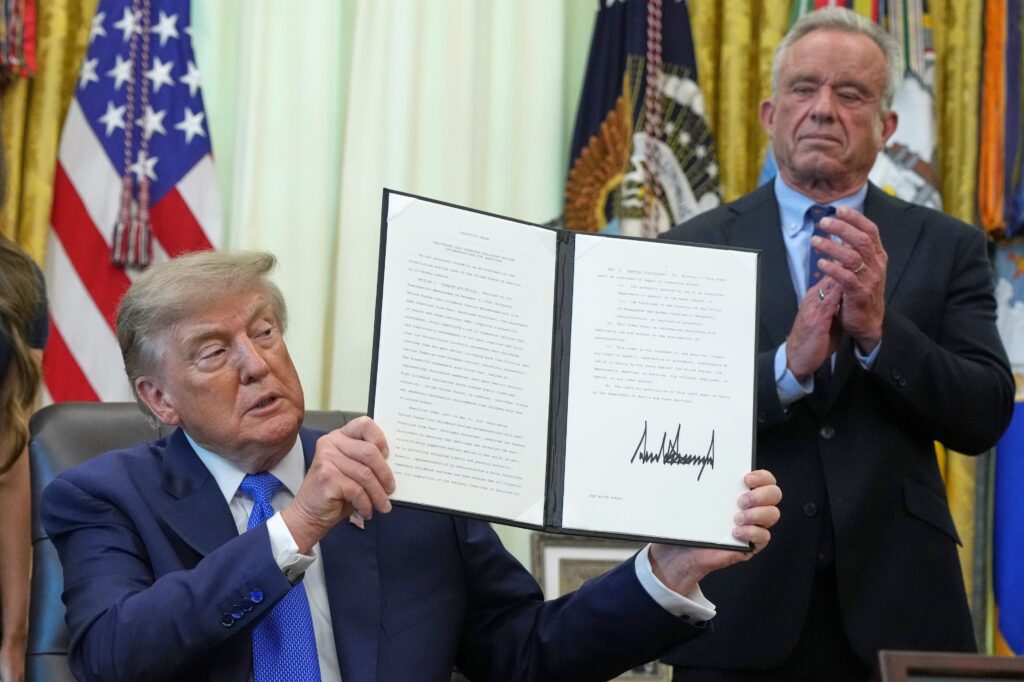
The president, however, couldn’t abide victory through defeat. On Monday, he signed an executive order reviving the issue, directing federal agencies to advance his new vaccine schedule “to the fullest extent allowable by law.”
Trump’s order will probably not have immediate repercussions, given that it has already been blocked in court and that states control vaccine mandates.
Nevertheless, the details are unnerving. Previously, the government recommended universal childhood vaccines for 18 illnesses. Trump’s schedule reduces that to 11 and recommends administering them at separate medical visits “to the maximum extent feasible,” stressing “maximal parental choice.”
That would further erode Americans’ faith in lifesaving vaccines and undermine herd immunity.
In the Oval Office, Trump claimed that the combined measles, mumps and rubella vaccine might be “quite lethal,” and that if the components were delivered separately, they would be “not at all lethal.”
The claim is irresponsible, possibly deadly. The MMR vaccine has been available in its combined form since the early 1970s, and research has repeatedly affirmed its safety. It’s also not possible to simply administer the vaccine as three separate shots. Developing such an option would take years of clinical trials.
Yet Trump’s assertion might convince parents to forgo the vaccine at a time when measles is spreading at its highest levels in more than three decades.
The United States has rightly prided itself on having the world’s most robust vaccine recommendations, developed over decades through careful examination of research by epidemiologists.
Trump’s proposal would replace much of that work with the judgment of a handful of political appointees who disdain the medical establishment. They have arbitrarily modeled their schedule off the immunization practices of Denmark, a country with a population about the size of Wisconsin and a dramatically different health system.
This is not a policy seeking to “follow the science, wherever it leads,” as Erica Schwartz, the president’s new director of the Centers for Disease Control and Prevention, promised during her confirmation hearing. This is cherry-picking data to support a preferred outcome: fewer childhood vaccines.
Americans may pay the ultimate price.
The post The arrogance of Trump’s vaccine policy appeared first on Washington Post.