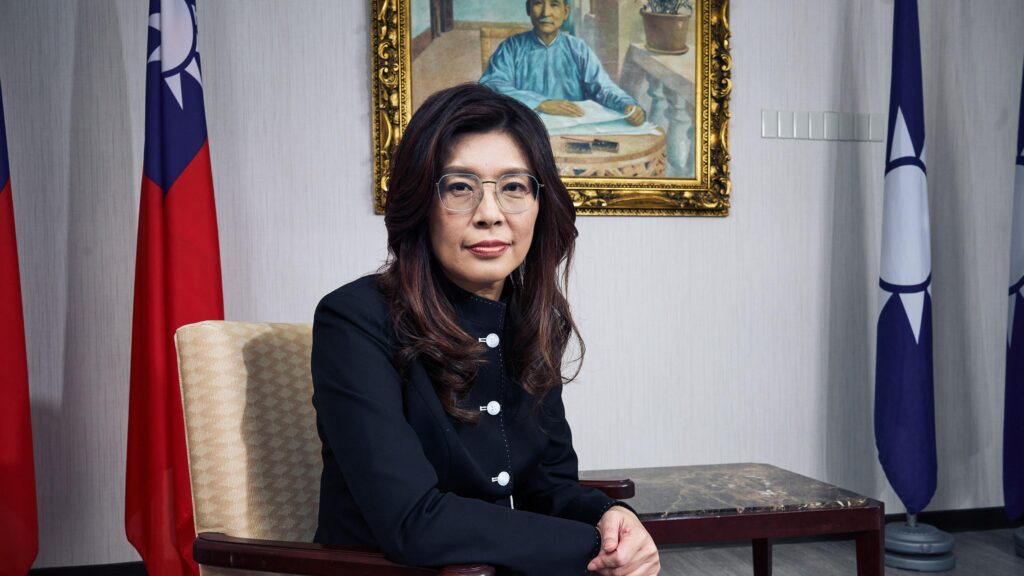
Cheng Li-wun once called for the destruction of the party she now leads. Back in 1988, when she was still a teenager, Cheng took the dais at a farmers’ rally to condemn Taiwan’s Nationalist Party, or KMT, as “the most detestable ruling force,” urging her compatriots to “overthrow KMT tyranny and establish our own country.”
Today, Cheng runs the KMT from its Taipei headquarters, where her chairperson’s office boasts the eclectic talismans of her unconventional journey: a cuddly kangaroo, a model Xiaomi electric car, and a jade Buddha statue guarding her desk. “I’m a very devout Buddhist,” Cheng tells TIME.
Read more: Taiwan in the Shadow of War
Cheng’s stunning transformation from Taiwanese independence zealot to leader of the self-ruling island’s China-friendly opposition is illustrated by another office adornment: a framed copy of the China Daily newspaper documenting her April meeting with Chinese President Xi Jinping in Beijing, under the headline “Xi calls for closer bonds across Strait.”
It was the first trip by a KMT leader to China in a decade and came against a backdrop of spiraling tensions, with near-daily Chinese combat aircraft, warships, and coast guard vessels rehearsing port blockades, precision strikes, and foreign-intervention denial. “Before the meeting [with Xi], nobody really had expectations of how it would go, and I think that they were very surprised by the goodwill that we received,” Cheng says.
For Xi, Taiwan is not merely unfinished business from the 1945–49 Chinese Civil War, after which the routed KMT fled to the now democratic island of 23 million. It is the keystone of a far grander project: the national rejuvenation of China as the world’s dominant technological, economic, and political power. The island’s very existence—a prosperous, democratic Chinese society integrated with the West—offers a stinging rebuke to the claim that authoritarian rule is uniquely suited to the Chinese people.
Cheng’s conversion encapsulates Taiwan’s own agonizing debate: whether security lies in distancing itself from the power threatening to take the island by force, or drawing closer to it. The ruling Beijing-skeptic Democratic Progressive Party, or DPP, sees Taiwan’s future as distinct from China’s and has prioritized building trade and other unofficial ties with Asian neighbors. In 2010, China accounted for 83.8% of Taiwan’s total outward investment; during the first five months of 2026, that figure had plunged to just 0.9%.
That decoupling has also seen Beijing squeeze Taiwan economically and diplomatically. Over the past decade of DPP rule, Beijing has restricted imports of Taiwanese goods and limited free-spending tourist arrivals, while poaching 10 of Taiwan’s diplomatic allies, so that only 12 remain.
Read more: The U.S. Must Beware of Taiwan’s Reckless Leader
Swelling anxiety increasingly shapes Taiwan’s domestic politics. Within the KMT, there is a strong belief that Washington cannot be relied upon indefinitely and that Taipei must engage Beijing from a position of weakness. The party’s implicit message is that Taiwan will not choose unification now—but nor will it formally choose another future.
Cheng’s emergence embodies that bargain. Despite her pro-independence past, Cheng has embraced Chinese identity, the so-called 1992 Consensus that both sides of the Strait belong to “One China,” and direct engagement with Beijing. Her meeting with Xi allowed Beijing to display its neglected carrots: economic incentives, restored exchanges, and the promise of stability. But Cheng’s limited electoral experience, thin Washington ties, and lackluster appeal to the KMT’s traditional base leave open the question of whether she can persuade Taiwan’s broader electorate.
“It’s not a good move for Taiwan,” Puma Shen, a DPP lawmaker and the party’s candidate for the upcoming Taipei mayoral election, says of Cheng’s meeting with Xi. “China is the country that wants to invade Taiwan … and they’re also pushing more and more gray-zone tactics.”
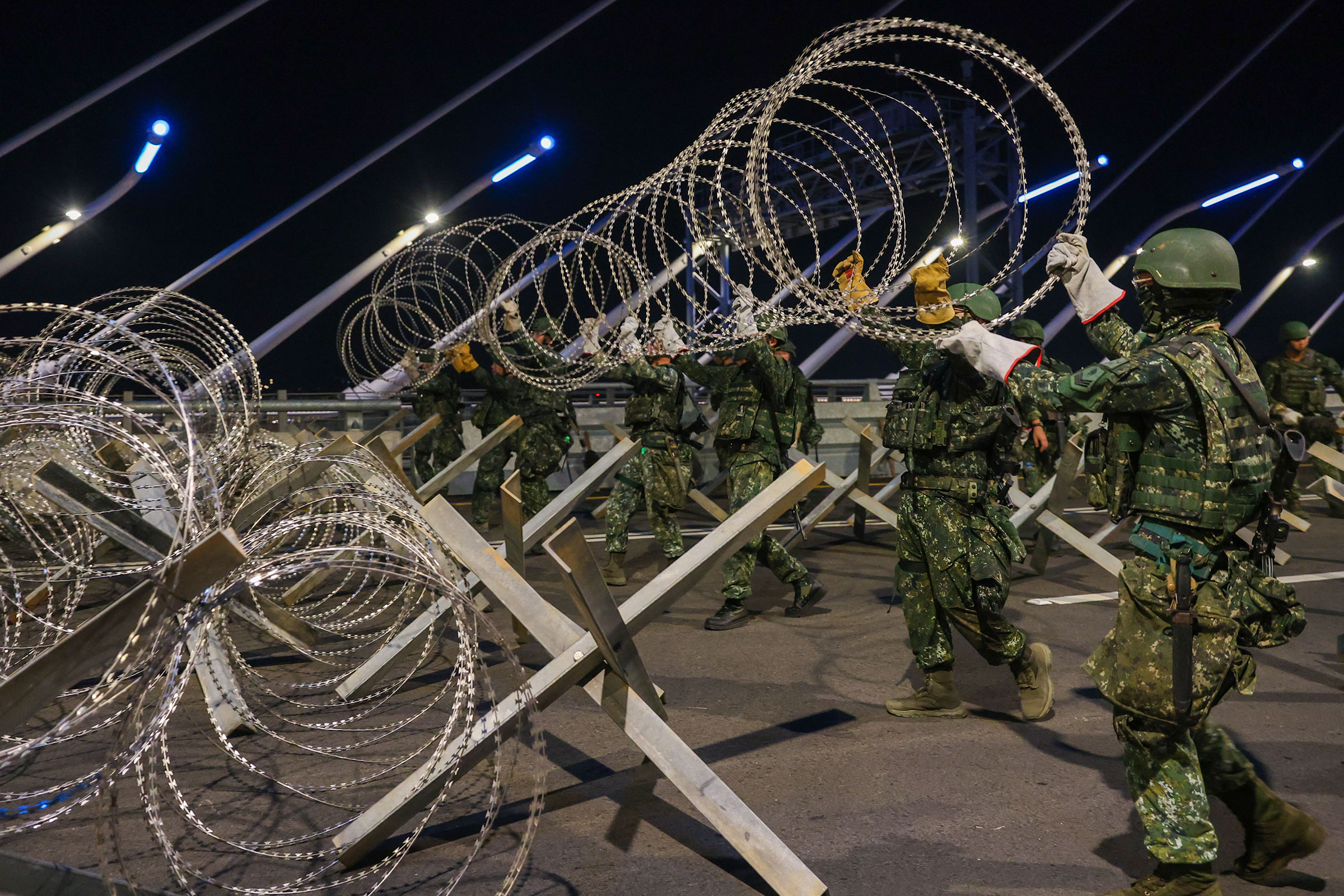
Yet that doesn’t necessarily mean Xi is racing toward war. He appears to regard history as moving inexorably in China’s favor and may believe he can afford to wait. The surest form of deterrence, then, may not be convincing Beijing that unification is impossible, but that patience remains the least costly path.
“I want to do away with the Cold War thinking,” says Cheng. “I do not want the first island chain to be thought of as the front line of military conflict. Rather, I would like it to be the front line of peace.”
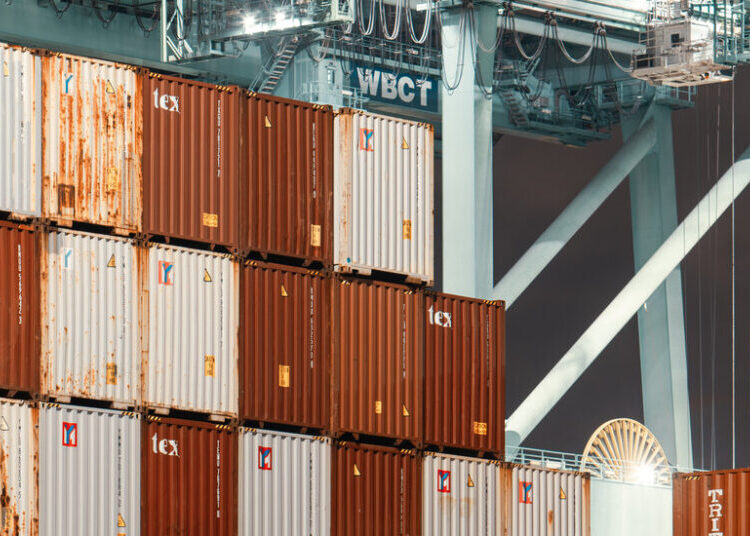
The need to dial down the temperature is indisputable. A Taiwan contingency would decimate global supply chains in unprecedented ways, costing some $10 trillion, according to estimates by Bloomberg Economics. Opinion is split, however, on how best to prevent conflict.
While the DPP has formal independence for Taiwan written into its party charter, its recent leaders have pragmatically skirted that goal, aware that Beijing has vowed to meet secession with a military response. But such ambiguity has cut little ice with China’s leadership, which loathes President Lai Ching-te as a “provocateur and saboteur of peace.”
Cheng’s prescription is direct engagement and the revival of the KMT’s role as an intermediary between two governments that, under two-and-a-half DPP terms, only communicate through warplanes and naval exercises. But peace offered by a stronger adversary rarely comes without conditions—and Cheng’s task is to prove she understands the stakes.
“This is a really important time for Taiwan,” she says. “Are we going to go toward war or toward peace across the Strait? This is really why I decided to take the party chair.”
Standing 5 ft. 10 in., Cheng is an arresting presence with a reputation for chest-thumping speeches. Sure enough, during our interview, her answers betray a bombastic staccato honed on the stump. Behind the scenes, however, she is amiable and slightly introverted.
“I actually am a very, very quiet person,” she says. “I don’t like to see people, and I don’t like to talk to people. I like to keep to myself.”
It’s a surprising revelation given Cheng’s political journey under the spotlight, which in many ways reflects the complicated social dynamics of Taiwan, where political fault lines have historically been drawn between native islanders and mainland arrivals following the Civil War.
Cheng grew up in the southern city of Tainan, the daughter of a Taiwanese mother and a KMT soldier father from China’s southwestern Yunnan province, who fled to Taiwan in 1953 via Southeast Asia’s arcane Golden Triangle. “My father really hated politics, hated war, and hated the army,” Cheng says. “He hated the KMT. My father thought all politicians are assholes!”
How would he react to her current position? “I surprised my father quite a few times!” she laughs.
Indeed, Cheng was once a student leader in Taiwan’s Wild Lily democracy movement of the early 1990s, though her participation came as something of a shock to her parents. “One day when I was leaving my home, my father said, ‘Don’t go out today, it will be very dangerous,’” Cheng recalls. “He didn’t know I was the leader!”
After graduating in law at National Taiwan University and Philadelphia’s Temple University—she later earned a master’s degree in international relations at Cambridge—Cheng served as a DPP representative in the now-defunct National Assembly. As the daughter of a mainlander, she enjoyed a fast-tracked rise in a party desperate to broaden its appeal beyond its native Taiwanese base.
But Cheng resigned from the DPP after criticizing the party’s handling of sexual harassment allegations against a superior that were eventually dismissed, spurring disciplinary proceedings against her. Cheng insists her defection had nothing to do with sour grapes, but a Damascene realization.
“I became very disappointed because I realized that the DPP’s advocating for Taiwan independence was really a scam,” she says. “It’s something they pull out during elections in order to get votes.”
Cheng joined the KMT in 2005 and was elected as a lawmaker three years later, also serving as party spokesperson and hosting a TV talk show after briefly losing her seat. “I only did that for the money,” she laughs. After returning to the legislature, Cheng was then elected as KMT chairperson in October on a platform of reengagement with China. “Based on the 1992 Consensus, we want to create sustainable and institutionalized peaceful cross-Strait relations,” Cheng says.
Yet her rise was contentious. Cheng’s candidacy for the KMT leadership was supported by a social media blitzkrieg that critics allege was underwritten by Beijing. “That’s part of [China’s] information operations,” says Shen. “Tons of YouTube channels just emerged … to praise Cheng Li-wun. That’s one of the reasons why she got elected.”
Cheng vehemently denies she is a stooge of the Chinese Communist Party. “It’s a ridiculous joke,” she says. “This is a complete fabrication.”
It will be left to voters to decide. On one hand, Taiwan’s citizens have a dwindling affinity for the mainland; the proportion of Taiwanese who reject unification rose from 39% in 2005 to 61.7% this year. However, coercion and the constant specter of war have also fed disillusionment and conflict fatigue. A separate survey last year found that only 40.8% of respondents were willing to lay down their lives to protect the island—down four percentage points from two years earlier. Meanwhile, 58.3% favored resuming government-to-government talks with Beijing and easing people-to-people exchanges.
It is often quipped that Taiwanese want a “Goldilocks approach” to cross-Strait relations, says Ryan Hass, an expert in China-Taiwan relations at the Brookings Institution. “Not too hot, not too cold, just right.”
The problem is whether dialogue alone will be enough to satisfy Beijing. During the last KMT administration from 2008 to 2016, Xi pushed then President Ma Ying-jeou hard to enter talks toward closer political integration. Ma demurred, saying the time was not yet right. But by Taiwan’s next presidential election in 2028, 12 years will have passed since that strategy was last tested—and the gamble is whether Xi can still be strung along.
“Beijing is probably eager to pick things up and push them forward, maybe on a timeline that is a little bit more ambitious than what the KMT are hoping for,” says Hass. “This is the underappreciated risk of the KMT retaining power. Because unrealized expectations can fuel disappointment and actions that relate to it.”
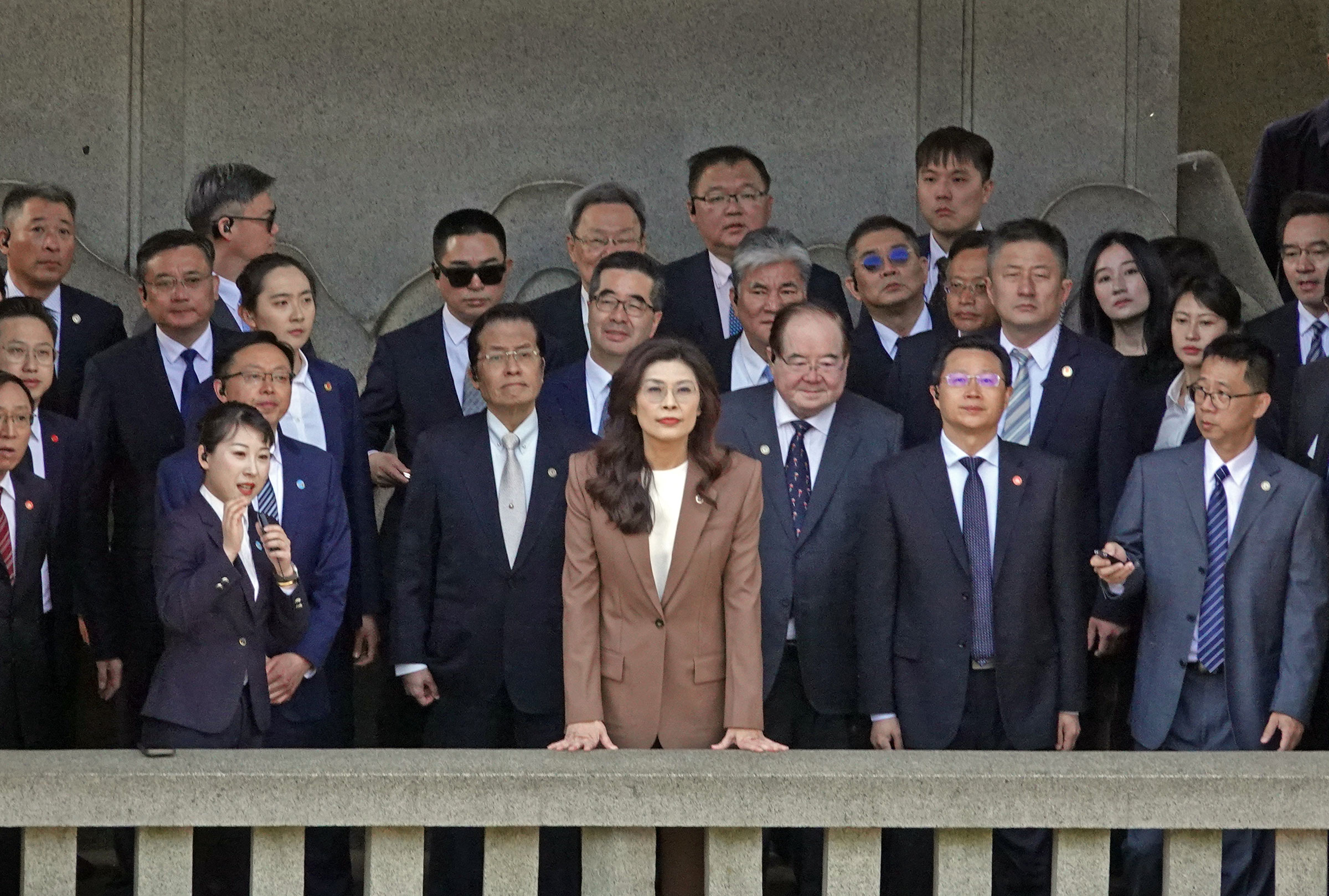
Taiwan certainly has no appetite for Beijing’s standing offer of reunification under “one country, two systems,” the framework used in Hong Kong, where freedoms have drastically eroded. Cheng highlights that Xi did not raise “one country, two systems” in their April discussions and that they saw “a very friendly side” of the strongman. “He expressed real, authentic sentiment toward us and goodwill,” she says. “He treated us as members of the same family … and cherished the opportunity to show that he is not interested in war.”
Would she consider a referendum on reunification? “There is no rush to make any changes to the status quo,” Cheng says. “A referendum would count as a big change, and that would have to align with the interests and willingness of the Taiwanese people.”
Cheng’s words are carefully calibrated to reflect the tightrope she must walk. The KMT has long adhered to the mantra: “Endear ourselves to the U.S., befriend Japan, and pacify China.” But following three straight presidential election defeats and plummeting poll numbers, Cheng won the party leadership on the platform that a radical shake-up was needed. With anxiety growing over U.S. security guarantees under the capricious Donald Trump, Cheng’s pitch was that befriending Beijing was the party’s ace in the hole.
Cheng is now attempting to forge a controversial “Taiwanese KMT” narrative, delicately balancing local sentiment with an overarching Chinese identity. But it is an uneasy pivot: she cannot talk too much about shared democratic values lest she irk Beijing, and she cannot lean too heavily into blood bonds between Chinese across the Strait for fear of alienating Washington. What remains is a torrent of bromides without a clear plan for moving closer to China without salami-slicing away Taiwan’s cherished autonomy.
“I am not only seeking reconciliation across the Strait but also a better relationship between the U.S. and China,” Cheng says. “That not only helps create peace in East Asia but in the whole world.”
Above all else, securing U.S. commitment to Taiwan is paramount. While Washington officially switched recognition from Taipei to Beijing in 1979, the U.S. is obliged by act of Congress to provide Taiwan with the weapons it needs for its own defense. However, the latest $14 billion package—the largest ever—has still not been signed off by Trump. The understanding in Washington is that the U.S. commander-in-chief does not want anything to derail Xi’s prospective state visit to the White House next month.
Cheng’s Beijing visit was also historic because she was the first KMT leader to visit China before the U.S.—which she eventually did in June. She denies this indicates that she is placing cross-Strait ties above those across the Pacific.
“The situation across the Strait is very tense and hostile, and we had to take the first step to show that we are interested in peace,” she says. “That’s the reason that I wanted to take that peace tour first—I had to confirm that there was this willingness to create peace in the Taiwan Strait before I went to the U.S.”
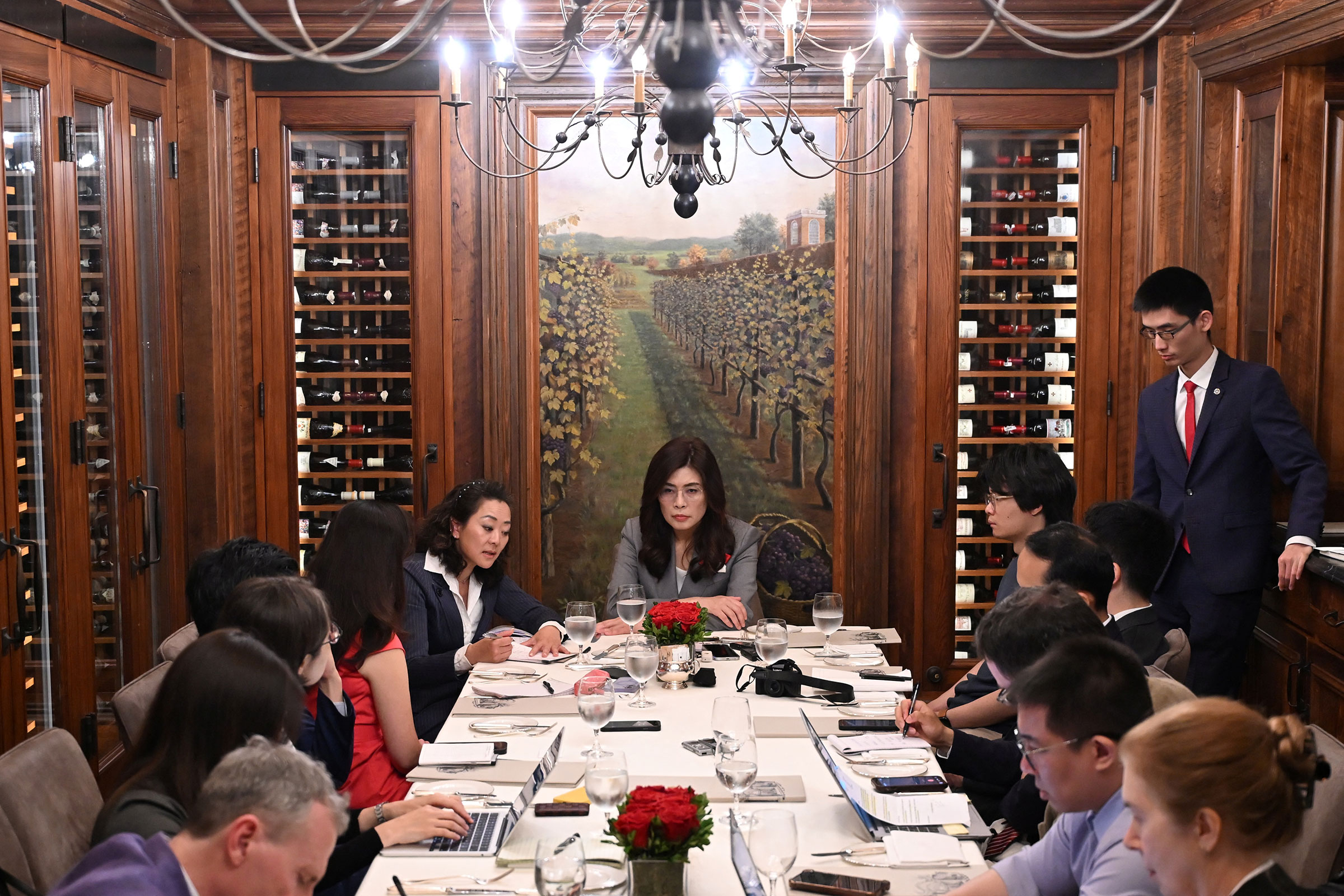
If that trip was intended to reassure the Beltway, it was not entirely successful. Cheng did not meet Trump and appeared to upbraid U.S. foreign policy when she told crowds in New York City that she did not want Taiwan to become the “next Strait of Hormuz.” She also attracted criticism for saying there is no reason ethnic Chinese cannot exert similar influence over American society as the Jewish community, prompting condemnation for seeming to parrot an antisemitic trope.
It was not her only questionable statement on the road. Cheng raised eyebrows while in China when she criticized the colonial legacy of Japan—one of Taipei’s staunchest backers. In November, Japanese Prime Minister Sanae Takaichi even sparked a diplomatic spat with Beijing by saying that a Chinese attack on Taiwan could trigger a military response from Tokyo. Cheng, again, tries to walk the tightrope.
“The Japanese Prime Minister commented if there’s a problem in Taiwan, that’s a problem for Japan,” Cheng says. “I don’t want that to just be negative; I want it to be positive: if there are no issues in the Taiwan Strait, then there is no issue in the world.”
Taiwan’s future is a global quandary. For U.S. policymakers, above all hangs a semiconductor industry responsible for more than 90% of the world’s bleeding edge chips, which form the bedrock of the AI revolution and has propelled the tiny island’s bourse to become the fifth most valuable across the planet. Those advanced fabrication plants have long been dubbed a “silicon shield” that prohibitively raises the cost of conflict. Yet they are also a tantalizing prize, one which, if seized, could offer a commanding advantage in that transformative technology.
Cheng has campaigned against what she has called an “arms race” with Beijing and torpedoed the Lai government’s proposed NT$1.25 trillion, or $38 billion, special defense budget in the legislature. During meetings with U.S. lawmakers, Cheng said the KMT was not opposed to buying American weapons but wanted spending to follow due process, maintain fiscal discipline, and combat corruption. The final approved special budget was capped at NT$780 billion, or $24 billion.
“National defense is very important to us,” Cheng says. “If there are more details in the future for new amounts, then we would also put those to the [legislative] floor for review.”
Beijing’s pressure, meanwhile, is becoming subtler. Military intimidation continues, but China is also waging a battle over language, law, and international legitimacy. Its effort to reinterpret U.N. Resolution 2758—which switched the world body’s China representation from Taipei to Beijing—as recognition of Chinese sovereignty over Taiwan anticipates a future crisis in which diplomatic support could matter almost as much as battlefield success. A decisive U.N. vote for Beijing could portray China as the defender of the international order—and the U.S. as its reckless subverter.
Cheng says the KMT she once despised has the best vision for securing Taiwan’s future. In any case, local elections scheduled for November will provide a bellwether for whether her message has cut through with a Taiwanese electorate that craves neither confrontation nor political absorption. Cheng’s task is to persuade Taiwan that talking to China is not the same as yielding to it.
“To be honest, President Xi and I are strangers,” she says when asked whether she trusts China’s leader. “I’ve never met him before. Therefore, trust is something that we should build up on both sides. I also need Chinese people on the mainland to trust me, because this is something we need to create stability in the future.”
The post Taiwan’s Opposition Leader Says Talking to China Is the Island’s Best Defense appeared first on TIME.