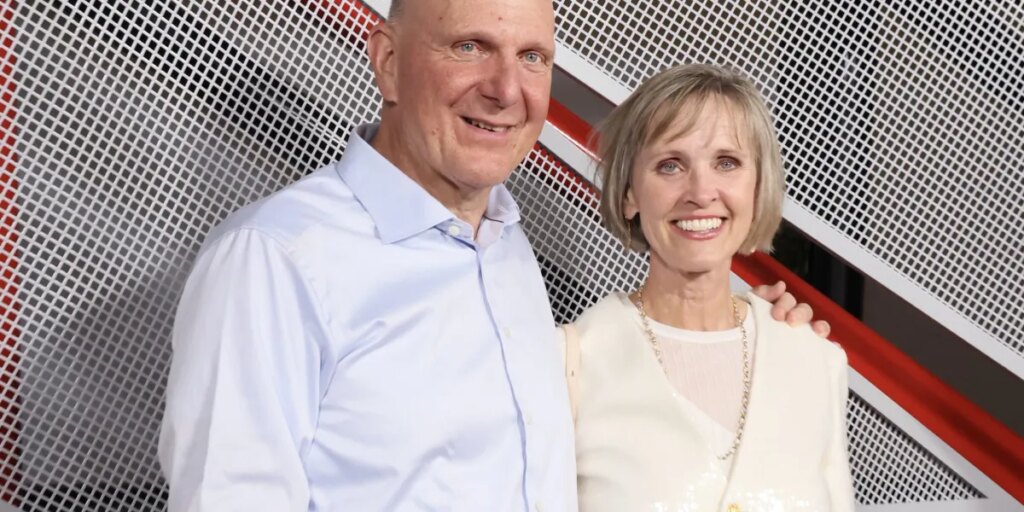
Steve and Connie Ballmer have given away more than $8 billion during the past two decades, and founded the Ballmer Group in 2015. Now they’re changing who gets to decide where the next donations go.
The couple’s economic-mobility philanthropy, Ballmer Group, is spinning its three regional offices into separate, independent nonprofits. The organizations, including MoveUp Southeast Michigan, MoveUp LA, and MoveUp Washington, will operate on their own but stay funded by the Ballmers. Steve was the CEO of Microsoft from 2000-2014 and has an estimated net worth of $177 billion, making him the ninth-richest man in the world, according to the Bloomberg Billionaires Index.
Some of the Ballmer Group’s largest gifts include a $425 million gift to the University of Oregon to establish the Ballmer Institute for Children’s Behavioral Health, a $237.5 million gift to Blue Meridian Partners for its Place Matters Initiative, and an up-to $165 million pledge to Communities In Schools to scale its student-support model to 1,000 new schools.
Each of the Ballmer Group’s new regional philanthropies has significance to the couple. Steve grew up in Southeast Michigan, the couple owns the Clippers in Los Angeles County, and Washington is home. So their logic behind splitting their philanthropy into three is to put decision-making about donations closer to the people doing the work.
“How do we keep staying close to the work, and how do we empower our leaders?” Ballmer Group CEO Terri Ludwig told Fast Company in an interview published Monday, adding she sees the new entities as startups, not spin-offs.
Each organization will build its own board and keep running its existing regional work while adjusting to fit local needs, according to a release from the Ballmer Group on July 1. Ballmer Group staff in each region will transition to the new organizations during the next year. Current grantees keep their commitments without disruption, according to the group. Ludwig will serve as a founding board member for all three while continuing to lead Ballmer Group, which will narrow its own focus to a smaller set of large, scalable national initiatives.
“Our intention is to ensure that these local philanthropies can be permanent, ongoing resources in each region, while we concentrate our national efforts on advancing economic mobility in new ways,” Steve and Connie Ballmer said in a joint statement.
The financial structure of the new organizations is still being worked out, but an endowment is one option under consideration, GeekWire reported.
About the Ballmer Group
Connie Ballmer began the couple’s philanthropy about 25 years ago, long before Steve’s Microsoft options turned into billions. Her early work was rooted in Washington State’s foster-care system, and she used to write checks from their kitchen table, according to Fast Company.
She and Steve later founded Ballmer Group in 2015, but the couple has kept a relatively lower profile than peers like other billionaire philanthropists such as MacKenzie Scott, who is frequently in the headlines for her massive giving sprees and cumulative $26 billion in giving. (To be sure, Scott doesn’t publicize her gifts herself). Her ex-husband, Jeff Bezos, and his new wife, Lauren Sánchez Bezos, are also very prominent philanthropists, running the Bezos Earth Fund and making other major gifts that garner a lot of attention.
But Connie has stepped further into view more recently. In April, she donated $80 million to NPR, which was one of the largest gifts in public media history, after the Trump administration pushed Congress to slash roughly $1.1 billion from public broadcasting. That gift was personal, not a Ballmer Group grant, as Connie is an avid NPR listener.
“We need fact-based journalism, and we need local journalism,” Ballmer told the Wall Street Journal in an interview published in April.
Ludwig came to her role at the Ballmer Group in 2019 from Enterprise Community Partners, the national housing-development nonprofit, and worked in finance before that. Like the Ballmers are doing, Ludwig advises newly minted billionaires from the AI boom to start giving and not wait for the perfect strategy.
“Start with the problem you deeply care about,” Ludwig told Fast Company. “Find the people who are closest to the challenge, learn from them, and begin. Refine your approach over time.”
That’s the main idea behind the Ballmer Group’s new strategy: Move the money toward the people who already know the work.
The post Steve and Connie Ballmer are splitting their $8 billion philanthropy into three so the people closest to the work can decide how the money is spent appeared first on Fortune.