The crowd chanted her name: “Diana! Diana!”
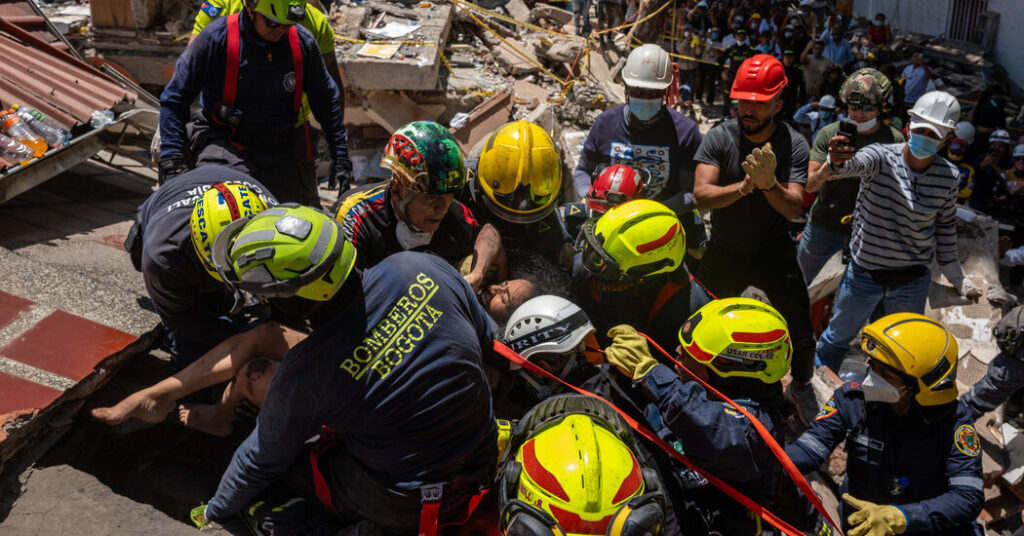
As search and rescue efforts continued the day after a deadly earthquake in Colombia, firefighters toiled in searing heat on Tuesday to pull a 31-year-old biomedical engineer from the rubble of a collapsed building in the city of Cali.
Diana Marcela Troncoso had been trapped for almost 30 hours. She was limp, save for a hand that gripped the arm of a firefighter like a lifeline. She cried in pain as they strapped her to a backboard. But she was alive.
Desperate searches for survivors of Colombia’s strongest earthquake in a decade continued on Tuesday throughout the western part of the country.
The death toll from the 7.4-magnitude quake had risen to at least 181 people, according to Asocapitales, an association of Colombian cities, with at 1,310 people injured and 153 buildings collapsed. With communication still down in some affected areas, officials said they expected the numbers to rise.
The highest toll appeared to be in Cali, the country’s third-largest city, which is known as a hub of culture, music and dance. The city, about 100 miles south of the epicenter, was supposed to spend the week celebrating an annual music festival known as Petronio, a cherished tradition that attracts thousands of revelers.
Instead, the quake hit Monday morning, causing at least 45 structures to collapse. As of Tuesday, more than 230 people were trapped alive in the rubble, according to local officials. And firefighters and aid groups have come streaming in from Bogotá, the capital, and beyond.
It was Bogotá firefighters who helped pull Ms. Troncoso from the rubble. People clapped and cheered them on as they carried her down a mountain of crumbled concrete.
“She works to save lives,” said her cousin, Andrés Troncoso, once she had been placed in a waiting ambulance. “And fortunately today it was her turn and she was saved.”
The U.S. State Department said Tuesday that it was sending a disaster response team to support rescue operations, on top of committing $15.5 million in aid for emergency shelter, food, protection and earthquake assessments.
The United Nations and other international aid groups have also pledged support.
The scenes at collapsed buildings in Cali contrasted sharply with those that had played out just a few weeks earlier in Venezuela, where back-to-back powerful quakes killed at least 6,300 people.
Venezuela’s disaster was far larger and harder to tackle, and in the wake of that disaster, it was civilians who carried out much of the search and rescue effort, with the state often absent. Emergency teams had been crippled by years of budget cuts under an authoritarian government focused on its own survival, and the teams that remained in operation lacked the tools to carry out complex rescue missions.
Rescue attempts were often chaotic as everyday people debated what to do, with no clear chain of command. Many Venezuelans said that they felt abandoned by the government in their time of need.
But in Cali, at several collapsed buildings on Monday and Tuesday, it was state emergency workers running operations, sometimes cordoning off the area with yellow tape while civilians helped remove rubble on the sidelines. At one building on Monday night, an ambulance stood at the ready. A yellow construction machine was used to haul away some heavy concrete.
Yet in both countries, the emergencies are testing new leaders.
In Venezuela, the disaster response has hardened popular anger at President Delcy Rodríguez, who took power in January following U.S. capture of her predecessor.
Colombia’s new president, Abelardo De La Espriella, a lawyer who had never held office, took office just three days before the quakes hit, promising new opportunities in places beyond the capital.
He visited the western city of Pereira on Tuesday, meeting with officials and assessing damaged buildings. He has said repeatedly since the quake that victims will not be abandoned.
Both Ms. Rodríguez and Mr. De La Espriella are supported by President Trump.
Beyond Cali, cities in Colombia’s coffee-growing region, including Pereira and Manizales on the western flank of the Andes, were heavily affected by the quake, as was the Chocó region on the Pacific Coast.
The governor of Chocó, one of the poorest areas of Colombia, said Tuesday on national radio that the full extent of the devastation was not yet known, in part because communications were still down in eight municipalities in her department.
“What we don’t have is a complete tally of the physical damage,” said the governor, Nubia Carolina Córdoba Curi, “because it is truly massive.”
In Cali, rescue efforts were sure to continue long into the night, with firefighters desperately trying to find people in the critical first 48 hours after the disaster.
At one collapsed residential building in the Tequendama neighborhood on Monday evening, firefighters, paramedics and other rescuers clawed through the debris to try to find a family of four they believed was trapped inside, while civilians formed human chains to haul away buckets of dust and rubble.
“We believe they’re there because we heard them screaming,” said Daniel Leguizamo, a 16-year-old paramedic with a private rescue squad who rushed to Cali from the city of Popayán shortly after the quake.
Katerín Carrillo, 32, a local business owner, said she and friends handed out water, electrolyte drinks and homemade sandwiches, taking them to rescue sites after learning about the damage online.
“We washed our hands with alcohol and made sandwiches right in the vehicle,” Ms. Carrillo said. “The people who are hauling rocks over there should at least have something to eat.”
Amid the debris lay remnants of lives disrupted: a scrapbook called “my 15 years” filled with old photographs, a “my first year” poster, a shoe, a piece of zebra wallpaper. Collected items pulled from the building were placed in bins, which people searched to recover what they could.
When rescuers needed quiet, people raised their hands and the signal rippled through the crowd.
The post Shouting Names, Hoping for Replies and Digging for Survivors of Colombian Quake appeared first on New York Times.