Desperate searches for survivors of a deadly Colombian earthquake continued throughout the night Monday and into Tuesday, with firefighters and other emergency workers using pickaxes and other tools to hack through the rubble in affected cities.
The death toll had risen to at least 181 people by Tuesday morning, according to Asocapitales, an association of Colombian cities. At least 1,310 people were injured and 153 buildings have collapsed.
The governor of Chocó, the region in western Colombia that was the epicenter of the quake, said Tuesday morning on national radio that the full extent of the devastation was not yet known, in part because communications were still down in eight municipalities in her department.
“What we don’t have is a complete tally of the physical damage,” said the governor, Nubia Carolina Córdoba Curi, “because it is truly massive.”
Late Monday the U.S. State Department said that it was committing $15.5 million in aid for emergency shelter, food, protection and earthquake assessments.
“We are united in prayer with the Colombian people and stand ready to support President @ABDELAESPRIELLA,” the department said in a statement on X, referring to Colombia’s new president, Abelardo De La Espriella.
The 7.4-magnitude earthquake, which struck Monday morning, was the strongest recorded in Colombia in the last decade, according to the Colombian Geological Survey.
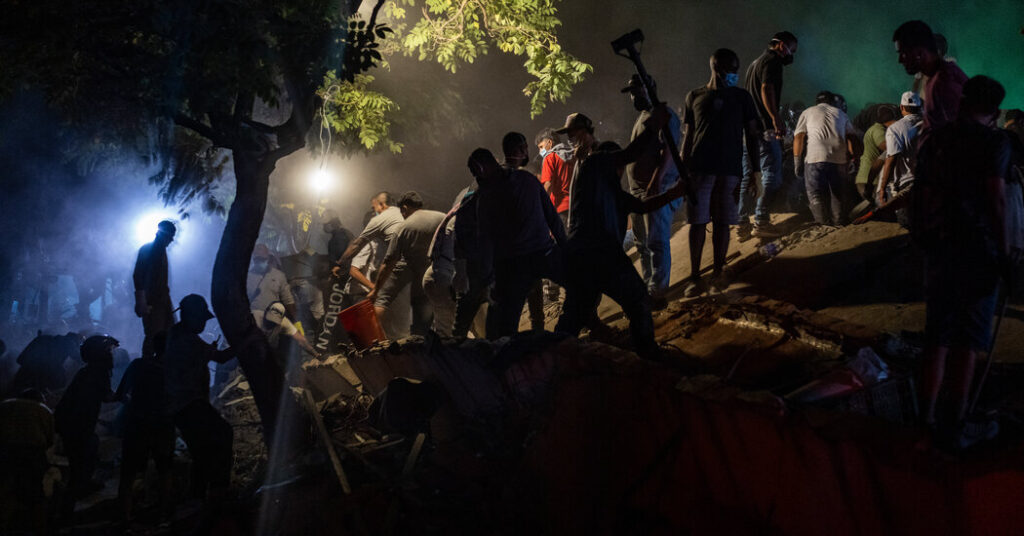
In Cali, Colombia’s third-largest city, known as a hub of culture, music and salsa dance, rescue workers spent a grim night scrambling over the remains of collapsed buildings, trying to hear the taps and calls of those trapped inside. Cellphones, headlamps and lights powered by generators showed the way. The city has had the highest death toll from the quake, with 95 people dead, according to Asocapitales.
At one collapsed residential building in the Tequendama neighborhood, firefighters, paramedics and other rescuers clawed through the debris to try to find a family of four they believed was trapped inside, while civilians formed human chains to haul away buckets of dust and rubble.
“We believe they’re there because we heard them screaming,” said Daniel Leguizamo, a 16-year-old paramedic with a private rescue squad who rushed to Cali from the city of Popayán shortly after the quake. “Right now they’re going to lift this concrete slab to try to free that section underneath.”
Katerín Carrillo, 32, a local business owner, said she and friends handed out water, electrolyte drinks and homemade sandwiches, taking them to rescue sites after learning about the damage online.
“We washed our hands with alcohol and made sandwiches right in the vehicle,” Ms. Carrillo said. “The people who are hauling rocks over there should at least have something to eat.”
Amid the debris lay remnants of lives disrupted: a scrapbook called “my 15 years” filled with old photographs, a “my first year” poster, a shoe, a piece of zebra wallpaper. Collected items pulled from the building were placed in bins, which people searched to recover what they could.
As the night wore on, firefighters remained in control of the search-and-rescue effort, with support from the police and city government, while civilians worked on rubble removal. An ambulance stood at the ready. A yellow construction machine was used to haul away some heavy concrete.
When rescuers needed quiet, people raised their hands and the signal rippled through the crowd.
By midnight, rescuers had still not reached the family of four.
But just a few hours later, at a different building, shouts went up. “One, two, three!” Firefighters who had come in from Bogotá, the capital, had found a man alive in the debris. “One, two, three!” they shouted as they pull him from the space between a column and a beam. “One, two, three!”
The post Late-Night Hunt for Survivors After Deadly Colombian Quake appeared first on New York Times.