Freedom Plaza, an urban square on Pennsylvania Avenue, the grand ceremonial connection between the White House and the U.S. Capitol, is one the best places to see the deep design of Washington, D.C. The open pedestrian plaza features a large-scale copy of the original “L’Enfant Plan” of Washington embedded in its paving. Thus, it immerses visitors in the complex overlay of grand, axial avenues and a grid of domestic streets that mirrors the dynamics between federal and local power embedded in the Constitution.
Historian Woody Holton hasn’t visited Freedom Plaza since the National Park Service installed more than a dozen sculptures representing Revolutionary-era subjects and themes, including six bronze statues of African Americans who fought against British rule. But when told that the “Spirit of ’76 at Freedom Plaza” exhibition centers on a large equestrian statue of Caesar Rodney, a Founding Father from Delaware and an enslaver, he laughs heartily.
“Those Black soldiers are there to cover for Caesar Rodney, to state the obvious,” says Holton, author of five books about the Revolutionary era, including 2021’s “Liberty Is Sweet: The Hidden History of the American Revolution.”
The installation gives the controversial Rodney statue, which was taken down from its original site in Wilmington, Delaware, during the Black Lives Matter protests of 2020, a prominent new home, perhaps temporary, in the symbolic center of the nation’s capital. It now sits in a place of honor in a square that was renamed, in 1988, for the slain civil rights leader Martin Luther King Jr., who wrote his “I Have a Dream” speech in the nearby Willard Hotel.
Perhaps because it’s billed as a temporary installation, the “Spirit of ’76” display hasn’t garnered the same national attention as other semiquincentennial events and attractions, or the administration’s campaigns to build a giant victory arch and massive new White House ballroom. But the statuary ensemble, which also includes a new 23-foot rendering of a female figure dubbed “The Spirit of Liberty,” is one of the most cogent and confrontational expressions of the Trump administration’s views on race, urban design and public space.
The ensemble of statues looks, on first glance, a bit like the chess-game scene from the first Harry Potter movie: Two rows of six soldiers each face off across the plaza, as if these allies are about to make uncivil war with each other. The figures bristle with military vigor, guns drawn, swords unsheathed, pistols at the ready. Their posture and blunt rendering resemble the small plastic soldiers that little boys use to stage mock battles on the kitchen table. The details are generic and the designs have no particular aesthetic merit. Like the Great American State Fair that opened in late June, the whole thing feels provisional and slapdash.
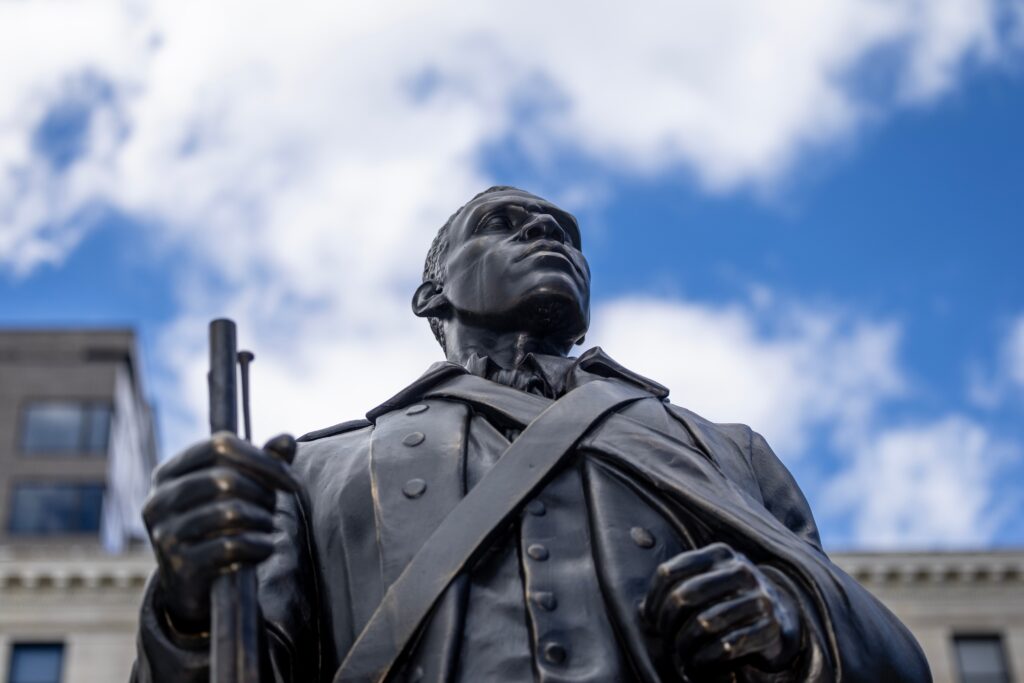
But six of the statues represent African Americans, including James Armistead Lafayette, a relatively well-known enslaved man who eventually won his freedom after serving as an American spy, feeding critical information about British strategy to the Marquis de Lafayette, who was serving as an American general.
The figures chosen, Holton said, are “very North heavy,” meaning they represent the smaller percentage of enslaved or formerly enslaved African Americans, mainly from the north, who served on the American side, rather than the much larger group, especially in the South, who saw the best chance for freedom and equality by serving the British. The role of African Americans in the Revolution is an interesting historical chapter, but the framing of this narrative by the National Park Service — as the spark of an ultimately successful movement to abolition — misses the larger story, Holton argues.
“The Revolution blew open the door to westward expansion, at the expense of Native Americans and African Americans,” he says. Without British limits on seizing land beyond the original colonies, slavery expanded and became entrenched in a more systematic and brutal way throughout the South and in newly settled states like Alabama and Mississippi.
The National Park Service did not identify the artists who made the statues, nor did it respond to questions about the cost of the exhibition, who paid for it, or the process used to create the statues, most of which appear to be made from thinly molded plates of metal. It sent a statement calling the display a “civic tableau” meant to encourage “Americans to visit our cultural and historic sites and engage in meaningful conversations about the moments that have shaped our country.” It also declined to respond to a question about a bizarre claim on a webpage supporting the exhibition: “America became the fourth of the world’s 128 nations to end slavery.”
The arrangement of this civic tableau on a map of Washington generates a cascade of more and less dismal absurdities. Perhaps it’s an accident that the Park Service chose a plaza featuring the original L’Enfant Plan of Washington, a map and a city that did not exist at the time of the Revolution. Perhaps it’s just unfortunate happenstance that several of the sculptures obscure quotations embedded in the plaza paving, including one directly over the passage from Article I of the Constitution that led to the establishment of Washington as the capital. The name of the famous African American poet Paul Laurence Dunbar, who wrote, “Negro life in Washington is a promise rather than a fulfillment,” has also been covered.
But given the administration’s reluctance to foreground the stories of Black Americans, what should we make of the presence of Rodney, whose family was greatly enriched by the wealth piled up by hundreds of bondsmen? The 1923 Jim Crow-era statue to a Founding Father who is relatively little known, is a technically more accomplished work of civic furniture than the new, unattributed depictions of African American soldiers. Seated on his horse, the well-cast figure of Rodney, the enslaver, now appears to be the commander of the poorly rendered Black soldiers. The arrangement also conjures the image of a plantation overseer, riding herd over enslaved workers, a loathsome and iconic figure from American history whom Frederick Douglass described as pathologically cruel, often drunk and derived from the dregs of society.
The message about African Americans embedded in this civic tableau is the same one delivered to the Smithsonian Institution’s National Museum of American History in a recent White House report criticizing what the administration believes is the overrepresentation of the darker chapters of American history. Black people can be present, but their presence must be subordinate; their stories can be told, but only as incidental to the larger narrative of American progress and exceptionalism.
The placement of these figures on Robert Venturi’s map of Washington also evokes a vision of occupation. Venturi’s park isn’t universally beloved, especially in the summer when the plaza lacks shade. But that openness is essential to its message and purpose, which is to immerse visitors in the original design of the city, with its giant axial avenues suggesting openness and civic ambition, and its grid of cross streets incorporating vigorous urban life. Author Sarah Luria has described the L’Enfant Plan as an essential tool for selling a new idea of government, with its wide, diagonal avenues suggesting federal ideals embraced by men like Alexander Hamilton, and its smaller, more domestic streets representing the democratic localities of Jefferson’s vision.
As Elizabeth Meyer, a professor of architecture at the University of Virginia’s School of Architecture and a former member of the Commission of Fine Arts, says, Freedom Plaza makes the “esoteric visible,” immersing people in a representation of checks and balances, the branches of government, and the interplay between city life and federal power. It is, she says, “a giant decoder” ring to Washington and what Washington represents.
Because of its central position, its openness and its proximity to the District’s Wilson Building, the locus of local power in Washington, Freedom Plaza is an essential First Amendment space, and a perennial site for protests, including the Occupy Wall Street encampments of 2011.
Today, it is literally occupied, by a squadron of tin soldiers and their horseback commander. And thus, a First Amendment space hosts a symbolic infringement of the Third Amendment (“No Soldier shall, in time of peace be quartered in any house, without the consent of the Owner …”) in a city currently occupied by thousands of National Guard troops.
Meyer cites the work of geographer Don Mitchell, author of “The Right to the City: Social Justice and the Fight for Public Space,” to stress how occupation is essential to the definition of public space. “Public space isn’t public unless it can be appropriated,” she says, meaning, unless the public can claim it, use it, repurpose it and, in some cases, redefine it.
And now it has been, but not by the public, nor with any public input or consent, to create a hierarchical arrangement of enslaver and the enslaved. It also includes an allegorical representation of liberty that stresses not the potential for peace and prosperity, but her drawn sword.
Holton is right about the presence of six Black soldiers on the plaza. They give cover for reerecting the statue of Rodney. But there’s a larger contest in this bizarre display, between statues and maps, symbols and ideas. Maps are open-ended, they evolve, improve, become more detailed and encompass wider vistas and larger spaces. Statues are static, fixed and closed. No one, except an antiquarian or collector, would prefer an older, outdated map to a newer, more accurate one. But statues are designed to be permanent.
How long will Caesar Rodney sit in the center of Washington? The National Park Service did not respond to a question about whether this display will, in fact, be temporary.
The post How an enslaver’s statue became the center of Trump’s exhibit at Freedom Plaza appeared first on Washington Post.