
Society is running out of babies, and no one can agree on why. Most people around the world, including Americans, live in a country where overall fertility is below what demographers call the “replacement rate,” meaning that without migration, the population will shrink from one generation to the next. In some places, the birth rate is so low that each generation is set to be half the size of the previous one.
A number of theories have been put forward to explain why this is happening. Some experts point to smartphones and social media, others to the cost of child care, still others to existential dread or overparenting. Claudia Goldin, the Nobel Prize–winning labor economist, favors another explanation: It’s the men. In a widely discussed new working paper, she argues that husbands still fail to do their fair share of housework and child care, forcing their wives to choose between procreation and career success. As a result, women are making the economically rational decision to have fewer kids. “The more that men can credibly signal they will be dependable ‘dads’ and not disappointing ‘duds,’ the higher the birth rate will be in the face of greater female agency,” Goldin writes in a companion essay.
Goldin’s theory is attractive because it promises to resolve an uncomfortable tension in the fertility discussion. Historically, falling birth rates have accompanied increases in women’s education and autonomy. This was widely seen as a good thing when it meant going from seven kids on average to two or three. Now that birth rates have fallen below replacement, however, calls to reverse the decline can sound like attacks on feminism itself. But if Goldin is right, there’s no tension. Under her framework, rising equality for women helped bring birth rates down, and only more equality will get them back up.
Unfortunately, the theory does not appear to be true. The data simply do not support it. For decades, men have been increasing their share of housework and child care. But the number of babies just keeps falling.
When a country gets richer, its fertility tends to decline. But in the 1990s, scholars noticed that some high-income countries, such as France and Norway, had much higher fertility rates than others, such as Japan and Italy. What could explain this variation?
Some hypothesized that traditions change more slowly than economies. In the Japans and Italys, they theorized, women were being told to be modern outside the home while still being asked to perform most of the labor inside it, leaving them burned-out and uninterested in having the usual two or three children. In the Frances and Norways, meanwhile, people were having more children because they were confident that things would be fairer in their households. “Women are able to see what happens to other women,” Peter McDonald, an Australian demographer who, in 2000, wrote one of the most famous papers proposing this theory, told me.
Goldin’s new paper builds off the work of McDonald and others. Her theory is that countries with low fertility are experiencing a “mismatch” between women’s desire to be modern and men’s desire for them not to be. The paper proposes a simplified economic model to describe reproductive decisions. In the model, men are either “dads” who do sufficient child care and housework or “duds” who do not. If an educated woman marries a “dud” and has children, he won’t help out much, forcing her to limit her career and end up earning the same wage as if she had not gone to college. If she instead marries a “dad,” she can have kids and still realize her full economic potential. At a societal level, because these women don’t know which type of man they’ve married until after they have had a child, they’ll base their decision on whether to have children in proportion to the ratio of dads to duds in their country. The fewer the duds, the more comfortable they will be giving birth to the next generation without fear of a wage penalty.
[Marc Novicoff: The birth-rate crisis isn’t as bad as you’ve heard—it’s worse]
All economic models are simplifications, but some make more reasonable assumptions than others. Goldin’s model assumes that only college-educated women weigh whether to have children, but in some countries, including the United States, women who haven’t graduated from college are shifting toward childlessness faster than women who have. Another key assumption is that dad-or-dud status is randomly and blindly assigned. In fact, prospective couples are probably sorting more finely than ever. People are more likely to marry other people of similar education levels, the share of marriages that end in divorce is down, and the time spent living together before having children is up. We have never had more time to examine our partners before having children, and the chance of randomly drawing someone with sharply different beliefs about household gender roles is small and shrinking.
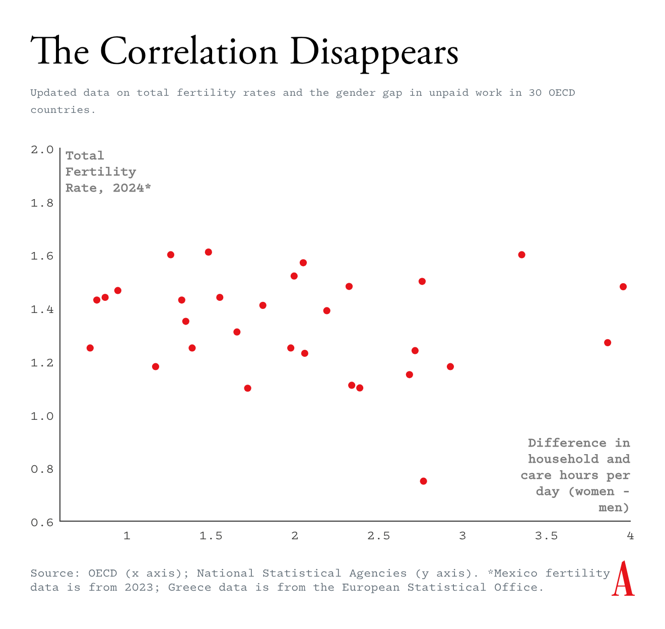
An even bigger problem with the theory is the data ostensibly backing it up. As a proxy for the share of duds in a given country, Goldin uses survey data on how men and women spend their time in a set of OECD countries. In places where women report doing a lot more unpaid work (such as child care and household chores) than men, Goldin shows, the total fertility rate is lower. In places where the work is divvied up more evenly, fertility is higher. Her paper includes a graph that shows a strong correlation between the two factors.
The trouble is that the relationship that the graph describes holds up only when you stick to Goldin’s somewhat idiosyncratic selection of data points. The fertility rates she uses for her y-axis, for example, are all from 2019, regardless of when the time-use survey was completed in a given country, and despite the fact that birth rates in many countries have fallen sharply since then. This creates distortions in various directions: Finland, for example, completed the survey she uses in 2010, when fertility stood at about 1.9 children per woman, but Goldin plots it at its 2019 fertility rate of 1.35. That happens to be close to Finland’s current rate, but the same isn’t true of Estonia, where fertility fell from about 1.7 in 2019 to 1.2 in 2025.
Goldin restricts her sample to OECD countries with time-use surveys completed from 2009 to 2019, but leaves out two of them—Mexico and Turkey—in which women did a large share of the unpaid work but fertility was nonetheless high in 2019. She then adds Portugal and Denmark, whose time-use surveys were conducted in 1999 and 2001, and leaves out six other countries—Australia, Austria, Lithuania, Slovenia, Latvia, and Ireland—that conducted their surveys sometime from 1999 to 2009 and whose fertility rates mostly don’t fit the pattern of the ones included. In some cases, newer time-use data exist. Factoring in the latest surveys from Poland and the U.S., for example, would show a roughly 25-percent-smaller gap in unpaid work.
If you include the countries that Goldin omits, and use the most recent time-use and fertility data, what you are left with is virtually no relationship at all. The slope flattens, and the amount of variation in fertility rates that is explained by the time-use differences (known in statistics as “the R-squared”) approaches 2 percent.
When I spoke with Goldin about the paper, she was open to critiques about it. “All the comments that you’ve raised, I would raise about my own work,” she told me. She granted that “you can change the model in a hundred different ways.” As for the data points, she said she was trying to stay consistent with a previous version of the paper. “Sometimes, when you’re working on something, you begin with using one set of data and you build off that. And then you don’t ask, Well, maybe I should use something else.” Later, over email, she said that the graph was “not a major part of my paper or my research” and that “cross-country analysis is to be avoided.”
[Derek Thompson: When a promotion leads to divorce]
Versions of Goldin’s argument made by other academics have also been hampered by methodological issues. In a Slate article published last year, Darby Saxbe, a psychologist at the University of Southern California, argued that “dads can fix the birth rate” by doing more chores and child care. Her piece featured its own chart comparing men’s share of unpaid work to fertility rates in OECD countries. When I tried to re-create the chart, the results looked totally different. Over email, we figured out the likely culprit: The data for Saxbe’s chart, she explained, were sourced by AI, which seems to have hallucinated some of the numbers.
Goldin told me that the original idea for her paper came from an influential 2008 study titled “Will the Stork Return to Europe and Japan? Understanding Fertility Within Developed Nations.” The authors of that paper showed a strong relationship between what young mothers said their male partners contributed to care and housework in a given country and that country’s fertility rate. According to the authors’ math, a 10-percentage-point increase in men’s unpaid-labor share was associated with 0.4 more births per woman—an enormous difference.
So the correlation between fertility and men’s contributions at home was robust at one point. But, if you update the data, it disappears. The authors of “Will the Stork Return” used surveys and fertility rates from 2002. Using the 2022 version of the survey (the most recent available) and 2024 fertility rates (also the most recent available for most countries) produces an almost perfectly flat relationship, one in which variation in men’s share of housework explains essentially none of the variation in a country’s fertility. Birth rates still differ among rich countries, but the male share of housework apparently has nothing to do with it.
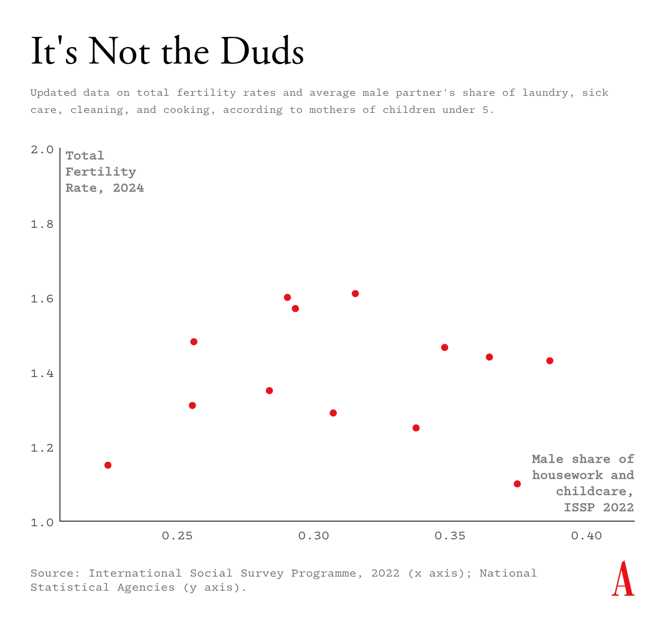
“Will the Stork Return” included optimistic predictions for the future. Observing that “men in all high-income countries appear to be taking on a larger share of household duties,” the researchers forecast that “high-income countries with the lowest fertility rates are likely to see an increase in fertility in the coming decades.” That has not come true. Men’s share of housework has continued to rise, but fertility has only declined further. This set of facts applies to basically every country for which data exist. In Finland, the gap in unpaid work roughly halved from 2010 to 2021; the fertility rate went from from 1.9 to 1.5, and now sits at 1.3. In South Korea, the gap in household work shrank 42 percent from 1999 to 2024; over that time, South Korean fertility rates went from 1.4 births per woman to 0.75. “I would guess that the theory is right and there’s other things going on that have completely overwhelmed the theory,” Bruce Sacerdote, one of the economists who wrote the 2008 paper, told me. But if men’s increased participation in unpaid labor is pushing fertility up, the effect is undetectable.
If men helping out more at home could reverse the birth-rate decline, that would be great news. It would ease the burden on women and simultaneously help save the world from aging populations, stagnant economies, and crumbling pension systems. Alas, the experiment has been run, and the results are in: Men are chipping in more, and the number of babies is still falling. That doesn’t mean they couldn’t do more, but it does mean that doing more is unlikely to fix the situation. And telling women that they’re surrounded by “duds” seems unlikelier still.
The post A Popular Explanation for Low Birth Rates Has a Big Problem appeared first on The Atlantic.