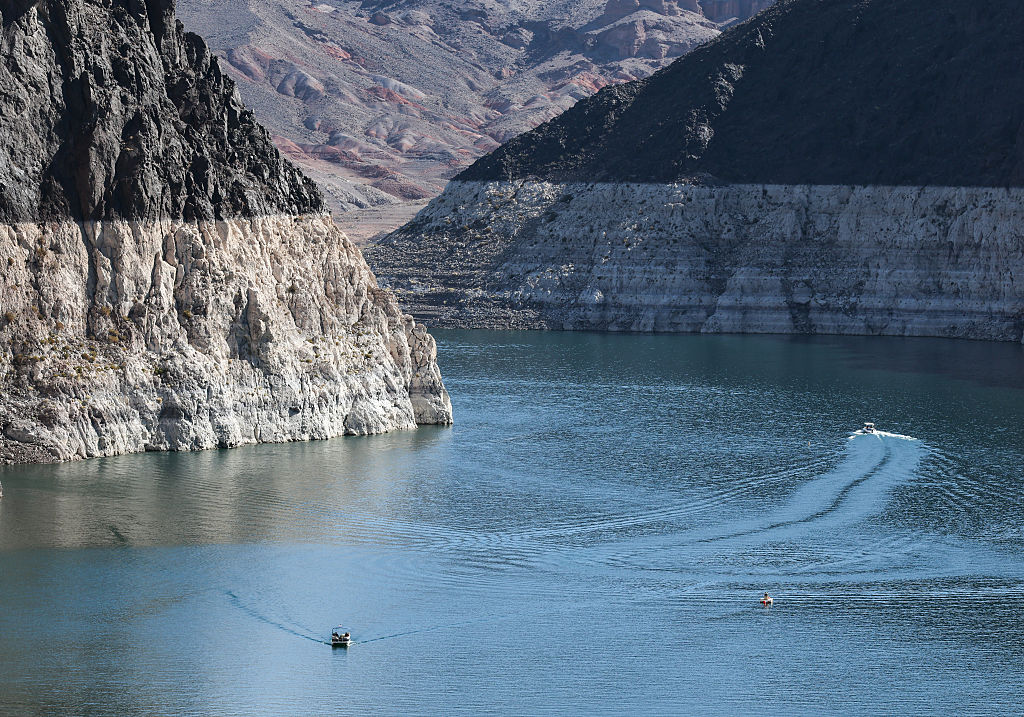
Lake Mead, the reservoir on the Arizona-Nevada border that is a crucial source of water for the American Southwest, sank to its record-lowest levels in the past week, raising concerns about deepening water supply cuts affecting millions of people.
Data from the U.S. Bureau of Reclamation show that, as of Sunday, water levels at the man-made lake formed by the Hoover Dam have dwindled to 1,040.3 ft (317.1 m.) above sea level, lower than the previous record set on July 28, 2022, since Lake Mead was initially filled in the 1930s. The reservoir’s surface measures more than 1,220 ft. above sea level at full capacity. Each inch of vertical height in the reservoir represents billions of gallons of water.
Last week’s levels at Lake Mead are the latest sign of pressure on the Colorado River system, which is under threat from overconsumption and increasing temperatures, no thanks to a persisting megadrought in the region. The other large reservoir in the Colorado River Basin, Lake Powell, is also on track to hit record lows due to the same threats. In July, a group of Colorado River experts found that the total water stored at Lakes Mead and Powell was the lowest in about seven decades.
Melting snow adds to the system’s water supply, but this year’s warm winter has led to the worst snowpack on record in the Colorado River Basin. (The Colorado Climate Center said in a blog post that March was the warmest in Colorado in the past 132 years.)
J.B. Hamby, who chairs the Colorado River Board of California, told the Associated Press that the low level in Lake Mead is “extremely significant and extremely concerning,” given how some 30 million people are “directly impacted” by risks to the reservoir.
Seven U.S. states—Arizona, California, Colorado, Nevada, New Mexico, Utah and Wyoming—Native American tribes, as well as two Mexican states, turn to the Colorado River Basin, not only for drinking water supply, but for agriculture, industry, and hydropower production.
The dwindling supply at Lake Mead puts hydropower at risk as the latest figures show it’s not far from the 1,035-ft operational threshold: when elevation drops to this level, some turbines at Hoover Dam will have to shut down, and its generation capacity would drop by 70%. A July 2026 forecast from the Bureau of Reclamation shows that Lake Mead water levels could come close to that threshold in the next few months and could fall below that by spring next year.
For years, states have tried to discuss how to allocate and conserve the water in the basin, but negotiations have led to disagreements and even threats of lawsuits. The federal government intervened and, in a proposal last month, suggested that the three states that make up the Lower Basin—Arizona, California, and Nevada—take less water.
Secretary of the Interior Doug Burgum said in a statement that the department “has a responsibility to ensure the Colorado River system remains reliable and resilient for the millions of Americans, communities and industries that depend on it.”
Under the proposal, those states may be forced to reduce their use by up to 3 million acre-ft per year until 2036—though actual reductions would be assessed every two years based on the basin’s conditions. The three states already have a shorter-term plan to reduce their water consumption, and in response to the federal proposal, Arizona Gov. Katie Hobbs strongly pushed backand called the cuts “unacceptable,” potentially setting up a political battle.
The situation in the Colorado River Basin is just one among a handful of water reservoirs in the U.S. where water supply has significantly declined: of the 54 tracked by the Bureau of Reclamation, nine, including Lakes Mead and Powell, have recently logged their lowest levels in the last 30 years.
The post The U.S.’s Largest Reservoir Just Fell to Its Lowest Water Level appeared first on TIME.