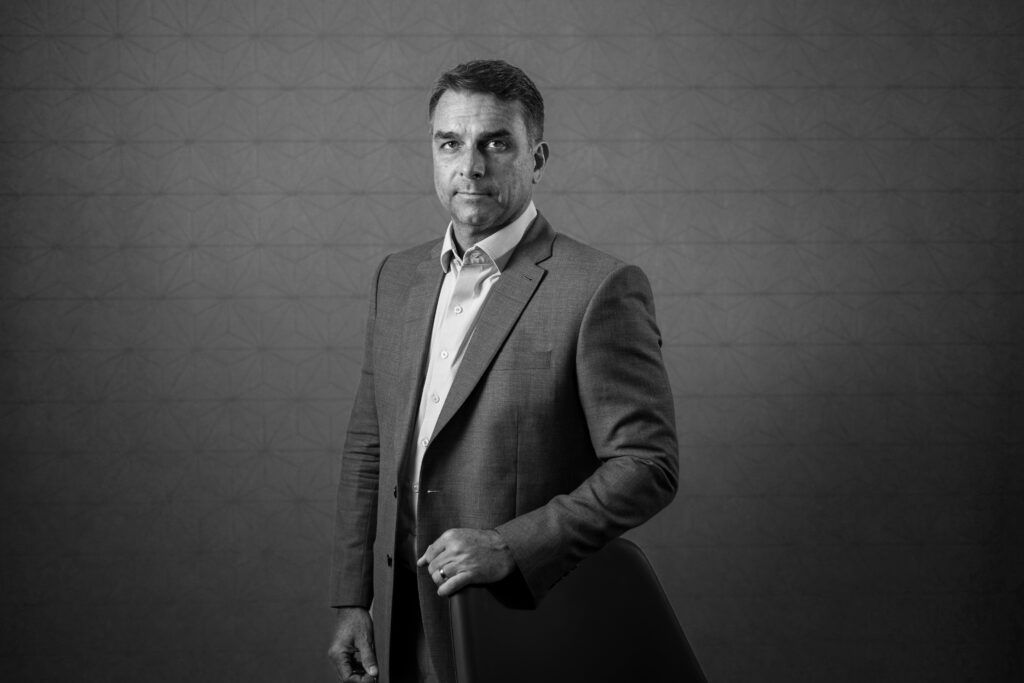
AVENTURA, Fla. — Flávio Bolsonaro was eyeing a chocolate-frosted doughnut with sprinkles. The baked good beckoned to him from a countertop at a co-working place. He slid over.
“Can I eat that?” he asked.
This was Bolsonaro, 11 days after losing in the second round of the Brazilian election to President Luiz Inácio Lula da Silva, and eight days after arriving in the United States following a secretive escape from his country — staring out into an empty office space, indistinct in the sprawl just north of Miami, quietly munching on a doughnut, before departing for Mar-a-Lago, President Donald Trump’s private club in Palm Beach.
How Bolsonaro went from the cusp of presidency just days ago, to where he is now, is a head-spinning question that the right-wing politician said even he could not answer. The experience, he said, has been a mental and physical shock. He didn’t win an election that he had every reason to think he would. He’s in a country where he speaks little of the language. He doesn’t know what he’s going to do now, or next, or how he’ll ever make it back to Brazil.
“It’s still very early to make any definitive decisions,” he told The Washington Post, having agreed to sit for an interview in the conference room of a co-working space in Aventura, Florida, north of Miami. “But obviously what I need to do now is get my immigration situation in order and, well, think about what I’m going to do.”
So much uncertainty for someone for whom all had seemed so set.
Bolsonaro came out ahead in the first round of the Brazilian election, defeating Lula, but it went to a runoff because he was short of an outright majority. The second round was his to lose: Not since Brazil rose from a dictatorship in 1985 had anyone won in the first round but lost in the second. The main contenders who dropped out after the first round had run to Lula’s right, and their voters seemed likely to go Bolsonaro’s way.
By all indications, Bolsonaro’s father, former president Jair Bolsonaro, convicted and sentenced to 27 years in prison for plotting a violent coup following his own 2022 electoral loss to Lula, could soon be free.
Then Lula won. Following a blitzkrieg social media campaign, the leftist incumbent added an astounding 10 million votes to his first-round haul, besting Bolsonaro by some 4.4 million votes, and nearly four percentage points. Calling foul without presenting proof, Bolsonaro initially announced he’d seek to annul the election, before going the following day to visit his father, under house arrest in Brasília.
The two spoke for 30 minutes, Bolsonaro said, after which he opened the front door and saw a phalanx of federal police officers assembled outside. Supreme Court Justice Alexandre de Moraes had ordered Bolsonaro to turn over his passports within 24 hours, in connection to an investigation into alleged money laundering.
The order terrified the men, Bolsonaro said. Moraes, a longtime foe of the family who’d overseen the elder politician’s prosecution, said he couldn’t leave the country.
“My father looked at me, tears in his eyes, and said, ‘You already know where this is going,’” Bolsonaro said. “I told him that I knew, and that I knew what I had to do.”
Bolsonaro backed off his threats to contest the election, and for the next 36 hours, effectively disappeared, leaving Brazilians to speculate about where he had gone. In defiance of the judicial order, he slipped across the border, perhaps into Argentina, only to reemerge Wednesday morning of last week at an airport in Miami.
He and his wife and two daughters, 12 and 14, were welcomed into the country by the Trump administration for “humanitarian” reasons. Trump has said Bolsonaro can stay in the United States for “as long as he likes,” though it remains unclear whether Democrats, newly emboldened after a sweep in the midterm elections, will oppose his stay.
In his interview with The Post, Bolsonaro declined to answer questions about how he made the journey, or whether U.S. officials assisted him in it. “I will never speak about the path that I took,” he said.
A senior Brazilian security officer, speaking on the condition of anonymity to discuss an ongoing investigation, said police are investigating whether a network of U.S., Argentine and Israeli agents assisted in Bolsonaro’s exit. The security official said an ex-Mossad agent was witnessed following the van carrying Bolsonaro to the Argentine border.
Secretary of State Marco Rubio has called such speculation false, asserting that the “U.S. government was not involved directly in any of the moves that were made.”
The Israeli Embassy in Brasília did not respond immediately to a request for comment on the matter.
It remains unclear when Bolsonaro crossed into Argentina, the security official said. Brazilian police are dubious of assertions by Argentina — led by conservative Javier Milei, who hasn’t formally recognized Brazil’s election results — that he entered the country late Oct. 27.
Milei’s office didn’t respond to a request for comment.
In a video posted to social media this week, Flávio’s brother Eduardo Bolsonaro — a former Brazilian lawmaker who lives in Texas as a fugitive from Brazilian authorities — heralded Bolsonaro’s escape as “the most sensitive operation in Latin American history, second only to the extraction of Nicolás Maduro” by U.S. Special Operations forces in January. He said the Bolsonaro team had to “fool everyone to throw them off his tracks,” feeding false information to news outlets, including The Washington Post.
“While they were putting out that he was arriving or had already arrived in the United States, he was in fact en route and only then leaving through Argentina,” Eduardo Bolsonaro said.
Brazilian police have little hope of capturing Bolsonaro, not with him in the United States. “Zero chance,” the security official said.
But the political vise around Bolsonaro has nonetheless tightened.
Even his closest allies and friends are privately excoriating him. Speaking on the condition of anonymity to provide a candid assessment, one adviser called Bolsonaro “soft” and his escape “the worst thing he could have done” if he wanted to contest the results of the election.
Another said he hadn’t believed the news that Bolsonaro fled at first and found the decision shockingly impulsive. “Flávio was in a bad place emotionally after the defeat,” he said. “He thought he was going to win, and he didn’t.”
Since the loss, Bolsonaro has repeatedly asserted that the election was stolen, lamenting how difficult it is to audit the Brazilian electoral system — generally considered a standard-bearer in Latin American politics, returning results within hours of the vote, under the eye of international election observers.
Brazilian electoral authorities haven’t found irregularities in the results. The president of the Superior Electoral Court, Kassio Nunes Marques, who was appointed to the Supreme Court by Jair Bolsonaro, has said repeatedly the election was fair.
Bolsonaro, who has provided no evidence to substantiate his claims, dismissed Nunes’s assessment.
“I guarantee to you that he doesn’t know what he’s talking about,” Bolsonaro said. “Not me, not you, not anyone who is watching, and not the president of the Superior Electoral Court can say with 100 percent certainty that there wasn’t fraud.”
To make that argument, he said, was part of the reason he decided to come to the United States, where he believes he can say what he wants without fear of arrest. Proof of his contention, he said, were the divergent political paths taken by his father and Trump.
Both populist politicians alleged widespread fraud in elections they lost. Both were accused of inciting a violent insurrection attempt, amid a slew of other criminal charges.
But only one went to prison, while the other returned to power.
“American institutions still work,” Bolsonaro said. “While in Brazil, they no longer function.”
One person who agreed with him on Brazil, he said, was Trump, who has called the Brazilian election a “disgrace” and “rigged.”
“Trump is convinced that Brazil is no longer a full democracy,” Bolsonaro said.
Feeling liberated to continue to make his case, Bolsonaro said he planned to deliver a speech at Trump’s Mar-a-Lago later that evening, where the Conservative Political Action Conference had convened a gala. Addressing the attendees, Bolsonaro would tell his “Brazilian brothers” that the end was not at hand, even if the end hadn’t been what they’d “hoped for.” He would promise, “big things were to come.”
But first, standing at the countertop at this co-working space, Bolsonaro needed to finish his doughnut.
Marina Dias in Brasília contributed to this report.
The post Why Bolsonaro says U.S. took him in: Trump ‘convinced’ Brazil is no longer a democracy appeared first on Washington Post.