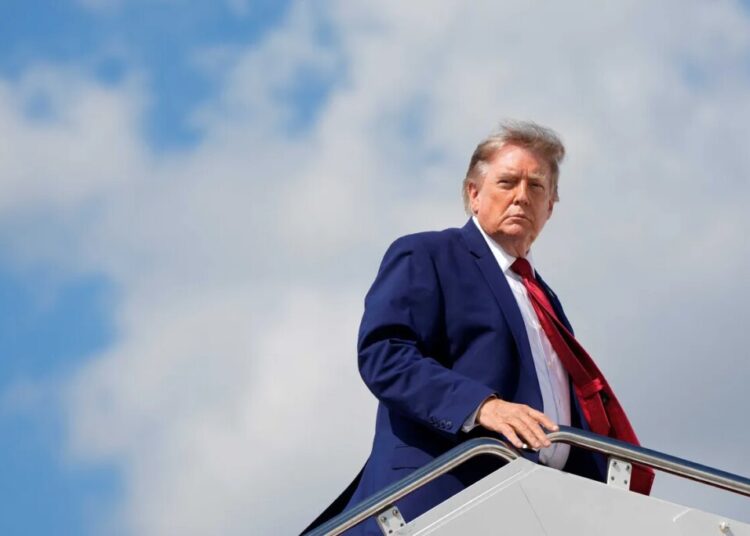
A year ago, President Trump pronounced Washington violent and slum-ridden and announced that he was going to “take back our capital.”
Many residents watched in dismay as the president declared he was sending thousands of National Guard troops and federal law enforcement agents into the streets and that the Metropolitan Police Department was “under direct federal control.”
Courts blocked some of the Trump administration’s most aggressive actions, but the incursion — which local activists call “the occupation” — has been the most serious encroachment on Washington’s limited self-government in a half century.
Armed troops have become fixtures in Metro stations, on downtown streets and around newly refurbished federal parks. Federal agents in flak jackets patrol residential streets alongside city police officers. The administration loosened restrictionson car chases by federal police (though there have been several crashes, two of them fatal). And with arrests and prosecutions soaring, the jail population has grown by nearly 20 percent over the past year, and courts are at what the city’s chief judges describe as a “breaking point.”
None of this appears likely to go away soon. The National Guard deployment, now 4,636 troops from 23 states and territories, has been extended until President Trump’s last day in office. A $292 million federal contract was recently awarded for building “apartment-style lodging units” for the troops.
The president’s announcement of the Guard’s deployment came just days after Edward Coristine, a 19-year-old member of the Department of Government Efficiency, was assaulted in what authorities say was an attempted carjacking. Two teenagers later pleaded guilty and were sentenced to probation in connection with the attack.
Citing the assault when he announced he was sending in troops, Mr. Trump declared that he was going “to rescue our nation’s capital from crime, bloodshed, bedlam and squalor.”
The impact in certain neighborhoods in Washington was immediate.
“From the moment the sun went down there was a caravan of police officers rolling through,” said Merawi Gerima, 38, a filmmaker and community activist in Ward 7, a working class and majority Black area.
Federal agents fanned out into neighborhood gatherings and apartment complexes, he said, confronting people about tinted car windows or open containers of alcohol. “That essentially has been the pattern they’ve maintained for the whole year,” he said.
The White House insists that the steep drops in homicide, carjacking and robbery are proof that the operation has been a success. “President Trump has transformed our nation’s capital from a crime-ridden city into a safe and beautiful haven,” said Lauren Bis, a White House spokeswoman.
However, the developments come as violent crime is in precipitous decline nationwide, falling to record lows in cities with no federal intervention. And in Washington, violent crime was already reaching the lowest levels in decades before Mr. Trump’s August announcement.
The city did not reply to a request for comment, but the mayor, Muriel Bowser, often reminds Washington’s 700,000 residents of the city’s particular vulnerability to the federal government’s whims. As a federal enclave created by the Constitution, Washington has had the power to elect its own leaders only since 1973, when Congress passed the Home Rule Act, and even that authority is highly circumscribed.
Given the Trump administration’s leverage, the mayor has tried to emphasize how a partnership could be beneficial.
Many residents want none of it.
The “takeover” of the police that Mr. Trump announced was quickly challenged in court, and ultimately limited to temporarily letting the administration direct the local police to assist with immigration enforcement and clearing homeless people’s tents.
Federal immigration agents detained hundreds of people suspected of being undocumented, sometimes in aggressive confrontations on busy daytime streets. But in December, a judge barred them from making arrests without warrants or probable cause, reducing the number of detentions.
The National Guard, the operation’s most visible component, is also almost certainly the most expensive. According to data that the Trump administration gave Senator Elizabeth Warren of Massachusetts, the deployment is expected to cost $1.4 billion from October 2026 until the end of the president’s term — on top of the hundreds of millions of dollars that have already been spent.
The effectiveness of the deployment is less straightforward.
A June report from the Niskanen Center, a centrist think tank, found that the Guard had likely contributed to a decrease in property crimes — motor vehicle theft, for example, is down more than 50 percent year to date. But the deployment seemed to have barely any effect on violent crime, which includes murder, robbery and assaults with weapons. Robbery and homicide declined at roughly the same rate before and after the Guard arrived. This year, violent crimes in Washington are slightly above this point in 2025, driven up mostly by a large increase in assaults.
The Guard members have also become crime victims themselves: In November, two were shot, one of whom would later die from her injuries, in an attack that authorities said was carried out by an Afghan immigrant who had driven from Washington State.
The biggest impact on many Washingtonians may stem from the surge into the streets of hundreds of officers from the Drug Enforcement Administration; the Bureau of Alcohol, Tobacco, Firearms and Explosives; and other agencies. These agents work mostly alongside members of the Metropolitan Police Department, often following local police cars in unmarked S.U.V.’s with tinted windows and obscured license plates.
While local police officers largely respond to 911 calls and emergencies, the federal agents often patrol areas by car and on foot in the company of one or more M.P.D. officers. According to the White House, members of the federal task force, which it says includes local agencies, have made 16,000 arrests, though it was unclear how differently these cases would have been handled without the federal intervention.
“It feels like they are looking to find somebody doing something,” said Gary Decker, an elected neighborhood leader in Columbia Heights, where, he said, federal agents drive up and down the streets, detaining people for infractions like public intoxication or drug use.
Mr. Decker said that his neighbors want nuisances like public drug sales to be addressed, but not by armed agents with no local accountability. “Many of my neighbors will not report crimes to the M.P.D.,” Mr. Decker said, “because they don’t know who will come with them.”
Washington has always been heavily policed, with thousands of officers and agents from the U.S. Park Police, the Capitol Police and the Secret Service in addition to the roughly 3,000 officers of the Metropolitan Police. But the federal law enforcement presence, once concentrated in the city center and around federal installations, has spread into residential neighborhoods.
Daraja Carroll, a defense lawyer in Washington, has encouraged some clients to serve out short jail sentences rather than agree to be released on probation, given that “there are just eyes and ears everywhere.”
“I couldn’t imagine being on supervised release and trying to feel free,” she said. “You don’t know who’s a special police officer, even at the grocery store.”
It is unclear what lies in store for the operation in Washington, which Mr. Trump insists has been nothing but a success. In June, the president said that if Janeese Lewis George, a democratic socialist who likened the federal presence to a military occupation, won the city’s Democratic primary, he might push to get rid of home rule completely.
“Maybe we take back Washington and run it on a federal basis,” he said. “We won’t put up with it.”
Days later she won in a landslide.
The post How Trump’s Yearlong ‘Takeover’ of Washington Has Changed the Capital appeared first on New York Times.