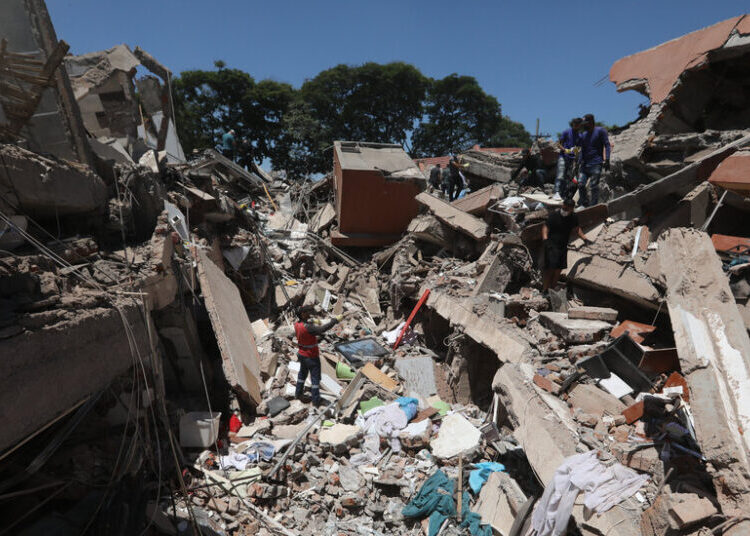
Colombia’s newest president was sworn in Friday. On Monday, disaster hit.
The president, Abelardo De La Espriella, is a former criminal defense lawyer with no previous political experience. He rose to power on promises to crack down on crime and on his country’s resurgent armed groups.
He ran as a populist and vowed to decentralize power, shrink the government and tackle a huge budget deficit following four years of what many called runaway spending under Gustavo Petro, Colombia’s first leftist president.
Mr. De La Espriella announced before taking office that he would govern from Colombia’s Caribbean Coast, near where he was raised, instead of solely from the high-mountain capital of Bogotá. He promised to spend time touring the country and tending to voters’ needs, instead of remaining ensconced in the presidential palace.
Now, days into his term, Mr. De La Espriella is facing his first big test.
In a brief video posted on social media on Monday morning that appeared to be shot from the presidential plane, he said he had canceled his travel plans and was headed to Bogotá, where he would “personally” lead the disaster response.
Addressing people in the worst-hit areas — around the epicenter in the Chocó region, and in the coffee-growing region known as Eje Cafetero, or Coffee Axis — he said, “You’re not alone.”
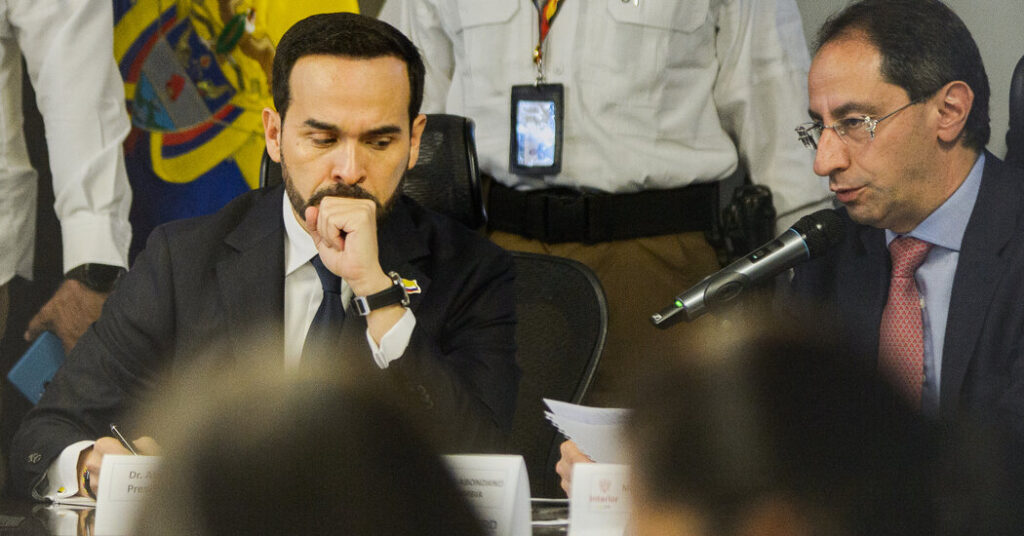
A few hours later, he posted more footage, this time from a conference room where he sat surrounded by scores of people, apparently coordinating the disaster response. Dramatic music played over the video.
The epicenter of the magnitude 7.4 earthquake was in Chocó, a rural region along Colombia’s Pacific Coast that is home to a large Afro-Colombian population and Indigenous communities. Isolated by geography and a lack of passable roads, some coastal communities have long been accessible only by water.
Towns and small cities in the neighboring coffee-growing region, Valle del Cauca, also suffered severe damage, officials said.
Colombia has for decades been mired in conflict that cut off some areas from the government and left armed groups as the de facto authority. Though Colombia’s largest rebel group, the FARC, signed a landmark peace accord a decade ago, the conflict has resumed in recent years.
Armed groups have multiplied and expanded into more of the country, fueled by soaring demand for cocaine and a boom in illegal gold and mineral mining.
As the groups battle for control of drug trade routes and mines, they have brought renewed violence, killing community leaders and forcing hundreds of thousands of civilians to flee.
Chocó, where the earthquake struck near the village of San José del Palmar, has in recent years become a flashpoint for clashes between two of Colombia’s most powerful armed groups: the National Liberation Army, or ELN, a decades-old rebel army with leftist roots, and the Clan del Golfo, or Gulf Clan, which has right-wing paramilitary ties.
The previous president, Mr. Petro, engaged armed groups in peace negotiations that largely failed.
Mr. De La Espriella pledged while campaigning that he would target Colombia’s armed groups with U.S. help. He made clear during his inauguration speech that the option of negotiations with the groups had been “completely exhausted.”
With Mr. De La Espriella in office, the Trump Administration has been seeking to fast-track military cooperation with Colombia as part of its regionwide effort to go after cartels; on Friday, the State Department announced that it would offer Colombia $1 billion in assistance as part of a “new era in U.S.-Colombia relations.”
Experts say Mr. De La Espriella’s iron-fisted message could result in an uptick in attacks by armed groups. Over the weekend, videos circulated online that appeared to show members of the ELN. In one, a fighter can be heard directing himself to Mr. De La Espriella, who adopted the campaign nickname El Tigre, or The Tiger, and saying, “Let’s see who roars louder.”
Earthquake responders could be moving into areas controlled by those same armed groups.
Mr. De La Espriella already faced the challenge of governing a sharply divided country. He won June’s election by less than one percentage point, narrowly defeating Senator Iván Cepeda, a member of the left-wing party Mr. Petro founded and leads, Pacto Histórico.
Mr. Petro has continued to cast doubt on the election results without evidence. Mr. Cepeda has not made those claims, but he and his fellow party members in Congress boycotted the inauguration, and he has called on his followers to engage in peaceful civil disobedience, pointing to Mr. De La Espriella’s alleged ties to paramilitary figures and to his U.S. citizenship, which he says stands to undermine Colombia’s sovereignty.
A Times investigation found that Mr. De La Espriella — who lived in Miami for more than a decade and whose clients included accused drug traffickers facing extradition — was investigated by U.S. authorities in connection with the movement of funds by a client accused in a major money-laundering scheme linked to the Venezuelan government, Alex Saab.
On Monday, when Mr. De La Espriella posted from the emergency command center in Bogotá, he added a caption.
“Colombia is united and we will move forward together,” it read.
The post Colombia’s New President Has Been Immediately Put to the Test appeared first on New York Times.