Most of our daily activities are a balancing act. Walking, climbing stairs and stepping down from a curb all happen on one leg.
Incorporating single-leg exercises into your routine can help improve balance, core strength and coordination, said Candace Young, a physical therapist at the Hospital for Special Surgery in New York. Training single-leg strength can also help you avoid injuries that arise from muscle imbalances, she added.
Just as you have a dominant hand, you also have a dominant leg. A simple way to check your leg dominance is to see which leg you naturally step forward with when doing a lunge or which foot you use to kick a ball, said Connie Sciolino, a personal trainer in Boulder, Colo.
“Most people feel more comfortable reacting with a certain leg,” Ms. Sciolino said. “But in life, you might be forced to lunge for a pickleball return or step off a curb with your non-dominant leg.” And if you don’t have the appropriate strength or coordination, that’s when injuries can happen.
When performing standard exercises, such as squats and deadlifts, it’s easy for your dominant side to compensate. “There’s no cheating with single-leg exercises,” Ms. Young said, since they can reveal strength imbalances almost immediately. Working each leg separately is more time-consuming, but the added balance challenge works your core and the stabilizing muscles in your feet and ankles.
You should feel confident performing the following exercises with two feet before trying the single-leg versions. For example, master a box squat with good form before you progress to a single-leg box squat. Ms. Sciolino has her clients start single-leg exercises on their non-dominant side. This ensures that your weaker side is fresh for the first set and that your dominant side has to perform under slight fatigue, she said. It also breaks the natural tendency to lead with the stronger side, she added.
If you are new to single-leg strength training, sprinkle two or three of these exercises into a full-body routine, Ms. Sciolino said. Experienced exercisers can complete the full workout in order. If you feel wobbly, you can rest your fingertips on a wall or a chair for many of the exercises. Focus your gaze on something still to help with balance as you move. Performing the exercises in bare feet or in shoes with minimal cushioning will help with balance and stability, she added.
Overview
Time: 25 to 30 minutes
Intensity: Moderate
Rounds: Perform two to three sets of each exercise. Complete all repetitions on one side, rest for 30 seconds and then repeat on the other side. Do not rest between sets.
What You’ll Need
-
A chair or box
-
A step or stair
-
Optional: Light dumbbells
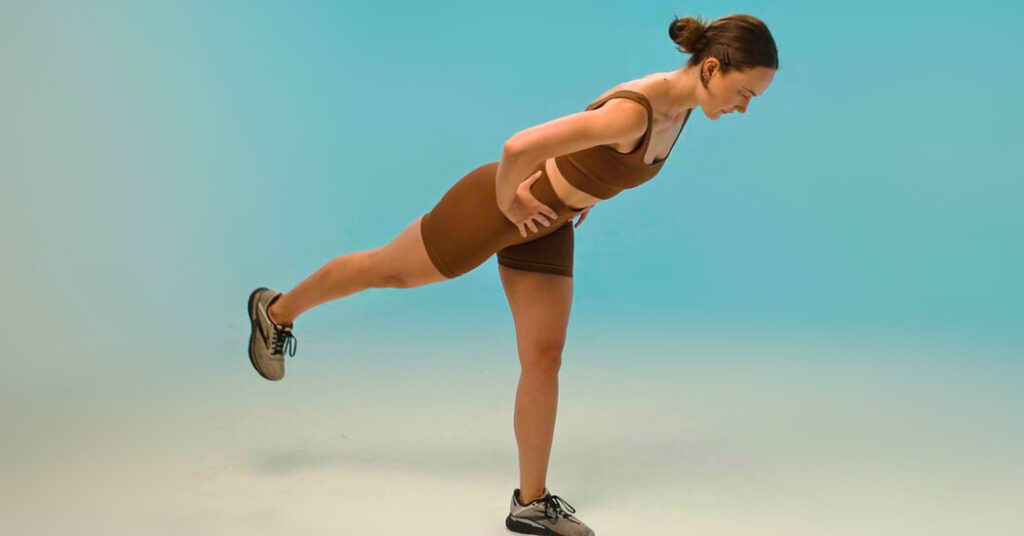
Hip Airplanes
Targets: Glutes, deep hip rotators, inner thighs, core
Repetitions: Six to eight per leg
Stand on your left leg with a soft bend in your knee. Hinge at your hips to tip your chest forward, nearly parallel to the ground, as you lift your right leg off the ground and keep it straight. Your hands can be on your hips or straight out to the sides. Slowly rotate your pelvis so your right hip opens around 45 degrees. Your right shoulder will also open slightly. You should feel the work in your left glute. Close your right hip so it internally rotates just past parallel. If you feel wobbly or fatigued, place your right foot down between reps or rest your fingertips on a wall or chair for balance support. Repeat and switch sides.
Single-Leg Box Squat
Targets: Quads, glutes, hamstrings
Repetitions: Eight to 10 per leg
Stand about an arm’s length away from a bench, chair or box, facing away from it. Extend your right leg out in front of you while balancing on your left foot. Slowly sit back and down, keeping your chest tall and hips even. If you feel wobbly, you can use the armrest of a chair to guide the motion. Drive down through your heel to rise. Repeat and switch sides.
Single-Leg Step Up
Targets: Quads and glutes
Repetitions: Eight to 10 per leg
Stand with your left foot in the center of a box or stable chair. Push down through your left heel to stand and bring your right knee up to about hip height. Squeeze your glutes at the top. Lower your right foot slowly until it touches the ground, and then immediately step up again. Don’t let your left knee collapse inward as you step up and down. Repeat and switch sides.
Kickstand Romanian Deadlift
Targets: Glutes, hamstrings, lower back
Repetitions: Eight to 10 per leg
Stand with your feet hip-width apart. If you’d like, you can hold a light dumbbell in each hand in front of your thighs, palms facing in. (You can also perform this exercise without added weight.) Take one small step back with your right foot. Balance about 80 percent of your weight in the left foot. Your right heel should be off the ground, with only your toes lightly touching the floor. Hinge at your hips so your butt moves backward while your torso moves forward. Keep your back flat and your core engaged as you tip forward. When your hands are just below your knees, squeeze your glutes and reverse the motion. Repeat and switch sides.
Single-Leg Calf Raise with Slow Heel Drop
Targets: Calf and ankle stabilizers
Repetitions: 12 to 15 per leg
Stand on a box or step with both feet, your heels hovering off the edge. Press into the balls of your feet to lift your heels as high as possible. Shift your weight onto your right foot and lower down about three times as slowly. Bring your left foot down to meet your right one. Your ankle should not roll in or out. Repeat and switch sides. You can rest your fingers on a wall, chair or countertop to help with balance and control.
Single-Leg Romanian Deadlift to Knee Drive
Targets: Hamstrings, glutes, hip flexors, ankle stabilizers
Repetitions: Eight to 10
Stand with your feet hip-width apart and your chest tall. If you’d like, hold a dumbbell in your right hand and raise a bent right leg to hip height. (You can also perform this exercise without added weight.) Ground down into your left foot as you press your hips back and move your chest forward and down, bringing your right leg straight behind you Keep your back foot in line with your spine and your hips square. Your left knee can bend slightly. Stop when you feel a stretch in your hamstring, or when your torso is parallel to the floor. Keeping your back flat, reverse the motion. As your right leg passes your left, drive your right knee to your chest. Hover and repeat. Switch sides.
On-set trainer: Amanda Katz
The post Take 25 Minutes to Improve Your Balance and Strength appeared first on New York Times.