Canada may be under economic attack from President Trump’s tariffs. But two key economic indicators released this week certainly showed no immediate sign of that. And indeed, in one of them, Canada dramatically outshone its neighbor last month.
Statistics Canada reported on Friday that Canada gained 75,000 jobs last month, while in Washington, it was announced that the United States lost 23,000 jobs in July.
That news followed another Statistics Canada trade report showing that despite the trade war with Washington, Canada’s overall trade surplus rose slightly in June, including a slight increase in sales to the United States.
How real is the trade data? Economists are now saying that the worries early this year about a Canada in economic decline because of the trade turmoil may now be in the past.
“From the trade data and the employment data we’re seeing a recovery and things trending now in the right direction,” Andrew Hencic, a senior economist at the Toronto-Dominion Bank, told me. “It’s nice to see, things trending in the right direction after a winter where there wasn’t a whole lot of optimism.”
Charles St-Arnaud, the chief economist of the Edmonton-based Servus Credit Union, also saw positive signs in the job growth.
“An improving labor market is further evidence that the Canadian economy is gaining momentum, putting to rest the idea that it is faltering,” he wrote in an analysis. “Nevertheless, this does not mean that the downside risks to the outlook have disappeared.”
Mr. Hencic acknowledged that there were still “icebergs out on the water” and cautioned that various factors, particularly in the trade numbers, might be depicting the economy as being “better than it actually is — for lack of a technical term.”
The largest of the icebergs, of course, is President Trump’s 50 percent tariffs on $20 billion worth of Canadian exports, which are scheduled to come into effect on Aug. 19.
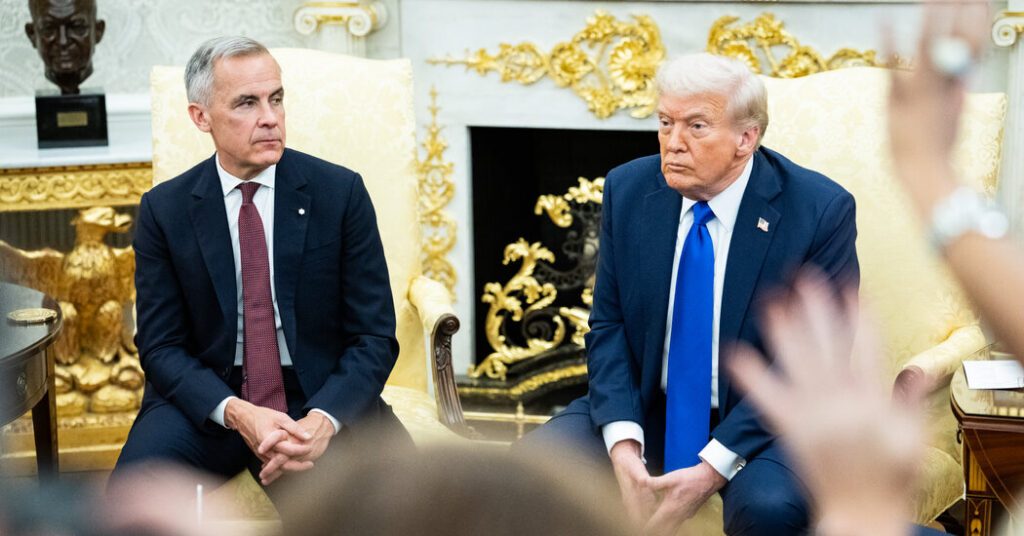
Prime Minister Mark Carney and Mr. Trump exchanged words this week about Canada’s approach to those talks.
During a speech in Las Vegas, Mr. Trump claimed that Canada and other countries had long been unfairly using tariffs against the United States. “Canada’s nasty,” Mr. Trump said. “They are. They’re nasty. I love the people, but they’re nasty. Nasty leadership.”
Mr. Mark Carney laughed it off, then applied the word to trade talks between the two countries that resumed last week.
[Read: After Trump Calls Canadians ‘Nasty,’ Mark Carney Says the Word Fits Trade Talks]
Two people who are familiar with the talks told me that Canada is willing to yield some concessions to stave off those tariffs. But there’s a significant condition: Canada will accept only a comprehensive deal.
[Read: Canada Offers U.S. Concessions in Trade Talks but Demands a Comprehensive Deal]
The biggest driver of Canada’s trade surplus in June was gold, being shipped largely to Britain. That has a Trump link. The global economic and political uncertainly created by the Trump administration has sent gold prices soaring. On Friday afternoon, they sat at $4,342.41 an ounce.
The value of Canada’s gold exports rose by just under 28 percent in June. But that didn’t mean that Canadian mines and refineries produced more ingots during the month, just that the ingots they did produce brought higher prices. Similarly, a 10 percent decline in the value of oil exports from Canada during June didn’t mean that less oil left the country. Indications that the American- and Israeli-led war against Iran would end caused a short-term drop in oil prices and, thus, the value of the exports.
The 50 percent tariffs Mr. Trump has planned are concentrated on manufactured goods. The president, who has said that the United States does not need anything from Canada, conspicuously exempted oil, gas, potash and other natural resources.
The trade numbers present a mixed picture for manufacturing. Exports of passenger cars and light trucks were up by 4.5 percent, which Statistics Canada attributed to increased production. The industries’ seeming invulnerability to Mr. Trump’s tariffs, which include adjustments for American content in vehicles, may reflect some good luck for Canada. Toyota’s RAV4 and the Honda CR-V, which are both made in Ontario, are such runaway success stories in the United States that the two Japanese companies are struggling to meet demand.
Beyond automaking, Mr. Hencic said, there are signs that manufacturers are feeling tariff pain. Employment in the sector economists call durable goods, which includes cars, fell by 1 percent during July.
Certainly there’s a lot of fear in factories. I spent part of this week visiting manufacturers for an upcoming article related to the impending tariffs. Trepidation about Aug. 19 was palpable.
“It’s not just ‘Are the tariffs being implemented,’ it is for how long they will be implemented,” Mr. Hencic said. “If it’s a week, that’s one thing. If it is a month, that’s another. If it’s six months, that’s a third thing. That’s the wild card in all of this.”
Ian Austen reports on Canada for The Times. A Windsor, Ontario, native now based in Ottawa, he has reported on the country for two decades. He can be reached at [email protected].
The bassist who captured Quebec’s soul takes on its scientific future
Norimitsu Onishi, our correspondent in Montreal, profiled Jérôme Dupras, Quebec’s new chief scientist. Across the province, Mr. Dupras has long been known for his double identity. He’s a well-known expert on the economic value of the environment, and a member of Les Cowboys Fringants, one of Quebec’s most famous folk rock bands.
Read the full article.
Trans Canada
-
A British Columbia music festival is trying to make drug use safer. Matt Richtel, a health and science reporter at The Times, reported from the Shambhala Music Festival in Salmo, B.C.
-
Hudson Williams, the Canadian star of the gay hockey romance series “Heated Rivalry,” has turned Canadian Tire’s humble reusable shopping tote into something of an “it” bag, Vjosa Isai reported.
-
Vanessa Friedman, who reports on the relationship of clothing to identity, power and politics, wrote about former Prime Minister Justin Trudeau’s boyfriend rebrand and what it says about the intersection of politics and entertainment.
-
Last month, an account appeared on X under the name John Doe and with the handle @heatedrivalryai. John Doe soon posted a link to a 25-page document with the title “Fandom Has a Hidden Generative A.I. Problem.”
-
Three teenage boys using Google maps estimated their hike time would be over five hours on a rugged trail in British Columbia. A helicopter crew had to retrieve them.
-
From NYT Opinion: An essay on the new bridge that divides Canada and America.
-
Also from Opinion: The former chief information officer of the Vancouver-based athletic apparel company Lululemon says companies need to stop kidding themselves about A.I.
-
About 4,400 flight attendants for WestJet walked off the job early Sunday morning, but the union and the airline reached a deal on a new contract about 24 hours later.
How are we doing? We’re eager to have your thoughts about this newsletter and events in Canada in general. Please send them to [email protected].
Like this email? Forward it to your friends, and let them know they can sign up here.
The post Signs of Economic Recovery While Greater Uncertainty Looms appeared first on New York Times.