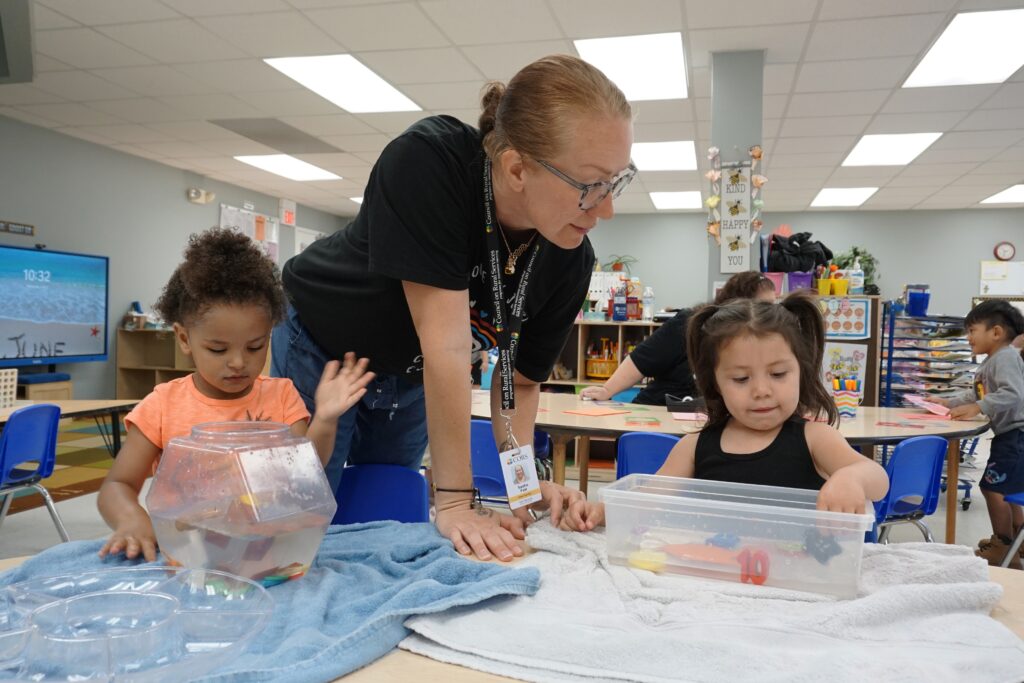
Soon after Alma Guerrero’s youngest child started Head Start in Skagit County, Washington, one of his teachers pulled the mother of three aside.
The boy wasn’t talking, unlike other toddlers his age who are typically using simple words and phrases. That observation led to speech therapy for her son, now almost 3. Guerrero said she’s amazed at how much his vocabulary has blossomed. “He comes home and he’s got something new to share,” Guerrero said.
Guerrero credits her son’s progress to his participation in Head Start, the federally funded program for low-income infants, toddlers and preschoolers. In addition to preparing children for school, Head Start programs have also focused on child and family well-being, through federal standards that govern how they operate.
But a new proposal this week from the Department of Health and Human Services, which oversees Head Start, seeks to fundamentally change this uniform approach by eliminating most of those standards and replacing them with significantly pared down versions.
Among the standards that would be dropped: a ban on expelling children, requirements on the number of adults needed per classroom and a mandate to provide full-day care. HHS is also proposing reducing the cap on administrative costs from 15 percent to 5 percent, a change federal officials said would free up funding to serve as many as 268,000 more children. States would have wide leeway to craft the program to their liking, federal officials said.
The administration’s proposal would also add some new requirements. Programs would need to develop strategies to promote father engagement and teach parents about marriage and healthy relationships. Head Start programs would also only operate in English, a shift from the program’s previous support for bilingual students. Programs operated by Native American tribes would be exempt as long as the language relates to “tribal heritage.”
The public has 60 days to comment on the proposal.
The changes would alter what Head Start is, providers say. Head Start could end up looking wildly different depending on the state, flying in the face of the program’s mission.
“It wouldn’t be Head Start anymore,” said Jen Bailey, executive director of the nonprofit Reach Dane in Madison, Wisconsin, which operates several Head Start programs. Without the national standards, Bailey worries that Head Start will become a “shell of a program.”
But in a call with reporters this week, Alex Adams, an assistant secretary at HHS, said the proposal aims to provide flexibility for the 1,600 local organizations that oversee more than 14,000 individual Head Start programs.
“One-size-fits-all mandates from Washington cannot fully account for the realities facing 1,600 grantees,” he said.
The proposal comes at a tumultuous time for Head Start, which has faced challenges and federal attacks in recent years. Head Start began in 1965 as one of the signature policies of the War on Poverty. At a budget of around $12 billion, Head Start and Early Head Start have about 716,000 seats for infants, toddlers and preschoolers, according to the most up-to-date figures from the federal government.
In 2024, the Heritage Foundation, a conservative think tank with ties to the president, published Project 2025, a governing blueprint that called for Head Start’s elimination. Last year, a leaked budget proposal eliminated the program’s funding, but after outcry from parents and advocates, it was included in the president’s budget.
Many individual programs were also caught up last year in a federal funding freeze and about 20 percent of the program’s federal staff were eliminated. Last spring, the government withheld nearly $1 billion in funding from local programs, a move that the Government Accountability Office later called illegal.
The Trump administration has closed five regional Head Start offices and consolidated all programs under the remaining five regional offices. Last summer, the administration proposed a rule to ban undocumented immigrant children from Head Start, an effort that was later blocked by a federal judge.
Providers say that Head Start has a broad purpose that the Trump administration’s efforts would undermine.
“Simply providing child care is not enough,” said Bailey of Reach Dane in Wisconsin. “It’s not our mission. It’s not our goal, and it’s not going to lead to the outcomes that we want to see for children and families.”
Studies have shown mixed results for the educational outcomes from Head Start: A government-funded study showed that Head Start children are academically no different from their peers by the time they reach third grade, but some research points to improved long-term educational outcomes for children, and more positive parenting practices.
Studies of social benefits, however, have been more positive. A 2022 study found increased high school graduation and college enrollment rates, reduced teen pregnancy and reduced criminal engagement in the second generation of Head Start attendees, suggesting the program has the potential to affect families over decades.
Opponents of Head Start, however, argue that there is not enough rigorous data showing that Head Start leads to long-term positive outcomes. A June report by the Heritage Foundation pointed to federal data that identified safety violations at some Head Start programs as evidence it should be eliminated.
“To have a federal taxpayer program-funded program that is performing this poorly, there’s every reason for the program to be sunset and turned into something else,” said Jonathan Butcher, acting director of Heritage’s Center for Education Policy.
Providers say the removal of the ban on expulsions could limit access to early learning for some children. Jennie Mauer, executive director of the Wisconsin Head Start Association, said she often hears about families whose kids with disabilities were kicked out of child care programs because those programs couldn’t support them.
“I worry deeply about our kids and families with special needs and behavioral concerns, because that’s a large portion of who Head Start serves,” Mauer said. “When you look at having those really intense fiscal pressures and pressures to serve more children, I worry that means some of our most vulnerable kids will end up being expelled from care.”
The Trump administration also says that ratio and group-size mandates are no longer needed because states have evolved to have “more robust licensing and oversight requirements” since the program’s creation.
In recent years, however, many states have made efforts to deregulate child care by loosening staff-to-child ratios and education requirements in child care programs. In Idaho in 2025, Adams, then the director of the state’s Department of Health and Welfare, proposed eliminating state-mandated ratios for child care programs altogether.
Experts say eliminating Head Start’s rules about how many teachers are needed per classroom could limit the amount of attention caregivers can provide to children in their care, at a critical time for brain development. The early years are when children most need nurturing care and interactions with caregivers, said Shantel Meek, executive director of the Children’s Equity Project, a child policy center at Arizona State University.
“State child care licensing is the bare minimum,” she added. Head Start standards, on the other hand, are “a much more robust set of standards.”
Meek recently co-authored a report that found state child-to-teacher ratios vary widely and are often looser than Head Start’s. For example, Head Start requires one adult for a group of four 2-year-olds. Only three states meet that standard. In Mississippi, one adult can be responsible for up to 12 2-year-olds on their own. In Texas, it’s 11 children.
In Wisconsin, Bailey said the children her staff serve in Head Start are especially in need of more one-on-one attention. “Having one staff member alone with a large group of preschool children is a health and safety issue waiting to happen,” she said. “Particularly when these children are working through trauma, the adversities of growing up in a low-income family. We have kiddos that need and deserve a lot of individualized support.”
Several program directors say the standards aren’t a burden.
“Doing anything really well is hard,” said Lori Pittman, a longtime early-childhood educator and chief strategist with the Washington State Association of Head Start and ECEAP. “Yeah, there’s a lot of Head Start standards, but those equal success, quality, and a future for children that they wouldn’t have if they didn’t have Head Start.”
The instability in Head Start has been difficult for families whose only source of child care is Head Start. The program is particularly concentrated in rural areas: About 46 percent of all funded Head Start slots are in rural congressional districts, compared with 22 percent in urban districts. In some states, 1 in 3 rural child care centers are operated by Head Start.
For Melissa Harding, a parent of four in rural Maine, the local Head Start program — a 45-minute drive from her home — was the closest child care option.
Harding is concerned about the proposed rule’s elimination of the oral hygiene requirement. Currently, Head Start programs must include toothbrushing routines and preventative screenings. That was the only reason her children had dental work, Harding said. With her older children, the closest option is a dental school where students are training to become dentists. That office is a two-hour drive.
“I think a lot of people don’t think about that benefit when they think about Head Start,” Harding said. “All the things that take place in that classroom are things that most people don’t have access to in their everyday life.”
This story about Head Start changes was produced by The Hechinger Report, a nonprofit, independent news organization focused on inequality and innovation in education.
The post ‘It wouldn’t be Head Start anymore.’ Providers say HHS proposal guts preschool. appeared first on Washington Post.