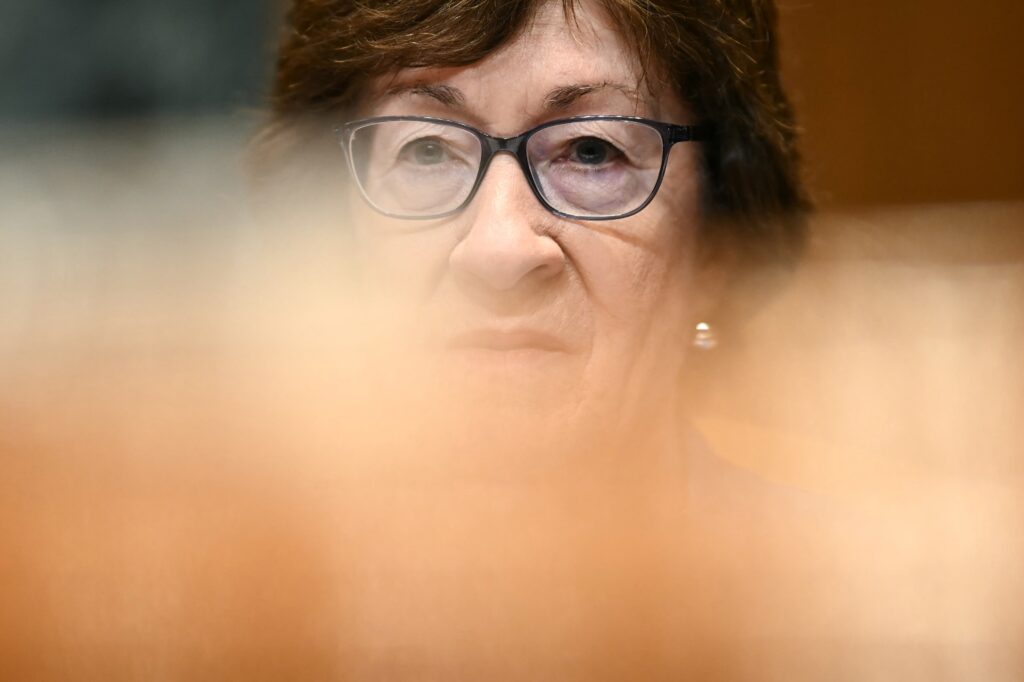
SCARBOROUGH, Maine— Susan Collins, the Republican senator and political powerhouse, has built her victories in this blue state on voters like Kim Bridgham.
“I just gave her the benefit of the doubt,” the 62-year-old Democrat said of her decision to vote for Collins in 2020, while simultaneously backing Democrat Joe Biden. “I tend to be somewhat moderate, and I used to believe that she was a moderate.”
But the shock-and-awe second presidency of Donald Trump has shaken Bridgham and left her with a very different impression of Collins. Like other Democrats, Bridgham has been aghast at the president’s aggressive deployment of Immigration and Customs Enforcement, as well as his expansive use of executive power that she said is eroding democratic checks and balances. In July, an ICE agent shot and killed a 26-year-old Colombian immigrant and delivery driver during a traffic stop only 10 miles away, in Biddeford, igniting a debate about ICE’s presence in the state.
Bridgham attended an emergency town hall meeting in nearby Scarborough last week as council members debated how or whether to evict the ICE processing center. The facility — where the ICE agent who shot the immigrant began his day — is now the target of weekly protests at a neighboring doughnut shop while a smaller contingent protests outside the office park full time.
“I’m horrified that some young father who’s just trying to provide for his family just got basically gunned down in the street,” Bridgham said.
The shooting is just the latest event in the second Trump administration that’s strained the relationship between the senator and the moderate Democrats and liberal-leaning independents who have been core to her victories, according to interviews with more than two dozen Maine voters. The high cost of goods and gas — and a sluggish economy — also pose a challenge as Collins runs for a sixth term against Troy Jackson, the former state Senate president whom Democrats settled upon after the political implosion of their previous nominee, Graham Platner.
The 73-year-old senator is battling the 58-year-old Jackson at a time when Democratic voters in particular have been clamoring for generational change and are skeptical of older incumbents, following Joe Biden’s disastrous exit from the 2024 presidential race.
Split-ticket voters — many of them women who saw Collins as a role model — forgave the senator after she voted in 2018 to confirm Brett M. Kavanaugh as a Supreme Court justice. But some have struggled to see her in the same light in Trump’s more aggressive second term. The high-profile times she’s broken with Trump — most recently, over his attorney general pick Todd Blanche, as well as his defense secretary, on the Iran war, and on his signature bill to cut taxes and some social services — have not been enough for them, given she usually votes with her party.
“When she voted for RFK Jr., I totally lost it,” Bridgham said of the vaccine skeptic who now leads the nation’s health agencies. “I feel like she only votes against her party when she knows it doesn’t count.”
In voting for Kennedy, Collins cited several factors, including his support for developing a vaccine for Lyme disease, which is especially prevalent in Maine.
Collins’s nearly nine-point victory in 2020 stunned her naysayers, who had grown hopeful as the Republican consistently lagged behind her Democratic challenger in polls. But Collins won by running up epic margins in Maine’s rural areas and peeling off voters from a core group of ticket splitters along Maine’s more liberal coast. Third-party candidates — who will not be on the ballot this time — also garnered a significant chunk of voters who may have otherwise voted for the Democrat.
An exit poll found that 13 percent of Democrats voted for Collins in 2020, and Daniel Shea, a Colby professor who polled that race, said voters including “the quiet Democrat” on the coast north of Portland who split their ticket for the bipartisan lawmaker were key to her victories.
“They’re not putting out the Collins sign on their lawn and they may even split with their spouse, but they’re quietly going into the booth” and voting for her, Shea said.
Those voters still exist, and they tout the senator’s experience and long history steering resources toward Maine, now as the Senate Appropriations Committee chair.
Madeleine Thibeault, an 83-year-old Democrat from the coastal town of Saco, south of Portland, said she plans to vote for Collins again because Collins has brought home money to the state and can exert influence on Trump.
“I know she’s been there 30 years, but she’s done things,” she said. “She kept the navy yard open, the fire departments — all kinds of stuff.”
Thibeault said she believed Collins had been given bad information ahead of her vote for Kavanaugh, who later voted to overturn Roe v. Wade, and that the senator generally does what she believes is right.
Jackson has said he hopes to win over these voters by contrasting his record with hers. He’s also slammed her for supporting billions of supplementary funding for ICE. A super PAC aligned with Senate Democrats is attacking her on the issue on the air, saying she wrote the bill that funded ICE.
But Collins’s team says Jackson’s record is too extreme and will turn off moderates, saying he took “far-right” positions against abortion early on his career before moving left.
“Jackson has based his latest campaigns on far-Left policies borrowed from the democratic socialist playbook,” Collins spokeswoman Blake Kernen said in a statement. “Centrist voters are going to have a clear choice this fall between a partisan Augusta legislator who has spent his entire career on the ideological fringes and a proven independent leader whose public service is defined by working with members of both parties to deliver for Maine.”
Collins is running ads that tout her constituent services and her record of funding fire stations and rural hospitals. One ad shows a younger Collins responding to the national security disaster of 9/11 in a bipartisan way, harking back to a less polarized era.
Just 6 percent of likely voters who identify as Democrats and 42 percent of independents plan to vote for Collins in the fall, according to a recent University of New Hampshire poll. That would be lower than how Collins has performed with the groups historically. Overall, 49 percent of likely voters said they planned to vote for Jackson, with 46 percent backing Collins, and 3 percent saying they are undecided. Polls in Maine have been notoriously unreliable, however.
Up the coast, in Penobscot, Margaret Shaw, a 74-year-old retired teacher, said she plans to vote against Collins in November.
The Democrat once consistently supported Collins, whom she regarded as part of a “sisterhood” that defended women’s rights. Shaw was upset ahead of 2020 after Collins voted to confirm Kavanaugh, but she recalls sticking with her because she did not know enough about Sara Gideon, the Democrat and former state House speaker running against her.
“That put the crack in the teapot,” she said of Collins’s Kavanaugh vote.
In the second Trump administration, Shaw has gotten far more involved with politics. She watches the news every night and religiously reads alarming summaries of the Trump administration’s actions from historian and popular Substacker Heather Cox Richardson. Her weekly sewing circle and her book club mostly talk about politics.
“I’m watching the country devolve before my eyes, and so I’m far more vocal and I’m thinking about it,” she said.
Shaw, who calls the senator’s office often to voice her opinion, wishes Collins would break with Trump more forcefully.
“Can’t she speak out? Can’t she be like John McCain?” she asked.
Others are thinking more about their bank accounts as they weigh their votes.
“She’s taking money from other people and she’s not giving it to us poor people,” said Theresa Boisot, 56, an independent voter who backed Collins in 2020 and Donald Trump in 2024.
Boisot, who receives disability payments and lives in Westbrook, said she regretted her vote for Trump, who she said has not done enough to help the economy.
“I just don’t like Trump, and I don’t like Susan Collins, and I think they both need to hit the road,” she said.
Beth Hutchinson, a 58-year-old independent voter from Brooklin, said she is not sure if she will vote for Collins again in the fall.
She said Collins has done well for Maine and been a strong role model for women, but believes she should step aside and make way for younger leaders.
“She should be retired. I’m sorry,” Hutchinson said. “I am retiring this year. She’s worked longer than I have. Really, lady. It’s time, go home.”
But she also is concerned that Jackson, the populist endorsed by Sen. Bernie Sanders (I-Vermont), could be too liberal for her.
“We’re in the middle, we’re more conservative,” she said of the state.
In Scarborough, at the town council meeting in late July, dozens of residents expressed their support for closing or relocating the Maine ICE facility, and just a handful spoke against the effort. The fight has renewed anger among liberals who say Collins is too aligned with the unpopular president in their blue state.
“Susan Collins isn’t going to do anything,” said one Scarborough resident who spoke. “She just voted to give ICE more money. … We need warriors on this.”
The ICE shooting has tested her influence on a mercurial president of her own party — and moderate Democrats’ appetite for the changes she has offered to soften Trump’s policies. Collins has urged an independent investigation into the shooting and asked Homeland Security Secretary Markwayne Mullin to halt nonurgent ICE vehicle stops in Maine. Mullin announced a temporary nationwide pause on those stops that was quickly reversed by Trump. Collins also touted her effort to include $20 million for body cameras for ICE agents and additional funding for de-escalation training in a recent appropriations bill.
But two days after the Scarborough meeting, Collins made an announcement. ICE’s acting director had told her all agents in the field would be wearing body cameras by the end of August, she said. And, she stressed, she had procured another promise for Maine: They would be delivered to her state first.
The post Democratic voters who used to back Susan Collins aren’t so sure anymore appeared first on Washington Post.