Michelle Angstrom expected she would cry when she returned to see what was left of her home, but she didn’t. She stood there in her husband’s arms looking at the smoldering ruins of the house she bought 20 years ago as a single mother of two.
The house was a reflection of the life she built. She had to start over again after her first marriage ended; building a career, raising her children. She had returned to the neighborhood where she grew up to give them what she experienced: a safe place off the beaten path where she could roam freely by bike.
The Angstroms were two hours north when they found out a fire threatened their home. Their dogs had stayed behind. The couple jumped quickly in the car and raced back to Spokane only to find they couldn’t get past the road closures, despite their pleas.
As their house burned, so did Baby and Tinka.
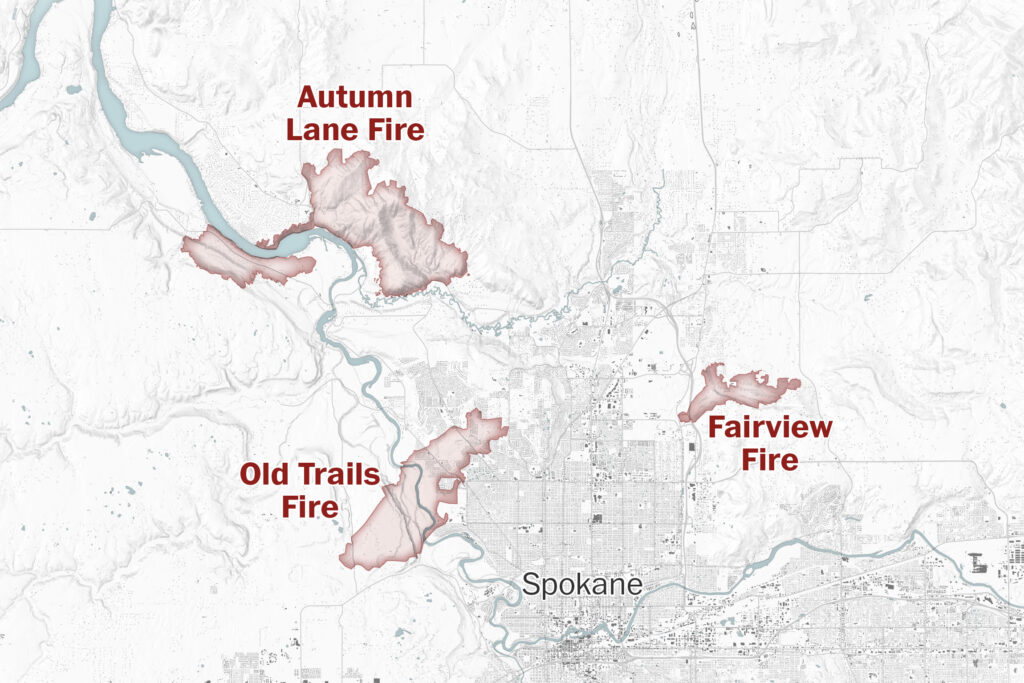
As wildfires have become more frequent and intense, places like Spokane, Washington — communities that once rarely burned or that many people considered to be safe — are now more vulnerable. A cluster of three wildfires there have burned more than 10,000 acres across the city in total. The flames have damaged at least 931 structures and forced tens of thousands to evacuate over the past week.
Swaths of buildings in the three fires’ perimeters fell into what has been considered “low” or “very low” hazard of fire, according to draft maps published July 1 from Washington’s Department of Natural Resources.
The maps use large-fire simulation modeling to assess burn probability. When a building is earmarked as a low hazard, it would burn once in every 500 years. Very low hazard is once every 2,000 years.
Matthew Dehr, at the Department of Natural Resources said the data has limitations especially in dense urban areas: “There’s a ton of variables that, really, we don’t have good science on, and it’s going to make it difficult to present an accurate picture of what the hazard actually is in some of those areas.”
“We’re in a new era of fighting these types of fires,” said Dave Kokot, a retired fire marshal living in Spokane. “The word unprecedented, it really applies to this.”
The Old Trails Fire, which burned Angstrom’s home, has now spread to more than 3,500 acres. On Monday, a 37-year-old man was arrested and charged with arson.
Officials have not yet determined the cause of the other two fires.
Spokane sits in a combination of rolling foothills and forested areas, like Riverside State Park, which backs up onto many homes that burned. Eastern Washington is far drier than the temperate western part of the state, which is famously rainy because of its proximity to the ocean. Average annual rainfall in Spokane is only about 16 inches.
“It’s a beautiful place to live because you’re sort of embedded in nature. But when fires then happen in the forest, it’s also then where people live,” said Lauren Stachowiak, who studies fire history at Eastern Washington University near Spokane.
A red flag warning first prompted evacuations over the weekend, eventually forcing at least 65,000 people from their homes as smoke billowed and the fires spread.
“What those extreme warnings mean is, if a fire breaks out, we can’t stop it,” said Matthew Anderson, a professor of urban planning at Eastern Washington University. “Even if we had more resources, more personnel, more capacity, I still don’t know if they would have been able to stop this sooner.”
Gregory Ritchie, who owns and runs a media production business, already knew that traffic was bad. He had to help his sister, who recovered from Stage 4 cancer and needed her inhaler, evacuate her apartment. He rushed down Indian Trail Road to get her as flames rocked his vehicle from side to side.
He knew from his work that wildfires are unpredictable. He saw how the traffic was piling up when he arrived at her apartment.
“I was just very stern,” he said. “We need to leave now, plain and simple.”
After they rushed out the door and into the car, they quickly came to a stop and remained stuck in traffic for hours. There were only two ways out of the neighborhood.
“Here we go again,” Kokot thought when he saw the weather forecast. In late June, a fire on the eastern side of the city put some 12,000 people under evacuation orders. In 2023, the Gray Fire destroyed about 200 homes in nearby Medical Lake. And in 2020, the Babb Road Fire burned about 80 percent of homes in Malden, a small town about 45 minutes south of Spokane.
But Kokot didn’t expect that the Autumn Lane Fire, one of the three burning in Spokane, which put him on notice to evacuate, was going to move as quickly as it did.
Not everyone evacuated.
Alex Smith, 23, stayed behind. He said he was told to evacuate but stayed to document the devastation to his neighborhood on video. He was in the middle of the fire Saturday, surprised by how fast it spread.
“It seemed like it all happened at once,” he said. “It was scary.”
Al Acosta walked two miles past a road closure Monday afternoon to see what was left of his house of 40 years: a basketball hoop and a mailbox, with the mail still inside.
Acosta and his family looked through the still-smoldering ruins. There were metal frames of two recliners for him and his wife, Janice; skeletons of the refrigerator and the stove; and the bathtub, all sunk to the basement after the ground floor burned. The house’s yellow walls, Acosta’s shed and precious artwork from their son, Jesse, who died in 2016, were all gone.
“It probably wasn’t a good idea for us to go, but my dad needed to see for himself,” said Renee Stewart, Acosta’s daughter.
Donna Light was away for the weekend with just her purse when the fire started burning. Her apartment was on the ground floor, its remains now mixed in with the rest of the complex.
She went back with her sister to salvage what she could, finding some of her jewelry and her Polish pottery collection.
“I saw that we were getting clumps of metal, like silver metal and gold metal,” she said. “I realized later that that was probably the rest of my jewelry that I was looking for. I think they just kind of melted together.”
Firefighters in Spokane are continuing efforts to contain the three fires before temperatures return to the high 90s this weekend. The National Weather Service has issued a red flag warning for Friday and Saturday, and wind gusts of up to 25 miles an hour are expected.
“Wind on a smoldering fire is always a point of concern,” said Benjamin Cossel, a spokesperson for the federal team managing the Spokane fires. “We realize we are not out of the woods yet.”
The post These neighborhoods seemed safe from wildfire. Then they burned. appeared first on Washington Post.